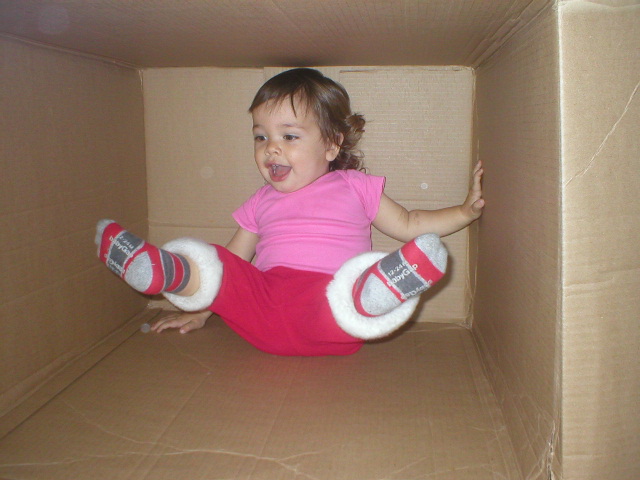
Tuesday, January 30, 2007

Flow vs. Its Opposite


Over at the Greater Good blog (my esteemed employer!), Christine Carter McLaughlin & Kelly Corrigan talk about "flow" and what makes their daughters happy, as part of a series of dialogues on the roots of childhood happiness. To define flow, Christine quotes psychologist Mihaly Csikszentmihalyi:

[A] person in flow is completely focused...Self-consciousness disappears, yet one feels stronger than usual. When a person’s entire being is stretched in the full functioning of body and mind, whatever one does becomes worth doing for its own sake; living becomes its own justification.


I've experienced the state Csikszentmihalyi describes, sometimes for long periods at a time, but when I hit my thirties it happened less and less often--and now that I'm a dad, it's very rare indeed. The irony is that my son Liko seems to spend ninety percent of his life in flow, broken by spasms of inconsolable rage and weepiness. It's as though on his birth my happiness jumped out of me and landed square in his little body, leaving me with only a bit of residue; I can smell it, like resin in a pipe, but there ain't enough to smoke...

I don't write this as an invitation for you to feel sorry for me; it's an empirical fact that most parents of young children feel as I do: self-conscious, enfeebled, unchallenged, displaced. Precisely the opposite of the state Csikszentmihalyi calls flow. "Studies reveal that most married couples start out happy and then become progressively less satisfied over the course of their lives," writes psychologist Daniel Gilbert, "becoming especially disconsolate when their children are in diapers and in adolescence, and returning to their initial levels of happiness only after their children have had the decency to grow up and go away."

Yet most of us, Gilbert notes, will say that our children make us happy--indeed, if you inquired as to my happiness, I would reply that I am, in fact, happy, and that Liko is the poopy, giggling fount of my happiness.

But it's a melancholy, distrait kind of happiness. Yesterday I took him to the merry-go-round. He rode around and around on his horse, up and down, flowing in every sense of the word. I watched his face and I was happy, but it was happiness tinged by a combination of fatigue (I'd been chasing him all day), anxiety (thinking about a looming deadline), and something else that's hard to describe--a feeling of fragility, like this moment couldn't last? More to the point, I was preoccupied with making sure that he didn't fall off the damn horse and break his arm. A moment's inattention, and Liko could be hurt, or worse. It's normal: people who care for little kids are often wracked with moment-to-moment nervousness, and every day we find another gray hair on our heads.

I can feel the reader, especially older parents, rushing to reassure me: it's OK, relax, don't take everything so seriously, get over yourself. It's our American impulse: we don't like to see anyone unhappy, we can't let them just be sad or angry. I share the hypothetical reader's impulse. As we were riding the bus home, Liko asleep in my lap, I looked at the people around me and most of them wore woebegone looks. I wanted them to be happy, for my sake as well as Liko's; who doesn't like to see people smile? It's a noble impulse, but there's also something stupid about it.

Gilbert sets forth three reasons why we insist, against all evidence, that our kids make us happy: 1) kids are, like fine wine or expensive cars, so costly that we actually rationalize their costs and conclude that something so demanding must make us happy; 2) "Memories are dominated by their most powerful--and not their most typical--instances," so that a single "I love you" can wipe out years of sleep deprivation; and 3) "When you have one joy, it's bound to be the greatest"--meaning, because children occlude other sources of pre-child pleasure, such as movies and sex, we demand that our kids give us some degree of happiness, dammit.

This list will doubtless horrify childfree people, and serve as a form of birth control. I think, however, that Gilbert's misses one big one reason why we have children: kids are, to borrow from Chris Hedges, a force that gives us meaning. They structure our lives, create comradeship and community with other parents, and drive us out of bed and into an world of responsibility and interdependence, where, in many ways, our will is not our own. We lose agency and freedom. We gain purpose and wherewithal. The meaning might be illusory, but the brute biology of the situation, and the intrinsic vulnerability of young kids, gives the illusion a massiveness that pushes smaller, weaker illusions aside.

"Our children give us many things," Gilbert writes, "but an increase in our average daily happiness is probably not among them. Rather than deny that fact, we should celebrate it. Our ability to love beyond all measure those who try our patience and weary our bones is at once our most noble and most human quality."

Just so. Here's my point: for adults, happiness is overrated. I'm aware that this opinion puts me in the company of Calvinists and drill sergeants, but I'd pick them over the happiness enforcers any day of the week. Happiness, in my view, is something that happens on the way to something else: not "a skill we can learn," as a colleague once put it, but an evolutionary accident whose pursuit can corrupt us, if we mistake it for an end in itself. "Flow"--that state when "living becomes its own justification"--may well be a kind of happiness unique to childhood, which we shed as we age. Perhaps I am not as able to "go with the flow" as I was when I was younger, but perhaps that is a necessary step towards a deeper kind of happiness.

Saturday, January 20, 2007

system error

This is an essay from the latest issue of boxcutter:

Going through her eleven year old's new Christmas purse, Andee exclaims that the entire thing is filled with nothing but technological devices: two tamagotchis, one ipod nano, one nintendo ds, one digital camera, one piggy flashlight, and a game holder with three different games. All of us sitting with her kinda laughed and snickered about `these kids these days,' shaking our heads. `Why do they want all this stuff,' we wondered, but soon we fell eerily silent: three sets of parents, three minds realizing how our kids' worlds are just so different than ours was. For example, my kids all wanted technology for christmas, and my partner and I at first balked, thinking we were gonna give them only books and do-it-yourself science toys; you know Good Toys, but soon we gave way to pleas about what all the other kids were gonna get, and we found ourselves saying, `we might as well just buy them what they want, if we're gonna get them anything at all.' Right? What would you do?

So there we were christmas morning, and under the tree appeared so barren, looked so empty because all the presents were in these little boxes; it looked like they barely got any presents. It seemed so pathetic. By the time we got up, got coffee, got to the sofa, they made these tiny piles in front of them. I suddenly got all worried that they didn't get enough. Perhaps though we were the pathetic ones, so caught up in wanting our kids to be happy, to feel loved, to be satisfied. Because presents do that, right? Why on earth do we bother to give presents at all? I hate it. Not just with kids. I was stressing out trying to find things for the adults in my life. How did I get like this: I, who make things. I, who think of myself as so creative, so anti-corporate -- rushing around the day before christmas, so worried that my lover would not like her jacket or if I spent enough on my partner for fear she spent more. And there sat my kids' little frilly boxes underneath the tree. The only thing that saved the apparent lack of presents was the two gifts I bought basically for myself but wrapped anyway -- a basketball and a board game.

This is a panic created by consumerism and technology, but what should we have done? What would you have done? How to fight it when everyone around you especially your kids is so in to it, is so content to participate in our crazy, self destructive culture? It's easy to blame the youth of today but that is wrong. As for technology, this is what they know; it's not the way we grew up, wanting all these little devices. Were there any devices when we were kids? Yes, walkmans, and soon pagers, but did kids want them like they want a cell phone? So do we just say no to anything because it wasn't the way we experienced childhood (I mean who back then could walk around with an Atari and play it on the bart). We live in a different world. Take myspace which seems the utmost in prefabricated realities where you get a list of a hundred or so friends most of whom you don't know; I immediately want to hate on it, but I also realize that in this world of constant surveillance and monitoring, with a lack of public space to hang out in, without getting hassled, watched, where can kids turn to to reclaim there own autonomy: yep, cyberspace. It may be owned by Rupert Murdoch but it is something that they can create, control, invent, talk smack in, try to foster an identity.

So I try to relax while they rip open their presents; as they each squeal and laugh and scream and shout thank yous, I inwardly smile. A few hours later after the techno stuff is pushed to the side, after the cyber pets are sleeping in their little cyber houses, and the music is turned off because the battery needs to be charged, my daughter asks, `what's this game like?' Soon we are all sitting around playing and laughing together.

And then I opened my other present: the basketball and at the end of the day we all stepped out into the street and played with a ball, a real ball, and with our real dog, and we laughed and got angry and teased each other and had a great old time as the sun set on our real lives. Next year though I promise to do something different.

If you need some game suggestions these games have all been played and enjoyed for hours with our neighbors and friends -- get them because they don’t need batteries:

Dominos -- I got my ass spanked by a student in my english class a few semesters ago and have been wanting a rematch ever since, so when my son and I traveled into the jungle of mexico all we brought were books and a set of dominos -- we had monster games, created new slang for ridiculous decisions we made while we both learned to play. It has been a continued source of pleasure to set up and play in our house. It lasts for about 30 - 45 mins...it's cheep to buy, easy to bring along, and perfect for talkin all kinda smack. Oh and I still lost the rematch...

Gobblet – This is an awesome looking game as well – made of wood and really easily set up and stored. It is like a crazy tic-tac-toe and connect four love child. The object is to get four in a row and you can gobble your opponent in the process. Hella fun and good for all ages and easy to learn.

Blokus – It’s a perfect way to kill an extra 20 minutes between cooking dinner and eating or after bath and before bed. Four people can play and as you get to know it more, you can get more strategic, but it is easy to learn and doesn’t take too long to finish. The main idea of Blokus is to get more of your pieces into play than anyone else. It is kinda like tetrus. Since the rules can be explained and learned in less than two minutes anyone can join in the fun with ease.

Thursday, January 18, 2007

Kids vs. religion

By Chip -- Do kids need religion?

No.

It really isn't necessary or possible to force children to believe in "god," in either a general or particular way. Moreover, morality, ethics, and being a good person don't depend on religion or belief in god.

I myself was raised in a religious family. I went to church every Sunday from birth until I left home to go to college. I went to a religious elementary school, and went to religious education classes when I was in public middle and high school. I took courses in theology as an undergraduate at a religiously-based university.

But I never felt like I actually believed that any of the stories I was told were literally true. I could see that they were parables and lessons, that they were stories that made philosophical, ethical, and moral points -- not all of which were very moral or ethical (for example the numerous genocides commanded by the Yahweh).

As for the theology, I never actually believed that there is a "god" somewhere out there micromanaging or even watching over humanity, much less having "personal relationships" with individual humans.

But then came kids. My wife was raised in a different Christian faith tradition, but she feels much the same way as I do about religion. We talked a lot about what to do. We ended up having both kids baptized at the church I was raised in -- largely for the sake of my parents and grandparents. And it gave us an excuse to have the extended family get together.

When my daughter reached kindergarten age, we began going to church, and she went to Sunday school, as did my son when he reached that age. My daughter made her first penance and first communion. I think that we both felt it would be good to do this, despite our own non-belief.

But I found this position increasingly untenable. I didn't believe, I had never believed, yet I was asking my kids to go through the motions.

We tried other churches, but we didn't feel comfortable in them either, mainly because they were so religious and were talking about god all the time (of course, what did we expect?).

So we decided that it was best to be honest with ourselves and with our kids. We stopped going to church, and stopped trying to get our kids to go through the motions.

They had early on proclaimed their atheism -- I'd had to ask them not to argue with the Sunday school teachers about this -- which was one of the issues that led us to this decision.

Unfortunately, in this society, I need to add this: My kids are moral and ethical, they have very strong senses of right and wrong, and though they are not perfect, they are great kids and will be wonderful adults.

(Of course, the very fact that I feel like I have to say this indicates how our society views nonbelievers. If I was religious and a believer, I wouldn't even have to tell you about my kids' morality and ethics...)

Morality and ethics do not come out of religion. We all know people who are immoral and unethical who were also believers. And there are plenty of nonbelievers who are moral and ethical.

The sense of ethics, the belief that there are right and wrong ways to treat other people, comes, I believe, from how we see our parents and significant others act as we are growing up. Adults model behavior to kids, regardless of religious belief. As they grow up, children absorb the values of the people raising them. Kids learn by being told, and talked to, and having things explained to them: Why some things are right, and why some things are wrong; why some people do bad things; why others are selfless.

Kids also learn by watching what their parents and care givers do, how they act, how they live their lives, apart from the words.

But I also believe that there is an innate sense of morality and ethics. I know plenty of people whose parents were awful, yet who themselves turned out to be great people.

To me that indicates that there is some level of morality that is part of the package of being human. Perhaps these people also were lucky enough to have other adults in their lives who reinforced their inner moral senses.

Given this, I believe that morality and ethics don't come from believing in god, or from being attached to a particular religious community. Those values come from within, and they are reinforced by the way adults explain what's right and wrong, and how those adults themselves behave.

When I was talking to my 15-year old daughter CB about this, she said she thinks that nonbelievers are actually more moral: they do the right thing not because of a fear of punishment in the afterlife, but just because it's the right thing to do. I wouldn't say that all believers do the right thing only out of fear; but for those who do, I think CB's reasoning is right on target.

That said, I do believe it is important for my kids to be familiar with the various religious mythologies that are part of our cultural heritage. My kids know the Bible stories, are familiar with the Jesus stories, the saints and other aspects of Christian religious belief. They are also familiar with other religious traditions, as well as the basics of the mythologies of ancient Greece and Rome.

I see this knowledge as important for purely cultural reasons. You cannot understand a large part of European literature and art if you don't know the background stories coming out of Christianity and Judaism. You cannot understand the politics of large parts of the US if you don't have some basic knowledge of Christianity.

But kids don't have to believe that the stories of Christianity are actually true, any more than they need to believe the ancient Roman or Greek myths.

Of course we're lucky to live in a community that is pretty progressive, which is not dominated by Christian fundamentalism, and in which my kids know other kids who are also not believers. But given the outright hostility to atheists in US society, I have also had to warn my kids to be careful, to not discuss their beliefs with people unless they know them.

While I have no problem with other people believing whatever they want to believe -- as long as they don't try to force it on me -- I also think it's important to recognize that kids don't need to have a belief in god, anymore than they need to believe in santa claus or the easter bunny. They need to have parents who instill in them their values, a sense of responsibility and empathy towards other human beings, and who walk the walk as well as they talk the talk.

So if you're feeling uncomfortable raising your kids in an atmosphere of religious belief, act on your own beliefs and instincts. Kids are just fine without god or religion.

Crossposted at daddychip2

Thursday, December 21, 2006

Science vs. Men vs. Women


I work at a popular science magazine that covers research into the roots of compassion, altruism, empathy, and other prosocial human behaviors and emotions. Last month we reviewed a study by Dutch neuroscientist Erno Jan Hermans (and colleagues) that set out to test whether testosterone can inhibit a person's ability to empathize with someone else.

To find out, the researchers dosed twenty women with either testosterone or a placebo, and then measured their ability to mimic facial expressions, which previous research has shown to be one marker of empathy. Their results showed that testosterone might indeed reduce empathic behavior.

I initially objected to publishing a brief about the study in the magazine. I'm automatically suspicious of the methodologies and conclusions of any study that suggests biology is behavioral destiny. Plus, even if the science is solid, I didn't think it would be useful to our readers. If testosterone really does limit empathy, so what? How does that knowledge help our readers, who are mostly educated lay people?

I talked it over with the other editors, including a psychologist who reviewed the methodologies. He felt they checked out. We agreed that reporting the study fell within the mission of the magazine. And so we turned to discussing ways to report the findings that would not play to social stereotypes about men and women. Looking back, I can see that I was learning something about how we can talk about science in popular forums.

It's first critical to begin with the fact that all human beings have the capacity for empathy; it's fundamental to our psychology, with a basis in evolution. Men are human beings and are therefore capable of empathy. That puts the findings in broad perspective. In addition, we need to keep individual variance in mind; I've met lots of men who are more empathetic than many women, and I'm sure you have, too.

Second, it's important to acknowledge the limits of the study. To get those, you first have to read the study and talk to the scientists themselves. Most scientists are extremely reluctant to speculate or make sweeping generalizations based on limited findings, for good reasons; they're also careful to acknowledge the limits of their methodologies and to suggest further areas of study. This doesn't stop journalists, politicians, and bloggers from seizing on findings and putting them at the service of their personal and political agendas; hell, I've done it plenty of times. (That's our job, but I think we can perform our jobs more responsibly.)

In the brief we are publishing in the magazine, we were careful to reflect the limitations of this methodology, noted by the researchers themselves. "While facial mimicry may be one component of empathic behavior, it is clearly not the defining feature," writes Mario Aceves, a fellow with the UC Berkeley Greater Good Science Center, in the brief. "Before we conclude that testosterone leaves men at an emotional disadvantage, additional studies must show that testosterone affects the many other dimensions of empathy."

My colleague Jason Marsh asked Erno Jan Hermans for a comment. "[Testosterone] reduces empathetic behavior; we can't say it reduces empathy,” he said. His research also shows that while "testosterone is a regulating factor in gender-specific behavior... obviously you can never rule out that there are cultural differences in play."

Last and certainly not least, scientific findings of this type don't dictate some kind of automatic ethical or political response. They do not prove that men are by nature emotional dolts, and therefore not accountable for idiotic behavior. They do not suggest that women are in essence loving, nurturing, dove-like creatures of ethereal beauty. No woman who wants to live in a more empathetic, compassionate society should plan to launch all-female communes in South America--even if you were to screen out women with high levels of testosterone, you're still not going to achieve a feminine utopia like Charlotte Perkins Gilman's Herland. Human beings are too complex. Attacking complexity is not the path to a better world.

Science is an evolving dialogue, in which new conclusions are constantly modifying old ones. Newton wasn't wrong about how motion changes with time, but Einstein took his ideas to the next level when he showed how mass bends spacetime. When back in the Seventies, Irven DeVore and Robert Trivers launched the field of sociobiology--which sought to find biological bases for human behavior--critics quite rightly raised the specters of Social Darwinism and Nazi eugenics, both of which invoked biological science as justification for policies that ranged from abandonment of the poor, denying rights to women and many other people, forced sterilization, and systematic genocide.

But as sociobiology branched off into evolutionary psychology and behavioral ecology, researchers discovered some things about human beings that directly contradicted the specious, self-serving assumptions of the Social Darwinists. Scientists like Johnathan Haidt, Leda Cosmides, Marc D. Hauser, and many others have found that human beings appear to be hardwired for compassion, altruism, cooperation, and so on. Biology might indeed be destiny, but it's a provisional, sanguine kind of destiny that doesn't automatically lead to pessimistic or destructive views of humanity. Above all, a great deal of new science is demonstrating the degree to which we humans are tough, adaptable little monkeys, defined right down to our neurons by a capacity for continuous growth and evolution.

Whenever we read about some new study about parents and children, men and women, we should remember how searching and tenuous the science is, and refrain from sweeping generalizations that might contradict our deepest moral instincts. We can't ever know where our questions will lead, but we can't be afraid to ask them.

Friday, December 15, 2006

Children and choice


By Chip -- Last week the website Momsrising.org flagged an article and discussion in the Seattle Post Intelligencer newspaper about their "Motherhood Manifesto," which argues for, among other things, quality childcare, universal health insurance for children, and other public policies to support children and their parents.

The article attracted an interesting discussion at the paper's website, including criticisms of the notion that society should provide anything to parents and children. The argument was that having kids is a choice: "Why should I have to pay for your choice?"

The most common response, including the main response from MomsRising.org, was a kind of utilitarian logic, that kids are the future of our society, and these policies are "an investment" in the future:
Some Seattle PI readers are calling policies like healthcare for all kids, access to childcare, and paid family leave, "More special rights just for making a CHOICE...." The "choice" being to have children. This type of thinking glosses over an essential fact that children are an investment every society must make; otherwise there won't be a future at all for that society (we'd go extinct!).
But I don't think we should have to justify societal support for children by focusing on their future benefits to individuals or to society as a whole, because doing so opens up a bunch of questions along these lines: are those kids who are destined to go on to be more "productive" more worthy of support than others?

This kind of utilitarian calculation is a slippery slope, and ignores a much more basic and fundamental reason to support kids and their parents.

For me the more compelling argument is that children are human beings who did not themselves choose to come into this world. If we are a society that claims to be civilized, we owe these helpless humans some basic things.

We as a society don't say that disabled adults who are unable to contribute to the economy should just fend for themselves, and that if their families are unable or unwilling to do so, that's just tough luck.

So when it comes to children, I think the most convincing argument is just this: not that they are future economic producers, or that they are "the future of society," but that they are human beings, regardless of what their parents did or did not do, who their parents are, how "irresponsible" they are, which choices they made or did not make. These kids are not themselves responsible for their situation.

That's the most important reason to provide universal health care, quality day care, decent public education, and other "benefits" -- or rather, minimum basic standards -- to all children. That's why these things, far from being "benefits," should actually be seen as basic rights.

Looked at through this lense, those who are whining about "having to support other peoples' kids" should consider that this is about basic standards of decency: how a society treats its most vulnerable.

But even granted this, why should parents, people who "choose" to have children, get "benefits"?

Our society has decided that families are the main support group for children. Part of the way we assure these basic standards for children is therefore by providing support not just directly to the children, but to their families as well.

Through this lense, the question then becomes, what is the best way for us as a society to ensure basic standards of decency to all children? And part of the answer is to provide resources and support to their families.

I think that few people would whine and complain about the fact that parents of severely disabled adults are the beneficiaries of government programs to help them care for their adult child.

So I see it as a very sad commentary on the state of human decency in this country that anyone would be so grudging about providing minimum standards of decency to the most helpless members of our society, our children.

On Edit 12/20: A similar discussion is going on in reaction to two blog posts by Joan Blades of MomsRising.org over at the Huffington Post: Should Societies Support Mothers Raising Children, and Indiscriminate Breeders!?!.

Cross-posted at Daddychip2

Tuesday, December 12, 2006

Assumption vs. Assumption


Recently I was swapping emails with a group of feminist activists I've known for 15 years. We were talking about progressive family policy.

At some point in the dialogue, I realized that we were starting from two very different assumptions. Theirs was that progressives should fight first and foremost for daycare and preschool, so that mothers could go to work and pursue worldly ambitions.

I couldn't help but feel that my friends saw kids as a burden that public policy should strive to alleviate, shades of Linda Hirshman. And until, oh, about 29 months ago, I pretty much shared their assumption and priorities.

Before Liko was born, we figured that after six months my wife would go back to work and we'd engage some form of childcare. Wrong. Liko didn't want his parents to go to work. This might have been a problem, except that we agreed with him. We didn't want strangers to take care of our son. We didn't think it was best for him or for us.

And so we changed our lives, in various ways I have documented here at Daddy Dialectic. Since then I have thought a great deal about our caregiving impulse and its relationship to our values, and what it might mean for the family policies I'd support as a parent.

Just to be clear: Childcare and preschool are good. High-quality childcare should, like health care, be available to anyone who wants and needs it. Moreover, I believe that daycare and preschool should be guaranteed and heavily regulated by government. It's a matter of equity as well as economic development. More women (and men) in the workforce is good for the economy.

Good for the economy, but is it good for children? Is it necessarily a good thing for all mothers and all fathers to march off to work every morning? There are literally hundreds of empirical studies that answer no to these questions; taken together, they suggest that parents working outside the home too much, too early in a child's life is bad for the kid as well as the parents.

Numerous studies, writes Jane Waldfogel in her new book What Children Need, indicate that "Children whose mothers work long hours in the first year of life or children who spend long hours in child care in the first several years of life have more behavioral problems...Children do tend to do worse [in health, cognitive development and emotional well-being] if their mothers work full-time." The effects of paternal employment have hardly been studied; social science firmly places the burdens and joys of caregiving on moms.

Does this mean that conservatives are right? Are working moms guilty of neglect and responsible for America's social ills? Emphatically: no. First of all, we need more men to contribute more to taking care of kids: there's no evidence at all that dad can't do it just as well as mom.

We need to be careful in interpreting these results [writes Waldfogel], given that in nearly all cases studied the fathers were either working full-time themselves or were not in the household at all. These results tell us the effect of having two parents working full-time or a lone mother working full-time. And so their clearest message is that children would tend to do better if they had a parent home at least part-time in the first year of life. They do not tell us that the parent has to be the mother.


Second, the studies also show that parental sensitivity and responsiveness "is the most important predictor of child social and emotional development--more important than parental employment."

Third, we need genuinely family-friendly policies that respect parents' choices and will allow parents of any gender to stay at home as much as possible with their kids for at least the first year. To my mind, this needs to be the progressive policy priority. The shape of such policies is well-known and widely implemented outside of the US, consisting of paid parental leave and wage replacement, job and legal protections, guaranteed health care, requiring employers to consider requests for part-time work, etc. As usual, the social democracies of Scandinavia set the standard. As usual, the United States looks like it watches too much Fox News.

It should be acknowledged that support for parents to stay home can help keep parents out of the workforce or inhibit career growth. There are solutions to this problem. Sweden combines support for parents to stay home with comprehensive daycare and preschool programs for when they go back to work, with good results. But I don't want to move to Sweden. It's too damn cold.

Tuesday, November 21, 2006

How the Sun Rose


Early morning. Liko goes to the window and sees the light spilling over Mt. Diablo.

"What are you doing, Liko?"

"The sun. I want to hold it."

"What will you do with the sun?"

"Put it in the sky."

Wednesday, November 15, 2006

God vs. Stay-at-Home Dads

God hates stay-at-home dads:

Men and women were created by God for specific roles and when men start giving up their responsibility to be the primary provider for their household, they’re falling short of the goal. Men should be out there doing whatever it takes to insure that mom can spend as much time as possible with her family because she is uniquely equipped by God for the role of managing the household and the kids on a daily basis.


No evidence offered, Scriptural or otherwise. Surprised? Probably not.

And evangelical Christians wonder why they've become so marginal to mainstream discourse.

Actually, most of this post is spent pushing an idea that I agree with:

Turn down that promotion. Give up some money. Do what it takes to be there for your family. People speak of quality time, but I remember that any time I spent with my dad was cool. Even if he just took me to the bar with him so that he could drink. Hey, we were still hanging out together.


Do they even allow kids in bars? That aside, it's interesting to explore the common ground that progressives might have with evangelicals on family issues, which are normally seen as divisive. Might we work together to win more family-friendly workplace policies?

In other news, the Ottawa Citizen covers a new book, Do Men Mother?, by Carleton University professor Andrea Doucet:

Many fathers who opt to stay home with their children do so as a fallback when they need a career change or are seeking a break from work, according to new Canadian research.

And once they are at home with their children, they are likely to combine paid work with child-rearing and offset the time at home with an eye to an eventual return to work rather than immerse themselves in the social world of parenthood.

The author of a new book about fathering says men’s reality is at such a remove from the conventional image that she wonders whether the term “stay-at-home dad” is even relevant anymore.

“So many do keep a hand in the labour market, whether through a bit of part-time work or through some studying/retraining, because so much of male identity is tied to earning or achieving or simply doing something apart from caregiving,” said Andrea Doucet, author of Do Men Mother?

“I think that men do not face the same fatherload because they do carve out time for themselves, even when they are at home with the kids. Perhaps there are some interesting things that we can learn from men.”

Her book, which is the result of four years of conversations with men who are primary caregivers for their children, charts the many differences in the way men and women view stay-at-home parenting, from their motivations for doing it to the way they shape their at-home experiences.


The article includes an excerpt from the book. I'll definitely be reading Do Men Mother?; I'll review here when I do.

Tuesday, November 14, 2006

rad dad # 5 out now

Hello

This is tomas from rad dad and rad dad #5 is hot off the copy machine with a beautiful cover once again by local artist and crafty card creator artnoose. It has essays that deal with radicalism and parenting, the follies of fatherhood, playground politics, and single fatherhood…

It's three dollars plus postage (63 cents) and issues 3 and 4 are still available while they last.

And as always I’m looking for submissions for the next issue of rad dad. I was thinking about how fathers deal with separation and divorce or how discipline is connected to the father role or even a whole issue on bad dads and the failures we face…as well as pieces that deal with sexism, gender, pop culture, relationships; feel free to just send something in.

I'm hoping to get the submissions by early march and it will be available march 18th.

Hope everyone's well…

tomas moniz
1636 Fairview st
Berkeley ca 94703
http://raddadzine.blogspot.com/

Friday, November 10, 2006

Queer vs. Queer

Still working on my "Science vs. Parents" post. In the meantime, see this essay in the Bay Times about the impact of the "Gayby boom". Writes Dr. Rick Loftus:

KGO anchor Pete Wilson's idiotic remark calling the birth of Supervisor Bevan Dufty and his friend Rebecca Goldfader's baby Sidney a "travesty" resulted in a firestorm which brought the reality of gay parenting into sharp public focus. Once, parenthood might have seemed to gay men like an exotic tourist destination across the ocean... More and more, however, gay men are snapping up real estate and putting down roots on the "Father Shore." According to the Urban Institute, between 1990 and 2000, the percent of gay male households including at least one child had quadrupled, from 5% to 20%...

What's striking to me is how invisible these men often remain in our community. Until I started doctoring them, I had no idea how many gay men in San Francisco were parenting. Some would say the absence of gay parents from gay culture isn't an accident that "gay parent" is an oxymoron, that the two worlds collide. And Pete Wilson is hardly the only person to suggest gay life and parenthood are incompatible. An April 2006 story in the Los Angeles Times, for example, illustrated the tensions resulting from the increased presence of families with children in the Castro. Concerned over how the street's racy storefront displays might affect their kids, parents - straight and gay - complained to the city. Traditional gay activists countered that there's only one neighborhood in all the world with as unabashed an embrace of gay sex as the Castro, and if parents - straight or gay - don't like it, well, they can live elsewhere.


I live on Castro St. at the Noe Valley/Castro border, and I confess that I've started to wonder how I really feel about Liko seeing posters of men in bondage getup, striking provocatively explicit poses - which, as Loftus notes, is a dilemma that unites gay and straight parents. (I'm actually curious if readers, especially older parents with a bit more perspective, have any thoughts on the issue.) Loftus continues:

What does all this mean for the cultures of gay men in San Francsico and the world-at-large? To my mind, it’s a welcome annex to the ever-expanding Winchester Mystery House of queer life-paths. I also see it challenging assumptions about gay culture, both by enemies external to our communities, but also by those within LGBT cultures. Recent efforts on behalf of gay marriage, for example, have uncovered rifts in our ranks, as radicals worry advocacy for presumably monogamous LGBT marriages may neglect, even undermine, queers with less “conventional” lifestyles. Some may see queers who choose parenting and family paths as “sell-outs” betraying “true” LGBT culture.

Of course that’s ridiculous, and provincial. When you consider that the Castro twenty years ago had taken on the icy pall of a ghost town due to AIDS, its present-day rejuvenation—including the patter of a few tiny feet—is a sign of resilience. What could be a better symbol of hope in the face of so much death, than the smattering of baby carriages and snugglies now spotted amongst the next generation of gay men walking its streets?


Well, it'll be interesting to see how the Castro - and queer families - will evolve over the next several years, and what differences and what common ground they'll find with straight families, both traditional and non-traditional.

Monday, November 06, 2006

Nature vs. Nature

News flash: "Women’s Math Performance Affected by Theories on Sex Differences," according U. of British Columbia researchers.

I'm working up to a nice big blog post on sex differences, science, and social responses. Later this week? See you then.

Friday, November 03, 2006

Hormones vs. Meteors

Things have been slow here at Daddy Dialectic: I've started a new job; Chip's been traveling; I'm willing to bet that Tom and Chris, both teachers, are preoccupied with school. But here are some more links to keep you busy and amused:

1) I ran across this sort of goofy post on the happiness and anxiety of being a stay-at-home dad. You can just hear the hormones racing around inside this guy's head (I've been there), but he raises some serious issues about what happens to your confidence and direction when you opt out of the work force.

2) Speaking of hormones, Popular Science reports that, "though men do seem to be getting better at playing stay-at-home dad, they still can’t claim to be the best fathers in the animal kingdom. Among primates, that honor may belong to marmosets, small tree-dwelling monkeys whose males spend 70 percent of their time caring for newborns. The result of all this baby time, according to new research, adds up to more than just a sensitive monkey. The nurturing actually boosts mental activity."

Good for the marmosets. But does daddyhood make human guys smarter? I can say without any doubt in my enfeebled mind that I've gotten worse at many cognitive tasks; the other day I forgot how to do long division. However, I also feel very strongly that I've become more emotionally and socially intelligent. It's been instructive for me to see toddlers grow personalities; it's helped me realize how precious and unique each of us is, which makes me much smarter about how other people are feeling.

3) Smartmom posted a right-on critique of the film Little Children and its relationship to reality. I've blogged before about the absurdity of stay-at-home moms and dads getting it on together, which I've gleaned is a common fear/fantasy about the impact of stay-at-home dads on the playground.

"When Smartmom’s pal Tofutta had a massive crush on a stay-at-home dad she met at Tots-on-the-Go," writes Smartmom, "she barely had enough time to go to the bathroom, let alone plan an afternoon interlude." So true. Go-to-work spouses: you have nothing to fear, really. Your stay-at-home partner is more likely to get struck by a meteor than have a torrid affair with Patrick Wilson.

Last but not least, an election is coming. Don't forget to vote! And don't forget to get a friend to vote!

Wednesday, November 01, 2006

i don't know -- an intro from rad dad #5 out in mid november

Note: as the essay says I am hoping to travel around the bay area -- sf, san jose, santa cruz, sacto, santa rosa, and the east bay -- in December to do some readings with another zine writer, artnoose who does kerbloom!, and hopefully with other parents/writers (hint, hint) so if you are interested in helping make it happen or can suggest a place to contact for a reading or even something cool to do with my kids in your part of town, please let me know. And of course rad dad #5 is 3 bucks and will be out in mid November…

I was tabling at the sf zine fair and I forgot how much I enjoy talking to people, especially strangers, talking about parenting, about politics and teaching, talking about just about anything. I shoulda been a sales person even though it is true I hate the limelight and how everyone comes up and says, “so you're a rad dad huh?” But here at the zine fair, it was just kinda fun and silly. My daughter was sitting with me and I always threw the question to her.

“Well, he tries to be.” She laughs and says, “No, he is.”

But more than selling, more than getting cool stuff, more than meeting cool people, I realized how much we need to talk to each other about our lives, our choices and their implications. I realized how many people wanted to ask me things when I put myself out there. Like these two bgirls (to use my youngest daughters term for gender blenders) looking at my zines, picking each one up, seeing my story on vasectomies. One simply looks at me and smiles and states: “So what, you can’t cum anymore?”

I stared not sure what to do.

“You know,” she continues, “because you got it cut.”

“No,” I smile, ”I can.”

“Oh, it’s just clear or something?”

“No, it's just the same.”

And as we were debating this I realized there are three other people listening and snickering, and I think I’ve turned a bright red, and my daughter has suddenly moved four tables away. The bgirl laughs and says “Really, I just wondered if that makes you not a father anymore?"

I appreciated the honesty, the frankness and go on to say something about not being able to impregnate someone makes me no less a father than when my kids aren’t with me.

“So what makes a father?”

“I don’t quite know but take one and then write me back and you tell me.”

And it went on like this; people wanted to talk: the mom holding an infant laughing at my rad dad business cards chuckles, “How does changing diapers challenge patriarchy?”

“I’m not sure, but there’s gotta be a connection right? I mean if more men did it and more men stayed home and more men respected breasting feeding and more…”

Or the dyke couple who asked about how parenting reinforces gender roles because they were thinking of adopting.

I just shrugged and said that it’s certainly changed my notions of gender but I don’t know and I asked what they thought and gave them a rad dad and asked them to let us all know what they came up with.

Or the woman who empathized with my struggle to deal openly with my son about smoking pot. She proudly boasts that she and her husband smoke pot everyday and they have a 10 year old. She paused and then asked what I thought she should talk to him about. Don’t ask me I joke because my son can’t seem to get enough and I struggle with how to handle it, how to keep the lines of communication open without totally condoning it, while my partner worries he’s becoming an addict. I just don’t know, but I thank her for talking with me, for sharing with me because it feels good to know other people are out there, struggling to make the right choices. And someone out there might know something we all need to hear, might have an experience that sheds light on some of these questions.

Because there are so many questions that I don’t know answers to.

But one thing I do know is that we need community; I know how invigorated I was, inspired by so many people wanting to talk about fathering, about parenting, about being parent allies! I want more community, so I am setting out right now to say publicly: I wanna create a radical parents conference. I imagine something like ladyfest where parents get together in the locations and create a meeting of people who realize that parenting is a key component to so many of the struggles we all face to change this world, to create and nurture the world we want to be a part of and the world we wish to leave behind. As for the conference, I don’t know what that means, I don’t know what it looks like or what it should be about, but I do know there are hella cool moms and dads out in the world that I wanna sit around with and talk to, be inspired by, get angry with. So help me. Write back; start something up. If you’ve already done some work, keep it up and tell me how I can help.

As for me, in December I wanna go around northern California to read a bit from rad dad and to meet other parents out there. Then in April my daughter and I will hit the road for a tour of the northwest with artnoose, an amazing friend and artist. If you know a place to read at, to meet with other parents, a place to crash, a museum or park to go to, let me know!

Thursday, October 19, 2006

What if it were your family?


A quick follow-up on my Oct. 13 post about Bevan Dufty and his new child: A smart and strikingly sane op-ed on the "what-if" scenarios often posed to non-traditional families appears in today's Chronicle.

Also: Salon has an essay on parenting that's well worth a look.

Also: Check out the blog "Navigating the On-Ramp," documenting Kim Moldofsky's efforts to transition from stay-at-home- to go-to-work mom. "How will I handle a full-time job plus everything already on my plate and not turn into an overstressed bitch?"

Tuesday, October 17, 2006

Odds vs. Ends, Once Again, with Focus on TV


Daddy Dialectic readers have been sending me tips right and left. Here are some hot spots:

1) Alex (in Boston, MA) pointed me to this blueprint for a policy program that values families, "including legislation, articles, research reports and other resources, to help legislators and advocates bring these policies to your states." It's an amazing resource.

2) Lara (in Colorado) sent me an incredibly disturbing expose of women who were fired from their jobs for getting pregnant. "I've seen more (pregnancy discrimination) clients ... in the last couple of years than I've seen in the past 10," says an attorney. Meanwhile, Cooper Munroe (in Pittsburgh, PA) shared this piece on a PSA campaign urging women to vote. The link between these two items goes without saying, yes?

3) Today The New York Times covers a new confirmation of long-term trends in work/family balance:

Despite the surge of women into the work force, mothers are spending at least as much time with their children today as they did 40 years ago, and the amount of child care and housework performed by fathers has sharply increased, researchers say in a new study, based on analysis of thousands of personal diaries.

“We might have expected mothers to curtail the time spent caring for their children, but they do not seem to have done so,” said one of the researchers, Suzanne M. Bianchi, chairwoman of the department of sociology at the University of Maryland. “They certainly did curtail the time they spent on housework.”

The researchers found that “women still do twice as much housework and child care as men” in two-parent families. But they said that total hours of work by mothers and fathers were roughly equal, when they counted paid and unpaid work.

Using this measure, the researchers found “remarkable gender equality in total workloads,” averaging nearly 65 hours a week.


Guys, we still need to do better. In ten years, I'd like to hear that men do just as much housework and child care as women in two-parent families.

In "To Be Married Means to Be Outnumbered," The Times tracks the rise of non-traditional families. "The numbers by no means suggests marriage is dead or necessarily that a tipping point has been reached. The total number of married couples is higher than ever, and most Americans eventually marry. But marriage has been facing more competition. A growing number of adults are spending more of their lives single or living unmarried with partners, and the potential social and economic implications are profound."

4) Finally, Chris at the Institute for Southern Studies (in Durham, NC), shared a brief story in Slate about a possible link between TV-watching and autism. "Cornell University researchers are reporting what appears to be a statistically significant relationship between autism rates and television watching by children under the age of 3. The researchers studied autism incidence in California, Oregon, Pennsylvania, and Washington state. They found that as cable television became common in California and Pennsylvania beginning around 1980, childhood autism rose more in the counties that had cable than in the counties that did not. They further found that in all the Western states, the more time toddlers spent in front of the television, the more likely they were to exhibit symptoms of autism disorders."

We don't own a TV. We dumped it shortly after 9/11 and haven't looked back. But we do watch DVDs on our computers and once a month we watch kids' movies with Liko. While obviously we're against excessive TV-watching, I must admit that Liko seems to get a lot out of the occasional Baby Einstein. Instead of staring slack-jawed at the screen, he really interacts, verbally and physically, with what he sees and hears, dancing, repeating words, and pointing to things around the house that he sees in the movie. (He calls movies "moo-moos" and calls my laptop the "moo-moo machine," as in, "Daddy took the moo-moo machine to work.") I guess my position, which seems common-sensical, is that a little bit of TV is fine and even beneficial. But I don't think we'll ever actually own a TV. The temptations, and the potential harm, are just too great.

In today's photo, you can see Liko and me at a game of the Reno Silver Sox, who took the championship trophy of the new Golden Baseball League in their inaugural season. Who wants to see a bunch of preening, bloated millionaires lumbering around a diamond? Minor league baseball is the way to go! Go Silver Sox!

Friday, October 13, 2006

Bevan, Rebecca, and Sidney vs. Pete Wilson


I've blogged before about Bevan Dufty, my representative on the San Francisco Board of Supervisors. Bevan got together (in vitro!) with lesbian friend Rebecca Goldfader to have a baby, who was born two weeks ago and dubbed Sidney.

Talk-radio host Pete Wilson rushed to the defense of the traditional family:

The Dufty-Goldfader baby is, in my mind, a travesty... I do not now nor have I ever accepted the idea that a baby is a toy, that it is a social science project or a possession. A baby is a human being, a delicate thing, our past, present and future. It is not an experiment. It is not an opportunity to see how far you can carry your views on parenting, alternative lifestyles or diversity in family structures.


I wonder, how does Wilson know that Dufty and Goldfader see Sidney as "a toy... a social science project... or a possession"? His only evidence for this assertion seems to be that Dufty and Goldfader are queer and therefore, in his little mind, incapable of true feeling for a child born of both their bodies.

It is raw, bleeding prejudice that drives Wilson to attack two-week-old Sidney as "a travesty," and it doesn't take much of a leap to connect Wilson's comments to attacks on stay-at-home dads, working and single moms, and anyone else who doesn't fit the version of the family that conservatives pass off as immutable. (In fact, historians date the nuclear family as starting sometime in the mid-19th century, coinciding with the move from agricultural to industrial society.)

So much for stating the obvious. It's much more interesting to think about the impact of the birth on the upcoming District 8 election, in which Dufty is facing off against two opponents who are positioning themselves as culturally, though not politically, to his left. I don't need a poll to know how my neighbors are going to react: now that he and his family have been attacked, we'll circle our wagons around them. Queer and non-traditional families are simply too widespread in the Castro and Noe Valley; residents will take Wilson's comments as an assault on the identity of the district.

I've stopped making predictions about elections, since I'm usually wrong, but in this case I'll make an exception: Dufty was going to win anyway, but as a result of this incident, Dufty will win in a landslide.

----------------

Speaking of San Francisco exceptionalism, I recently discovered the Left in SF blog, which has an amusing post on Bill O’Reilly's latest attack on San Francisco. Also, Jason at Daddy in a Strange Land pointed me to the new Anti-Racist Parent blog, which seems promising. Check it out.

Friday, October 06, 2006

Red Families vs. Blue Families


Good news:

Despite their packed megachurches, their political clout and their increasing visibility on the national stage, evangelical Christian leaders are warning one another that their teenagers are abandoning the faith in droves....

“I’m looking at the data,” said Ron Luce, who organized the meetings and founded Teen Mania, a 20-year-old youth ministry, “and we’ve become post-Christian America, like post-Christian Europe. We’ve been working as hard as we know how to work — everyone in youth ministry is working hard — but we’re losing.”


Just to be clear: If kids want to get down with Jesus, that's fine with me. I'm against not against the faith; I'm against the political agenda that's been hitched to the faith. If the base that supports conservative movement political power is in a long-term demographic decline, hallujah!

You know, here's something for evangelicals to think about: as the power of the church grew in Europe, so did its corruption. There's quite a lot of evidence that weaving religion into government resulted in wholesale rejection of the faith by Europeans who were oppressed by the combination.

Are evangelicals digging their own graves, seeking secular power at the expense of their moral power?

Also: my buddy Abby sent me this fascinating essay on red-state families vs. blue-state families. Check it out.

Thursday, October 05, 2006

The Power of Magical Thinking


For the first year of my son’s life I was the sole means of support for our family. I worked at an independent media organization that by the time of Liko's birth had turned from a dynamic, innovative nonprofit into a failing business. With others I had fought against that direction, but in the end we were beaten. In dribs and drabs, my allies left.

In the summer of 2005 I joined them, depressed and humiliated by what I saw as a professional failure. I sent out a few desultory resumes, but it didn’t take long for me to realize that what I really wanted to do was spend more time with my son. Unfortunately, my wife’s job would not be enough to support the three of us. I knew that I would freelance and consult, but there were no guarantees. In the middle of anxiously sleepless nights, I envisioned us homeless, forced to live with relatives.

Despite our fears, we made the leap into being a “reverse traditional family.” Like many stay-at-home dads, I didn’t want to stay in the house all day. The minute my wife left for work, I’d take Liko out the door and onto the streets. Together we’d walk, moving from shop to restaurant to playground to bench to friends' living rooms and back to the playground, stepping into the flow of the city.

“Unfortunately, nature is very much a now-you-see-it, now-you-don’t affair,” writes Annie Dillard in her essay “Seeing.” This is equally true of cities. It is also true of parenting. They are worlds unto themselves, containers of consciousness, definers of perception; but we are never quite able to hold them in our senses. During these months of uncertainty, San Francisco seemed to constantly shift in and out of focus, and so did my son. The babble from Liko's mouth sharpened into words, the syllables flashing like sunlight on windows. We'd cross the street and on the other side, he'd seem suddenly older.

During these months of transition I found myself doing a funny thing (“found myself,” meaning that thought followed action; perhaps also meaning that I uncovered an aspect of my personality that I'd never seen before). I'd give away money to anyone who asked for it: five dollars to a beggar, one-hundred-and-fifty dollars to a canvasser for California Peace Action, a dollar to the barista who made my $1.40 espresso. Once I found a ten-dollar bill on the sidewalk; without thinking, I turned and gave it to the man behind me. (“Uh, thanks,” he said, and hustled away, maybe worried that I’d change my mind.) This went on for months, and only began to fade once I felt my freelance work was a going concern and the financial uncertainty had ended.

This week I started full-time at my new job, as managing editor of Greater Good magazine, a publication of the Center for the Development of Peace and Well-Being at UC Berkeley. This morning as I edited an article on homelessness and begging, I recalled the period of my life after I left my job, when I gave away hundreds of dollars to absolute strangers.

Why did I do that? It seems crazy, given the uncertainty we were facing. Though it might seem like I am bragging about my own generosity and martyrdom in writing about this, in fact this is the first time I’ve admitted it to anyone but Liko (who merely gurgled mysteriously whenever I gave away cash). My wife did hear about the donation to Peace Action; at the time she gave me a pained, disappointed look. I mumbled something about wanting to stop the Iraq war, which sounded pathetic even to me. In context, my actions seemed foolish and even self-destructive. I hid them like an alcoholic hides a bottle.

The comparison with alcoholism might be warranted. I was addicted to giving away money, with each donation like a hit of some drug that alleviated my burdens. In the instant I handed over the money, my anxiety over money vanished. I felt floating, free, above it all. Of course, in a minute I’d fall back to earth, but that just caused me to want another hit.

Obviously I was not motivated by spiritual love for humankind, though certainly such moments have come up to me from behind, scaring me half out of my wits with their imperious demands that I change my life. I told myself at times that I was just looking for good karma; on a semi-conscious level, I believed that by helping others, it would somehow make people more inclined to help my family and me. I felt that the world was accumulating some kind of debt to me, quite without its consent, and that when I needed it, I could go to the world and ask to be repaid.

(In the article I edited this morning, the author paraphrases and quotes Søren Kierkegaard: “Sure, he said, we think a person who is loved owes a debt of gratitude to the one who loves them. There is an expectation that it should be repaid in kind, on installment, ‘reminiscent,’ [Kierkegaard] says sarcastically, “of an actual bookkeeping arrangement.’ Instead, [Kierkegaard] turns the whole thing on its head: ‘No, the one who loves runs the debt; in feeling himself gripped by love, he feels this as being in an infinite debt. Amazing!’” Kierkegaard was never a parent, but he seems to have understood parenthood well enough.)

There’s a phrase for this: magical thinking. Maybe the magic worked. I got plenty of work as a freelancer and consultant, more than I could handle given my responsibilities as a dad. When I found out about the position at Greater Good, at first I didn’t even consider applying. I was happy having so much time with Liko, making my own hours and doing work I wanted to do. Why mess with success?

Though it fell upon me almost by accident, being a stay-at-home dad irrevocably changed by interests and direction – it might not be an exaggeration to say that it changed the very core of my being, whatever that is. But I picked up a copy of Greater Good and thought about its mission – to “highlight ground breaking scientific research into the roots of compassion and altruism” – in relation to my life and my writing, in which I had increasingly turned my attention to parenting and kids. I met with the staff, and they told me about how they were researching the childhood roots of adult happiness, trying to figure out how to foster pro-social emotions and behaviors, and challenging, on scientific grounds, worldviews that depict human nature as primarily sinful, dark, and violent.

At the same time, I heard about another job at Stanford; this time the attraction was a heap of money. I applied for both and both were offered to me. In the end I don’t think that I had any choice. The mission of Greater Good vastly outweighed the salary at Stanford. Once again, I gave away money, hopefully to someone who needed it more than we do. Once again disappointments and fears dissolved, and I felt some degree of freedom.

So here I am. I go to work in the morning and come home in the evening. Shelly stays home and takes care of Liko. We’re a traditional family again, though we don’t think of ourselves that way. A year ago it seemed like life had kicked me in the stomach; in fact it had given me a gift. For that I’m grateful.

Monday, October 02, 2006

Paddling vs. Waterboarding


Yesterday's New York Times contained an interesting piece on paddling in public schools:

As views of child-rearing have changed, groups like the American Academy of Pediatrics, the National Association of School Psychologists and the American Medical and Bar Associations have come out against corporal punishment.

“I believe we have reached the point in our social evolution where this is no longer acceptable, just as we reached a point in the last half of the 19th century where husbands using corporal punishment on their wives was no longer acceptable,” said Murray Straus, a director of the Family Research Laboratory at the University of New Hampshire.

Among adherents of the practice is James C. Dobson, the child psychologist who founded Focus on the Family and is widely regarded as one of the nation’s most influential evangelical leaders.

DuBose Ravenel, a North Carolina pediatrician who is the in-house expert on the subject for Mr. Dobson’s group, said, “I believe the whole country would be better off if corporal punishment was allowed in schools by parents who wish it.”


I also just stumbled across this essay by Randall Balmer, an evangelical Christian and professor of religious history at Barnard College, which I share as a follow-up to the previous two posts on conservative childrearing practices:

The torture of human beings, God's creatures — some guilty of crimes, others not — has been justified by the Bush administration, which also believes that it is perfectly acceptable to conduct surveillance on American citizens without putting itself to the trouble of obtaining a court order. Indeed, the chicanery, the bullying, and the flouting of the rule of law that emanates from the nation's capital these days make Richard Nixon look like a fraternity prankster.

Where does the religious right stand in all this? Following the revelations that the U.S. government exported prisoners to nations that have no scruples about the use of torture, I wrote to several prominent religious-right organizations. Please send me, I asked, a copy of your organization's position on the administration's use of torture. Surely, I thought, this is one issue that would allow the religious right to demonstrate its independence from the administration, for surely no one who calls himself a child of God or who professes to hear "fetal screams" could possibly countenance the use of torture. Although I didn't really expect that the religious right would climb out of the Republican Party's cozy bed over the torture of human beings, I thought perhaps they might poke out a foot and maybe wiggle a toe or two.

I was wrong. Of the eight religious-right organizations I contacted, only two, the Family Research Council and the Institute on Religion and Democracy, answered my query. Both were eager to defend administration policies. "It is our understanding, from statements released by the Bush administration," the reply from the Family Research Council read, "that torture is already prohibited as a means of collecting intelligence data." The Institute on Religion and Democracy stated that "torture is a violation of human dignity, contrary to biblical teachings," but conceded that it had "not yet produced a more comprehensive statement on the subject," even months after the revelations. Its president worried that the "anti-torture campaign seems to be aimed exclusively at the Bush administration," thereby creating a public-relations challenge.

I'm sorry, but the use of torture under any circumstances is a moral issue, not a public-relations dilemma.


Amen to that!

Lastly, I'd like to point readers - especially any readers who doubt the link between conservative childrearing practices and right-wing policy - to this dialogue between Focus on the Family and combat veteran Michael Gaddy about the Iraq War.

Wednesday, September 27, 2006

Toddlers vs. Conservatives


A friend of ours is studying child language development. She asked us to note down words and phrases that Liko uttered during a 12-hour period. Here's a random sampling, for your amusement and edification. (For parents anxious to make comparisons, Liko is 26 months old. )

Baby, baby singing.
Cold. Cold.
Hold it. Mommy hold it.
Dump. Dump it. Milk.
Thank you.
More - all gone.
Got it, raspberry.
Moon, moon, sun, sun, sun.
Too hot. Too hot.
Dip, dip, dipping, dip, dip things.
Play ball. Liko play ball.
Bye, fire.
Beepbeep. Horn.
Guy sing that.
Sound banjo makes.
Hold them, George.
Tangled.
Daddy don't go. Come.
School - Sasha crying.
I saw a didgeridoo!


The last two lines require explanations.

Back in July, we attended the Didgeridoo Festival in Reno, NV. A didgeridoo is an aboriginal Australian musical instrument. It made an impression on Liko, who excitedly cries out whenever he sees one in a book. I'm still amazed that he can pronounce "didgeridoo."

As for "School - Sasha crying": Sasha is a little girl in Liko's preschool who terribly missed her mommy, and cried and cried. Liko, who also cried and cried when I dropped him off, started talking with us about Sasha at night as he went to bed. After a few nights of this, he said, "Liko crying." Why? we asked. "Daddy left." We asked him if Sasha's mommy came back. "Yes." We said that his mommy and daddy would always come back too and take him home. "Yeah!" Did he have fun at school while daddy and mommy were away? "Yeah!" Did he have a favorite teacher? etc.

Here's what's incredible (to me) about this story: Liko is clearly relating his feelings to another toddler's, remembering things, verbalizing his memories, and using his memories to put things in perspective. I'm proud to say that this is fairly typical of my son, who is exceptionally empathic and compassionate for a toddler; he often tries to clumsily comfort crying babies on the playground (a gesture that is not always appreciated).

I thought of this as I was wasting time reading conservative parenting books - recall John Rosemond's words, quoted here on September 24: “One does not have to teach antisocial behavior to toddlers. They are by nature violent, deceitful, destructive, rebellious and prone to sociopathic rages if they do not get their way.”

My son is none of those things (not yet!) and I don't know any toddler who is as "violent" as Rosemond describes. Sure, Liko cries and stamps his feet when he is upset; sometimes he blindly hits and kicks. But when he does that, I don't see "sociopathic rages" - I see a confused growing boy who is still learning how to deal with and express his feelings. A true sociopath has no feelings. Sociopathology is a mental illness; toddlers are not mentally ill.

Discipline is necessary and so is punishment, but discipline is not synonymous with punishment. It's a distinction the conservative parenting gurus I've read fail to make. Worse, they see evil where there is none. Toddlers are not yet socialized, but the capacities for empathy, compassion, and cooperation are already there and blooming. Conservatives would say that I am merely beguiled by my child, but I see such qualities in all of the dozens of toddlers I know. They are beautiful. I love the way they run, with every part of their little bodies moving independently of the others, and the way they laugh and explore. Toddlers want to share and help; they don't always know how.

Not only does the conservative portrait of toddlerhood fly in the face of my personal experience, it also defies all scientific research into the topic. (I can feel the one or two conservatives who might be reading this shutting off; as the books I've read make clear, they see science as the enemy.) In a 2001 study, UC cognitive psychologist Alison Gopnik discovered that 18-month-olds understood that another person's tastes might be different, and shared foods if the other person demonstrated a liking for it, an important first step in developing empathy. Nancy L. Marshall at Wellesley College found that "when toddlers saw a teddy bear suffer an 'accident,' their faces showed distress and concern. They also responded by trying to help or comfort the bear."

Researchers at the Max Planck Institute for Evolutionary Anthropology in Leipzig, Germany found "that preverbal toddlers as young as 18 months old understand when adults need their assistance and will do their best to help out, even for no reward." "The current results demonstrate that even very young children have a natural tendency to help other persons solve their problems,” says the study.

And so on and so forth. I found dozens of studies that identified prosocial qualities in toddlers, corroborating what most parents - those whose minds aren't warped by conservative ideology - know intuitively.

When people describe "Daddy Dialectic," they most often seem to use the word "thoughtful." I do try to see the other person's point of view and I try to play fair when disagreements arise, and my colleagues Chip, Tom, and Chris do the same.

And I believe that I'm remaining fair and thoughtful when I say that conservatives - who posit themselves the authorities on morality, family life, and parenting - are today promoting lies and half-truths about parents and children, in the service of an authoritarian ideology. At this point - with oceans levels rising, Iraq falling into the abyss, and evidence for evolution mounting, to name only three examples - it astonishes me that any thinking person, anywhere, would elevate their half-baked ideas over what science, reason, experience, and conscience have to say.

It's time for liberals and progressives, especially those of us who are parents, to stop retreating and take the fight to people who see us as their enemies. We're in a struggle we can't afford to lose.

[The photos that appear with this post are of my wife as a toddler, courtesy of my mom-in-law.]