Saturday, May 27, 2006

Anne Lamott vs. Her Critics


Anne Lamott isn't the kind of writer whom I ordinarily like; I prefer gloomy European eggheads. But during the first few weeks of Liko’s life, Shelly and I took turns reading aloud Lamott's classic memoir Operating Instructions: A Journal of My Son’s First Year, which we found to be hilarious and helpful.

Since then I’ve taken to reading her columns in Salon.com and I’ve really started to like the woman. It’s worth noting that Lamott does seem to be a little bit of a high-maintenance loon, but her writing is so amusingly human and relentlessly honest that I (for one) am willing to take her as she comes.

On May 22 she published a column in Salon detailing an “ugly and insane” confrontation with her now-17-year-old son Sam. Rather than quoting, I’ll let you read it. Sufficed to say that the column is full of anguish and pain at her son’s bad attitude and the turn their relationship has taken in his teenage years, and pivots on a slap Lamott delivers in a moment of weakness. It’s a common story – I was Sam, once upon a time, maybe even a little bit worse – and Lamott tells her side as candidly as she can. She doesn’t make herself look good, either. That’s part of the point.

The column provoked (at this writing) nearly 400 comments from Salon readers, many of them sanctimonious (“it takes a lot of something -- hell knows what -- to slap another person in the face”), laughably misguided (“what would people be saying if he’d been the one who slapped her in the face?”), self-righteous (“you’re a beater”), and sometimes even misogynist (“someone really needs to take this cupcake out behind the shed and slap her around”). Other Salon readers ably rebutted the worst comments, so I won’t add to the chorus.

But here’s what most struck a nerve with me: many commentators also condemned Lamott for writing at all about her son. “Lamott… has made a habit of cannibalizing her son's life for profit,” writes one person. “Violating your son's privacy by sharing this story here is a bigger mistake,” writes another, “and one that I don't think I would have EVER forgiven my parents for had they ever written about my foolish adolescent misdeeds in a public forum read by millions of readers.”

Since starting Daddy Dialectic in March, I’ve received two emails from people who called the blog “exploitative” for writing about my experience taking care of Liko; my critics even seem to be under the impression that I write Daddy Dialectic for some kind of financial gain. To which I reply: Ha! You have no idea what you’re talking about.

And so my first instinct was to side with Lamott; the first draft of this blog entry consisted of a defense of Lamott’s right and even duty to write honestly about her experience as a single mom.

However, in the process I thought a great deal about the limits, real and potential, that I impose on what I share and don’t share in Daddy Dialectic. Liko is still a toddler and so there is nothing I can write here that will reverberate in his social and emotional life; he’s just a little guy with little-guy problems, like learning to sleep through the night. The point of the blog is to document my own responses as a primary caregiver and think politically about my experience, based on the assumption that a dad-at-home is still a relatively new social phenomenon and therefore worth writing about.

However, there is a gigantic no-fly zone in Daddy Dialectic: my wife Shelly, who seldom appears except in passing. The reason is simple: she doesn’t want me writing about her. She and I have never discussed this, but after 14 years together, I instinctively understand that Shelly doesn’t want me talking about her or our relationship in any depth with a bunch of strangers, or even with friends.

And so you’ll never read in Daddy Dialectic about an argument we just had and any of my petty dissatisfactions as a husband. If, God forbid, one of us slapped the other in a moment of rage, you, dear reader, will just never hear about it. And I think that as Liko grows older, you’re probably not going to hear about our most painful growing-up moments. (There are, incidentally, ways to write about parenting in the teenage years that are respectful and appropriately distant. See, for example, the Daddychip blog.)

In the end, I guess I have to agree with some of Lamott’s more thoughtful critics, that in writing about an altercation with her teenage son, she might have showed poor judgment.

But here’s the thing: anything I write about my relationships with my wife and son, or any member of my family, is between me and them. Reading about one isolated incident in the life of a family is not license for the reader to judge an entire person or entire relationship, the way Lamott’s critics have done. Lamott showed courage in writing so frankly about her experience, and that should be honored even as we politely question her judgment.

Writers who share and explore their experiences perform a socially necessary task that our society rewards in various ways, through pay and prestige. It’s hypocritical to read Lamott’s writing and derive meaning from it, and then turn around and criticize her for writing at all. Lamott might (we’re not in a position to know for sure) have damaged her son and her relationship with her son by writing about their life together, but it can be simultaneously true that the column is useful to us as readers. Certainly, as the father of a future teenager, I read it very carefully, as a warning. For that, Lamott has my respect and gratitude.

-------------------------

One last, different note. Like many of you, this morning I read details of the latest massacre in Iraq perpetrated by American troops: “The 24 Iraqi civilians slain on Nov. 19 included children and women who were trying to shield them, witnesses told a Washington Post correspondent in Haditha this week and U.S. investigators said in Washington. The girls killed inside Khafif's house were ages 14, 10, 5, 3 and 1, according to death certificates.”

Imagine, right now, soldiers kicking down your door and murdering your children before your eyes. All of us as American taxpayers helped murder those girls; we paid for the guns. Wherever you are and whatever the circumstances of your life, do what you can to speak out against the war. It has to stop.

Thursday, May 25, 2006

Sharing vs. Imperialism

1. From my friend Alex comes this blog post on the relationship between American imperialism and sharing your toys, written by a dad staying with his son in the Philippines:

Josh and I went into another room and had a chat. I tried to articulate for him, once again, why he needs to share. We made a new rule – okay, I made the rule. If he can’t share it then he can’t keep it. What he won’t share we will give away, to that child or to someone else. Then I started reflecting on something I have observed about life in America: how riches often make people less inclined to share rather than more so; and how the version of childhood we have invented – more precisely, that the corporate market has invented – might contribute to this.

It is the very rich, those who can most afford to pay their taxes, who belly ache the most about them. (The drive to repeal the estate tax was concocted, it turns out, by the Walton family of Wal-Mart billions, et. al.) It is the very rich who often are the least inclined to give to someone else, relatively speaking....The Philippines are a very poor nation, materially. The U.S. is very rich. So what is the Bush Administration's priority in the Philippines? Enforcement of intellectual property laws, so that poor Filipinos will have to pay more -- often to us -- for cd's, auto parts, and most egregiously, prescription drugs.


2. It's behind a firewall (therefore, no link) but in today's Wall Street Journal (page D1), Jeffrey Zaslow follows up on an (in)famous 1986 Newsweek cover story based on a Harvard-Yale study that suggested that a mere 20% of 30-year-year-old white, college-educated single women would EVER find husbands. At age 40, said the study, the probability fell to 2.6%.

OMG! Naturally, the story set off a media frenzy designed to fan panic amongst members of the group in question and get them to the altar. But Zaslow's followup finds the obvious: most of the women studied, who are now in their 50s and 60s, did get married at some point, if that's something they wanted for themselves. Putting aside the question of the desirability of marriage as an end in itself and measure of self-worth, the moral is obvious: don't listen to sociological studies and commercial media that say your choices will lead inevitably to disaster. Just live the life you've imagined, and take it all as it comes.

3. My friend Howie sent me this bit on how "Germany is examining ways to encourage mothers to return to the work force after they have children." See my my March 6 entry for commentary on this issue.

Thursday, May 18, 2006

Odds vs. Ends, Again


Odds and ends on the Web:

1. ”A different perspective on motherhood,” by Karen Harris: One of my earliest kvetches on “Daddy Dialectic” was that we seldom hear in the mainstream media from moms who work while their men stay home with the kids. Harris’s Mother’s Day op-ed speaks for the go-to-work mom. Nothing groundbreaking or unexpected here; just an honest voice:

My husband has had his fair share of feeling disconnected--the only father at play dates, not included in the preschool-mom chats, asked by the pediatrician for the mother's input when he had all the knowledge of our son's illness.

This hasn't been the easiest of arrangements for me, either. I have the maternal instinct of wanting to be there for my children at all times. I sometimes wonder if I made the right decision. I wonder if I should have been the one there for the first words and the first steps. Instead, they were lovingly re-created for me when I came home from work.

My mother was a stay-at-home mom, as was her mother. They are and were wonderful role models. I have nothing but fond memories of growing up with my mother at home, volunteering at my school, and being part of my every day.

I think about how my sons will remember their father in that way.


2. "The Family as Firing Offense,” by Ruth Marcus: Again, no surprises, but in my opinion you can’t hear enough about how hard it is for blue-collar workers to get the time they need for their kids. Marcus reports on "One Sick Child Away From Being Fired: When Opting Out is Not an Option,” a report authored by Joan C. Williams at the University of California at Hastings:

Williams studied almost 100 union arbitrations that, she writes, "provide a unique window into how work and family responsibilities clash in the lives of bus drivers, telephone workers, construction linemen, nurse's aides, carpenters, welders, janitors and others." Many are mothers, but this is not just a female problem. Divorced fathers, and families that patch together tag-team care, with parents working different shifts, are similarly vulnerable. Indeed, nearly everyone is a potential victim of child-care plans gone awry: Among working-class couples, only 16 percent have families in which one parent is the breadwinner and the other stays home.

The stories Williams relates are foreign to those of us lucky enough to have flexible jobs and understanding bosses -- for whom it's no big deal to step out in the middle of the day to go to the school play. A bus driver is fired when she arrives three minutes late because of her son's asthma attack; a packer loses her job for leaving work because her daughter is in the emergency room with a head injury. A police officer is suspended for failing to report for unscheduled duty; she had arranged baby-sitting for her three children for her regular 4 p.m. shift, but couldn't -- without notice -- find baby-sitting for the noon-to-4 slot she'd been ordered to work.


In my experience, the problem for white-collar workers is that while there is more flexibility, there are fewer boundaries. Yes, you can go out in the middle of the day to deal with a mini-crisis, but you also find yourself obsessing over a spreadsheet at nine in the evening or working through the weekend on a powerpoint.

3. ”Paid-leave proposals gain steam,” in the Christian Science Monitor:

From same-sex marriage to universal healthcare coverage, Massachusetts has rarely shied away from blazing a trail of progressive reform. Now the state is considering another landmark proposal that would give workers here the nation's most generous paid leave policy.

The bill, which would pay workers their full salary (up to $750 a week) for up to 12 weeks to care for newborns or ill family members, comes just weeks after Republican Gov. Mitt Romney signed legislation that extends health insurance to nearly every state resident.

But the proposal is no liberal anomaly: Twenty-six other states considered some form of paid leave in their 2005 legislative sessions. California's 2004 program is currently the nation's most comprehensive.

Experts say the issue is gaining traction because it attempts to ease the difficulty many Americans face trying to balance work and family. A Harvard University report published in 2004 showed that of 168 countries studied, the United States is one of just five that don't offer some form of paid leave to women in connection with childbirth...

"Both liberals and conservatives recognize the reality of the situation," says Gary Chaison, a professor of labor relations at Clark University in Worcester, Mass. "But they have to make it seem like it is reflecting a new reality, without making it seem like they've become France."


I've lived in Massachusetts. I've traveled in France. There's no chance that anyone is going to mistake Massachusetts for France.

4. ”Being Poor,” by John Scalzi: A bit old now, and much blogged in its day (September 2005!), this is something that I only recently discovered. It’s a catalog of experiences of poverty from a family point of view: powerful stuff. The reader’s comments (350+) are worth a scan.

Monday, May 15, 2006

Followup on "Utopia vs. Families"

I was struck by the urgent and personal nature of the dialogue triggered by my "Utopia vs. Families" post.

While it might appear that "utopia" is a pretty abstract topic for a parenting blog, I'm relieved to discover that I'm not the only one who is struggling to find connections with other parents and family members, and with the future, through the medium of shared ideals. The concept of "utopia" that emerged in dialogue seems to me to be more about finding a better way to live, than it is about the blueprint for a perfect society. For most of us, the extended family my father describes is gone. In the Sixties and Seventies, young people proposed Kibbutz-style communes as an alternative, yet time proved their vision incompatible with contemporary life.

What can replace lost families and lost ideals? It seems to me dishonest for any one of us to claim we have the answer, but we shouldn't stop trying to find one. Antonio Gramsci: "The crisis consists precisely in the fact that the old is dying and the new cannot be born." Gramsci is also the guy who argued for pessimism of the intellect and optimism of the heart.

My friend Karen (mentioned in the first line of "Utopias vs. Families") described in a comment the origins of the "Peace Trek" coloring book, which I think is worth elevating to a post:

Jeremy found the said item hidden behind a big basket of toys, an oversized Richard Scarry book and a picture book of cloud nebulas. It was buried sort of like it was porn. Buried because there are things I find particularly annoying about the Peace Trek coloring book, things which more or less echo Jeremy’s sentiments.

The book was brought into our home by Mark. Mark is Argus’ father and the man that I love. Mark is an engineer/scientist who listens to Deepak Chopra and doesn’t find him kooky. Mark takes things at face value and does not devolve into worst case scenario. Mark thinks not only that the world can be good but that essentially it is good.

When Jeremy looked at the coloring book, I both avowed and disavowed it in the same breadth-saying I was too cynical for that kind of thing, but admitting, no gushing, how cute it was when Mark read it to Argus.


I responded that I love the image of Mark sharing with his infant son the utopian vision in "Peace Trek," no matter how flawed I think it is. It gets to the unstated question behind my post: what positive vision of the future can we impart to our own kids, through both words and actions?

Because I think you have to do that, even if we as adults are too corrupted by our experience to believe fully in that vision. It's a balancing act: we work to realize a vision of a good life and good society even as we try to train our kids to always question that vision, to modify and improve upon it as life and history goes on.

Hats off to Mark for providing us all with an example to follow.

Sunday, May 14, 2006

Liko vs. "Some Evil Mothers"


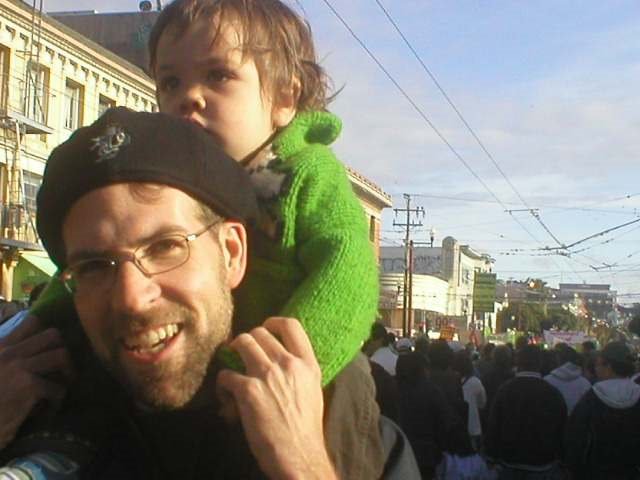
This morning: Liko dancing to the Velvet Underground's Loaded... pictured above... singing "pa pa-pa paaah" to the chorus of "Who Loves the Sun." (Answer: "not everyone!")

I'm so proud.

Happy Mother's Day! To my wife, my mom, and everyone else.

"Some people like to go out dancin'. Now other people they go to work. There's even some evil mothers, they'll tell you life's just made out of dirt. That women, they never really faint, and villains always blink their eyes.That children are the only ones who blush, and life is just to die. That every one who ever had a heart...that wouldn't turn round and break it, anyone that played a part, whooa, and wouldn't turn round and hate it. Sweet Jane, Sweet Jane, Sweet Jane. Sweet Jane!"

Thursday, May 11, 2006

Utopia vs. Families

Last week Liko and I were visiting with our new friends Karen and Argus. Leaning in the playroom corner we found "Peace Trek: Family Coloring Book," published in 1986.

“Why are people in this picture smiling and relaxed?" write the authors. "They are at peace with themselves and with everyone else in the world. That would make anyone a happy person. We must learn to be at peace with ourselves before we can help bring peace to the world.” We see businesses with names like “Soy Foods,” “Planetary Holistic News,” “Holistic Health Clinic,” “Curative Herb Garden,” and “Peace Academy.”

“In a world at peace," they write, "schools will be different from the way they are today. Money no longer needed for national defense and weapons will be used to buy wonderful equipment for schools…In a peaceful world, schools will become lifelong education centers for the whole community. Schools will be places of great excitement and adventure.”

Promises, promises! Can you hear the creepy, passive-aggressive, be-happy-or-else, wheat-germ grooviness behind these lines? I can. I have experience with this sort of thing.

“In a world filled with conflict and fights over money and property, many problems are caused," concludes "Peace Trek." "Many people think that all these problems can only be solved by raising children differently, and with much more love and attention.”

It's pretty to think so, isn't it? This morning I re-read a 1985 essay, "Looking for Mr. Good Dad," by Ellen Willis, one of my favorite cultural critics:

Why do men and women have such an unequal relation to parenthood? Is it biology - we bear children, they don't? Actually, this difference becomes inequality only in the context of a specific social system for rearing children - the family, or, to be more precise, familialism (since I'm talking about a system that affects us all, whether we're in actual families or not). A familialist society assigns legal responsibility for children to the biological parents; the society as a whole has only minimal obligations to its children...This system puts women at an inherent disadvantage: Since it's obvious who a child's mother is, her parental responsibility is automatic; the father's is not. And so the burden has always been on women to get men to do right by them.

[Nearly everyone] takes familialism for granted... After all, the family is so ancient, so apparently universal, that it seems as natural and fixed as sexual difference itself. Yet a mere 15 years ago [mid-1960's] it didn't seem that way at all. Feminists and other cultural radicals were pointing out that the family is a social arrangement, invented by human beings, subject to criticism and change. All sorts of radical ideas got a serious hearing: that children should be considered members of the community, rather than wards of their parents; that they are properly a collective responsibility; that every child ought to have a socially guaranteed right to be supported and genuinely cared for. Some of us envisioned a society organized around communal households, in which adults as a matter of course were committed to sharing in child rearing, whether or not they had biological children. With the conservative onslaught, debate on these ideas has been choked off...


Indeed. The conservative chokehold on family values had only just gotten started in 1985, mid-way through Reagan's regime; it's strange to think that people like Ellen Willis - whose own child was a year old at the time of the essay - or the creators of "Peace Trek" could still call to the page, even in past-tense, elegiac tones, visions of a future so fundamentally different from, and better than, the present.

Now we live in the future - the first decade of the 21st Century - in a world as exploitative, anxious, and wartorn as anything in dystopian science fiction. No one is "smiling and relaxed," unless they're on a psychotherapeutic drug. Few in post 9-11 America talk about utopia, except in the most derisive tones. The "family" - as an idea and as a unit in which most of us live - is a battleground, and yet we all find ourselves in the same trench facing an enemy who looks exactly like we do.

Even conservatives who relentlessly attack the latte-sipping urban liberal are really at war with their own ambition and the circumstances of their lives - the "liberal" is just a symbol and a scapegoat for the economic forces that undermine their yearning for stable home and hearth. In fact, no one of any consequence is ever willing to rhetorically "attack" the family.

Certainly not anyone who calls herself liberal, progressive, or left. Today even progressive visions of the family are fundamentally familial. Most of us in America make our experiments within the ambit of the nuclear family and capitalistic work, even as the nuclear family disintegrates and the demands of work tear children from parents and grandparents - covert, de facto attacks by employers are part of the landscape of our lives. If we really are in a war, it's a shadow war: it's us against someone else's profits. Perhaps because the family really is being undermined on every side, many of us are horrified by the prospect of quitting the safe familial realm and making the family an arena of utopian aspiration and experimentation – it sounds monstrous.

And the results of the radical ideas Willis delineates have been, when implemented in the real world, mixed. Take the Kibbitz movement. Early Jewish settlers in Palestine made children a communal responsibility. Babies slept outside the home, side by side in dormitories. "This experiment failed the test of reality," writes Israeli sleep researcher Avi Sadeh. "In a study that took advantage of the survival of communal sleeping on one kibbutz that still kept this tradition, scientists… compared the sleep of babies and young children in their parents’ homes to that of children who slept in communal children’s houses or in day-care centers. It was found that children who slept in their parents’ houses tended to have longer continuous periods of sleep than those in communal sleeping situations on the kibbutz…Researchers found that the kibbutz children’s sleep improved greatly after moving to family sleeping arrangement.”

Children are born of our bodies; it's not so easy and probably not so desirable to sever family from biology. Score one for familialism!

Maybe utopia and families don't mix. But when you think about it, all ideas of the family are ultimately utopian. No family utopia is at present more perfectionist, totalitarian, and widespread than the White American Christian ideal (which has counterparts in Black, Latino, and various Asian communities that differ in politically interesting ways).

Even non-fanatics hold in our minds an ideal of the perfect family; we all work to realize that ideal in daily life; all of us fail and suffer disappointment in not reaching that ideal. We try to forge a good life for our kids, inside and outside of standard gender roles: dad stays home; mom stays home; mom and dad split it all down the middle of a pie chart they post on the refrigerator; kids have two dads or two moms; we move to be closer to relatives; we tinker with disciplinary regimes, trying to balance our child’s need to develop as a creative person against the need to set limits.

And more explicitly utopian experiments still persist: in a recent New York Magazine article, Annalee Newitz profiles a 100-person commune on Staten Island, which sounds like "Peace Trek" in action. “Our cars are a perfect example of socialism,” says a founder. “Nobody owns them, so we treat them like shit.” If children are defined as a "collective responsibility," will they be treated like cars on a commune? Thanks, but that suburban townhouse is starting to sound pretty good.

And so we, from religious right to secular left, find ourselves trapped between the family life we've imagined and the quotidian, globalized reality of life in "the future." Last night Liz of Badgermama described her efforts, which have been so far frustrated, to launch a co-living community with other families. During the past year, Shelly and I have twice tried to set up more communal living situations with other families - we're not talking radical free-love vegan communes here, but just a mutually supportive, cooperative environment for our kids. Both efforts fell to pieces - or perhaps I should say are on hold for the moment - for many different reasons.

But when I think about it, all the reasons share an underlying unity having to do with the mobility and velocity of our society. Like our toddlers, we can't seem to sit still. There's always something better somewhere else, in a place we never seem to reach.

----------------

"Right now we can't waste time imagining or promoting alternatives to capitalism," a then-unknown Tom Frank once told me. "At this historical moment that's just soft-headed." At the time I disagreed. I was twenty-five years old.

Years later I interviewed the science-fiction writer Kim Stanley Robinson. "There's got to be a utopian strand, there's gotta be positive stories," he told me. "You can criticize over and over again, but it also helps to have some vision of what should happen... All ways of trying to imagine some post-capitalist world are useful, even though - or precisely because - they are wish fulfillment and escapist in some senses. It means there are wishes still in existence for a better and more just world, and it means people want to escape, like prisoners, the current reality. All to the good!"

At the time I agreed with Robinson, yet today - in my mid-thirties - I tilt more towards Frank's position. Never has my daily life been brighter; never has my imagination been darker. The contrast is intolerable and I would like nothing more than for inside and outside to find some kind of harmony. Perhaps Frank and Robinson are both right. In such a case, I think Robinson's is the more courageous default position. If only I could find his courage.

Wednesday, May 10, 2006

Moms vs. The Man


Miriam at Playground Revolution has posted a series of blog entries calling moms and dads to political activism. If combining parenthood and politics seems impossible, but you're still looking for a kick in the ass, read Miriam's May 5 entry.

Miriam also points to MomsRising, "a new organization founded by Joan Blades and Kristin Rowe-Finkbeiner with the goal of championing core motherhood and family issues in political, social, and economic spheres."

It's a worthy effort, though when I look at the organization's actual program, I have to wonder why those issues - parental leave, flexible work, healthcare for all kids, etc. - are defined as only mom's issues. Why not define them as issues for any parent or caregiver? Though I understand why it makes sense to target strategic constituencies, it still seems a trifle retro given all the changes families are going through.

Eh, what do I know. I'm just a guy with a laptop in one hand and a dirty diaper in the other. As I've said elsewhere, I see myself as a mr. mom. I've signed up for MomsRising, and you should too.

Tuesday, May 09, 2006

"Height of the campaign season" vs. "A very active, engaged co-parent"


Scenes of parenthood in San Francsico, from my fine neighborhood newspaper, The Noe Valley Voice:

Having a baby is hardly revolutionary, but District 8 Supervisor Bevan Dufty is destined to put his own unique stamp on it.

A gay man, Dufty announced in April that he is partnering with a lesbian friend, Rebecca Goldfader, to create a family. The couple plan to move under the same roof and raise the child together, while remaining open to other relationships.


The response in Noe Valley? Congratulations!

Actually, I found myself snickering at how the happy couple imagine life with baby:

The coming fall will bring not only the birth of Goldfader and Dufty's daughter, but it's also the height of the campaign season. Dufty plans to "campaign hard" for election to a second four-year term as supervisor, but being a good father is his top priority.

"I intend to be a very active, engaged co-parent," he says....

Dufty envisions creating a unique and diverse home environment... "I hope our home is like a fun salon, mixing food, politics, and good causes," he says. "I think that will be a great environment to raise our daughter."


Ha ha ha! Good luck on all that, Bevan. See? Straight, gay - it doesn't matter. People are all equally delusional.

---------------

Speaking of San Francisco: on Wednesday, May 10, I'll be taking part in a "rapid fire" (three minutes, tops!) reading at Valencia Street Books, along with people like Charlie Anders, Tim Pratt, and Pat Murphy. The event, which starts at 7pm, is a fundraiser for Strange Horizons and the Speculative Literature Foundation, two of my favorite science-fiction related organizations.

Sunday, May 07, 2006

Jeremy vs. Liko


1. My grandmother – Nana, to me – died early Friday morning. That afternoon I took Liko to lunch. I found myself sharing with him my fragmented, half-submerged memories of Nana, though he did not, of course, understand me and spent most of the time throwing food on the floor.

The memories are not the sort of thing I'd write down. Nana didn’t share heartwarming stories by the fire. She didn’t play the piano beautifully or teach me to love Shakespeare. The most famous person she’d ever met was Jack Kerouac’s wife, with whom she’d go grocery shopping. She was a terrible cook. My memories of her do not stand out as instants in time, but rather as a Thanksgiving that did not begin and has never ended, one whose menu consists of dry turkey and cooked-to-death vegetables, with World Federation Wrestling and the Home Shopping Network playing endlessly in the background.

Yet she was humble and decent, the best sort of white, working-class New England Protestant. She had few illusions in life - as far as I know, she did not believe in God - and faced the end of her life with courage. I liked and respected her, and I’m going to miss her.

Liko met her once when he was only four months old. He will never know her or miss her. He will never know very much about her. This seems typical of my atomized family, whose mutually suspicious members are scattered across the continent.

2. All parents secretly long for the day when their children will be able to look past the unreasonable punishments and emotional failures and petty hypocrisies that infest all parent-child relationships, to finally see whom their parents really are and why they did all the things they did. We wait for our children to have children, so that we will be finally understood and forgiven.

But in my experience a parent’s desire for vindication is almost never fulfilled. Relationships with children are never de-complicated in the way a parent hopes, for the simple reason that life doesn’t work that way. Living systems grow more complex, not less; only death simplifies.

Well into maturity, the relationship with our parents keeps convoluting. We may respect our parents more and understand them better when we become parents, yet we still have to deal with their actual personalities.

In fact, seeing our parents more clearly through adult eyes can be much more painful than any disappointment we suffered as children or adolescents. The home a parent creates is all a young child can know; there’s no way for a child to measure her experience against another’s. The trust and thrall is absolute; our family is the one true family.

But children grow. They compare and contrast. They learn – they have to learn - to mistrust. Fissures and shortcomings appear. Families are like any institution, community, nation – some offer more freedom than others. Many of us come into young adulthood striving to be free of our families so that we can live the lives we have imagined.

The parent sees ingratitude, but the child is only protecting herself: I love you – what else can I do? – but you can’t tell me what to do and you can’t hurt me anymore.

3. I’ve found myself thinking recently about what a vast proposition and long journey parenthood is, and how there are so many opportunities for failure along the way. My teenage years were defined – I can admit this now that I am a father, I would have denied it then – by the long, slow disintegration of my immediate family. I don’t write this to embarrass my parents; it’s a common enough occurrence and there’s no shame in it. In fact, today the family divorce, that rite of passage, is worn like a red badge of honor.

Perhaps my parents were happy for all the years that came before, loving and cooperative, even as strains built up, repressed, perhaps, “for the sake of the children.” But today their marriage is defined in my mind by its ending, not its beginning or its middle. My parents have to live with the memories I have, unfair and half-seeing as they are. You can’t simply erase the past – or rather, you can’t erase other people’s memories of the past. You can’t replace their recollections and responses with a set you might find more congenial. You have to find a way to live with other people’s memories. You have to find a way to live with your own.

And so it goes. I can be the perfect father now and for many, many years to come – but what will happen when Liko is twelve? What kind of person will I be and what circumstances will we face? What kind of relationship will I have with my wife? Are there strains building within our little family that we are now repressing, sacrifices of selfhood made for the peace of the moment, that will ultimately undermine our collective happiness and integrity? How can we save ourselves, if indeed we need saving?

Liko will not remember his infancy or toddlerhood, when I changed countless diapers and wiped an infinite amount of snot and casually saved his life twelve times a day. Will I still be there for him when he is thirteen? Will I still take care of him at fourteen? Will he be as alone as I was? The uncertainty is maddening, and I feel an entropy, an accumulation of random errors, at the liminal edge of my experience that resists any conscious design on my part. The end is coming. The end is always coming. It never stops and no amount of love and sacrifice can stop it. We can only start again. Liko will never know his grandparents and he will always live far away from most of his scattered relatives, no matter where he lives.

4. From "How to write a memoir," by William Zinsser in the current issue of American Scholar: "One of the saddest sentences I know is 'I wish I had asked my mother about that.' Or my father. Or my grandmother. Or my grandfather. As every parent knows, our children are not as fascinated by our fascinating lives as we are. Only when they have children of their own - and feel the first twinges of their own advancing age - do they suddenly want to know more about their family heritage and all its accretions of anecdote and lore. 'What exactly were those stories my dad used to tell about coming to America?' 'Where exactly was that farm in the Midwest?'"

Thursday, May 04, 2006

Dads vs. The Delivery Room


Where have I been? Busy, sick, and busy. Still sick. Still busy. But nothing can stop "Daddy Dialectic"!

Here’s some interesting stuff I’ve read:

1) ”Who let the dads in?”, from the Australian newspaper The Age, provides a light-weight but solid overview of the issues involved with men’s presence in delivery rooms.

Throughout the First World, a dad’s presence is now compulsory, due mostly to social pressure – you look like a bad, disengaged dad if you don’t want to be there for any reason.

But "Who let the dads in?” raises some key issues that almost no one talks about here in the States (no one I know, anyway). “Trawling back through history or examining other cultures, there is scant evidence of men having a role at birth. Traditionally, birthing mothers are helped by a group of experienced women.” It’s little wonder that midwives and medical personnel sometimes don’t know what to do with the dad; it shouldn't suprise that a dad might be out of his depth and scared of what he sees and hears. This deserves sympathy and constructive action, not scorn.

“One of the problems is that today's new dads are the first generation expected to be present at birth, and cannot turn to their fathers for advice, says childbirth educator Julie Clarke. ‘There's a real gap in knowledge,’ she says."

Now that so many men over the past 30 years have seen their children born, it might be time to ask hard, frank questions about which men shouldn’t be there, because of temperament or other factors, and how men’s presence should be structured. There clearly needs to be even better preparation. Sure, there are classes you can take and books you can read, and doulas, midwives, and doctors are usually more than willing to talk and answer questions.

But these are often tremendously inhibited conversations, with men reluctant to share what’s really on their minds with experienced women or in front of partners. Men need to share birth stories with each other just as women do, to model how to behave and what to expect. And we should open the door for a range of styles and levels of participation in the birth experience, based on the individual's desires and limitations.

There should probably also be more and better after-the-birth support, or at least a more supportive culture.

Liko had a fast but harrowing birth - precipitous labor, double footling breech – in which he could have died and Shelly could have been injured. I remember cradling Liko in my lap two weeks after he was born. Shelly was sleeping; it was very early in the morning. I thought about the birth for the first time since it had happened, replaying it in my mind, and I just started weeping helplessly, uncontrollably. I was not weeping with joy. (To my surprise, I’m starting to get choked up just writing this down. I don’t often think about Liko’s actual birth.)

In retrospect, I think it's pretty clear that I was having a touch of post-traumatic stress, which is a medicalized way of saying that I held a memory of something that might have been better forgotten. I kept it to myself and the bad feeling went away of its own accord. If someone had asked me how I felt (no one did, that I remember, but those brain cells could be dead), I would have shrugged it off, as would most men, I think. In fact, in public both Shelly and I were pretty cavalier about the whole thing. That’s OK. Our birth was, in the end, happy. It could have gone horribly wrong, but things turned out OK.

But many men have experienced far more difficult births, helplessly watching their wives in pain and their children born in circumstances they see as horrific. Nothing any man experiences can even approach the journey his wife is taking, but his experience shouldn’t be discounted. There’s absolutely no reason for men to be silent, and there may in fact be substantial social and personal benefits from sharing experiences in some kind of structured, honest way.

2) Speaking of which, my very good, old friends Matthew and Karen have started keeping a “He said-she said” pregnancy journal for BabyCenter.com, where Karen works as an editor. Check it out, especially you expectant parents.

3) Lastly, see this interview with sociologist Jody Heymann on “how globalization has radically impacted families around the world”:

Parents' work has shifted markedly around the world—and that goes for every region. Men in particular have been moving away from farmed-based work, and into industrial and post-industrial work—so they've moved away from the home. Women, likewise, have moved into the paid labor force and away from the home…If this had been the only thing that had happened, the world would have seen better opportunities for women, and more opportunities for families to raise their income…

But the globalization of the economy meant that there was increasing pressure for workers to accept lower labor standards. Companies increasingly say, "Unless you accept lower wages, longer hours, fewer benefits, and less paid leave, we'll move our factory to another country." Nations likewise feel pressure from economic globalization not to implement family-friendly policies—such as paid leave for illness or when a child is sick, or paid parental leave. And that leaves working families struggling to balance work and their care-giving duties.

Tuesday, April 25, 2006

Grups vs. Caitlin Flanagan


"Daddy Dialectic" is going offline from today until, oh, probably May 1 or 2; I have deadlines to meet, plus pressing personal business, and not enough time.

But in the meantime:

"You know that feeling when you're reading a magazine article and you realize the group they are profiling is basically you and your friends?" writes my friend Chris. "I'm not sure I want to be known as a 'grup,' but this article is all about hipsters with young kids. It's long, but worth a read ..."

It is worth a read. I don't have time to comment (media commentary isn't really what "Daddy Dialectic" does, anyway), but: a) the article has a clear class and race bias, so take it with a grain of salt; b) still, it's all true, most of it, for the narrow group described; and c) the generation gap is dying even as it's widening. More later.

After you read that, check out this so-funny-it-must-be-satire-but-isn't-so-therefore-it's-pretty-sad interview with anti-feminist New Yorker writer Caitlin Flanagan. "The perfect woman." Yeah, sure. (Found via Rebeldad.)

Friday, April 21, 2006

Inside vs. Outside


Liko sleeps in bed with us. Last week we started to night-wean him, so that he would not nurse all night on Shelly. She now sleeps in the living room; Liko and I sleep in the bedroom. We’ll continue this arrangement until Liko no longer tries to nurse at night.

It’s going fine. Last night as I watched him sleep, feeling like the bed was a raft and we were just drifting along a dark river, I felt something change within me. It’s difficult to communicate. I’ll try.

In the early months – the fabled fourth trimester – Liko needed Shelly and in my ignorance and inexperience, I was largely a supportive bystander. I could not imagine putting him down to sleep without mom; I couldn’t imagine caring for him all by myself, as a father. This bred a certain helplessness – common to first-time fathers – on my part.

Last night he curled up into the crook of my arm. I held him, feeling his little back rise and fall. I felt totally responsible for Liko and totally capable of caring for him, day or night. That feeling of responsibility and capability gave me a concomitant feeling of confidence and power – not “power” in the sense of physical force or strength, but as in the ability to do what has to be done.

“Parent” did not feel like a role that I was adopting, but like something intrinsic to my identity. It didn’t feel “like” anything, really; it was its own thing, my thing, like my arms or my legs. Today I feel somehow more free than I have felt in two years.

Before Liko, I remember watching parents with young children: I’d see the whining, the screaming, the messes, the rising frustration. I’d think: no, no, not me, never. Parenthood looks horrible. They must be miserable. After Shelly got pregnant, I walked the streets of San Francisco with a feeling of doom, imagining - correctly - that I wouldn't be able to go there or do that after the baby came. "The baby" was a very abstract concept.

I am writing this entry in the café of the San Francisco Main Public Library. A short time ago a young man, mid-20s, sat down next to me with another young man, who suffers from some degenerative nervous disorder. They are strangers to me, but I have seen them both around the Mission many times, one caring from the other. I don’t know anything about their relationship – brothers, friends? I know that they both dress like Mission hipsters, in high-tops and thrift-store jackets, the kind of conformist alterna-dress you see shoulder-to-shoulder at a Yo La Tengo concert. Over the years I’ve watched the sick one grow more palsied, more bent upon himself, less recognizable. I don’t know anything about his illness, but I cannot imagine him surviving too many more years.

For the past fifteen minutes I covertly watched one hold a drink up to the other’s mouth. I watched him wipe the other’s chin, force the other’s hands into a position that would allow him to eat, spoon food. A palsied hand knocked milk onto a shirt, the floor. One patiently cleaned it up. At the end one had a small seizure; the other dealt with it.

They just left, one guiding the other at the elbow. Watching them oppressed and saddened me; my hands feel heavy as I write. I’m trying to understand why. Perhaps I was seeing myself as I might appear with Liko to other people: burdened by responsibility, trapped in caring for another, covered in spit and milk. That’s the external image. Internally, how do the two young men feel? There must be anger, both at thwarted lives. But what freedom and power is there, where we can’t see it?

Thursday, April 20, 2006

Easter Sunday in San Francisco


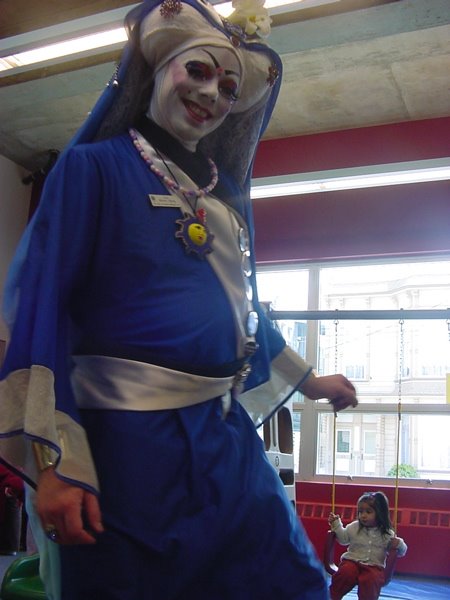
Easter in San Francisco: Children and drag queens everywhere; egg hunt, white rabbits, Hunky Jesus contest. At the annual Sisters of Perpetual Indulgence Easter Celebration, we saw our friends Lesley and Graham and their daughter Rivers; we also saw Shelley and Chris Pepper and their little boy Cole.

We were all happy living in a city where families and trannies (not mutually exclusive categories) can mix without fear of hellfire and damnation.

Shelley Pepper and I sat watching Liko and Cole tug-of-war over a truck:

Me: Boys sure do like trucks.

Shelley: Yeah, it’s true.

Me: They’re so little. I’m starting to think that there really are essential biological differences between boys and girls.

Shelley: Sure. I feel like I can admit that in San Francisco. Back in Missouri, I don’t think I would.

Me: Why is that?

Shelley: Because here you can admit it and people just think it’s funny. Back home people take it as evidence that women shouldn’t vote, or something.

Me: Here you can admit all kinds of things but not worry that somebody will put you in a box. Straight white guys like me don’t have all the social power.

Shelley: And everybody has better sex.

Me: You have sex?

(Liko loses the truck, starts weeping. Conversation over.)

Turns out that a recent study confirms Shelley’s observation. From the San Francisco Chronicle:
Sex is more satisfying in countries where women and men are considered equal, according to an international study of people between the ages of 40 and 80 by researchers at the University of Chicago…

"Male-centered cultures where sexual behavior is more oriented toward procreation tend to discount the importance of sexual pleasure for women," [said sociologist Edward Laumann, considered a top authority on the sociology of sex].


[For steel-eyed analysis of the study in question, see Echidne of the Snakes on April 20. Shelley, by the way, took the photos that go with today’s entry: Liko; a Sister of Perpetual Indulgence; Shelley's boy Cole dances with a rabbit.]

Thursday, April 13, 2006

Parents vs. Life


At the SF Weekly, Matt Smith writes movingly about the death of three-year old Olive Woo Murphy, who was in his daughter's pre-school class:

On March 29 Olive's mother, Linda Woo, brought her two children and a portable barbecue into a Subaru Outback at their Ingleside home. When a neighbor found them, Olive was dead from the barbecue's fumes. Her brother Carter, 4, was unconscious. Woo was still awake. She had reportedly been distraught over a recent separation from her husband. The resulting murder and attempted murder charges carry 25 years to life...

A jury will soon attempt to fathom what Linda Woo's demented thoughts were when she killed little Olive. So there's no point doing that now. We're merely left pondering whether, or when, there will be a next time, and if we're doing enough for children and their caregivers, and for people struggling, or who appear as if they might be struggling, with depression or other mental illness. We're left looking around us at a city that, despite its plethora of playgrounds, programs, and beautiful places for children to live, can be a lonely, stressful, even anguishing place for a mother. If you know one, this might be a good week to ask how she's doing, and listen. Ask if she needs any help. Then follow through if she does...


I recently discovered that a mom close to me is seriously depressed and even afraid that she might hurt her baby. Many parents I know in San Francisco feel pushed to the very edge. It's mostly moms, but stay-at-home dads -- not to mention working dads and moms - are also struggling to keep their heads above water. We face criticism from relatives, stress over money and work, conflict with our spouses, anxieties over status - the list is endless.

I guess I only want to second Smith's call to ask a mom how she's doing, and really listen. And ask a dad, too, especially a stay-at-home dad: in our culture (and in many cultures) men are punished, in ways large and small, subtle and obvious, for revealing anxieties or sharing emotions. That doesn't mean that they're not anxious or emotional. Dads and moms: when someone you trust asks how you're doing, don't be afraid to tell the truth. There are so many barriers that divide us; but if we can step over them, we might just help each other out.

[By the way, the photos for both today and April 10 were taken by our friend, Negar Siadatnejad. The April 10 photos of the immigration march in San Francisco were all taken by my wife Shelly.]

Monday, April 10, 2006

Mud People vs. The Bush Administration


I don't know much about how my ancestors came to the U.S. There are Native American names in my family tree, so some of them came over from Asia during the Ice Age. Many came down from Canada bearing both French and English names. I don't know if they were legal or illegal.

Shelly knows a bit more about her family. Her father's mother's family had households in China and Hawaii, and shuttled back and forth on cruise ships. When the Communists gained power in China, the family divided. Shelly's grandmother stayed in Hawaii and was raised by relatives. Shelly doesn't know much about her father's father's origins. The whole family became citizens when Hawaii became a state in 1959. Shelly's mom's family, meanwhile, is supposedly descended from Peregrine White, born on the Mayflower (" ...it pleased God that Mistriss White was brought a bed of a son, which was called Peregrine." -- Mourt’s Relation, ed. Jordan D. Fiore, Plymouth, Mass: Plymouth Rock Foundation, 1985.)

Our collective, familial memories are fading; we're forgetting that we were once immigrants, driven to the States by politics, economics, unhappiness, yearning. We flutter together like quantum butterflies, every flap of our wings triggering hurricanes in times and places we can't even imagine. How did all these people, bedraggled and confused, traveling from every corner of the earth, come together to form Liko Wai-Kaniela Smith-Doo, my miracle, my hurricane? His name is a trainwreck; so's his bloodline. He's a mutt, my son, a walking, talking Amerieuroasiapacific mashup. I think he's pretty cool.

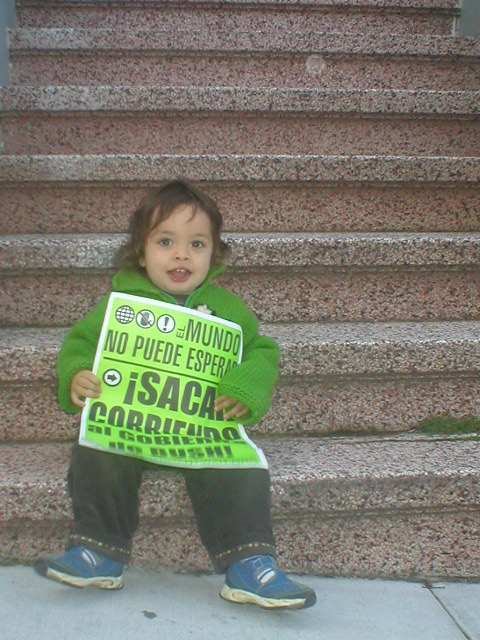
And this afternoon (I'm starting this late Monday night; will probably post early Tuesday morning) Liko and me and Shelly joined 5,000 other mongrels in marching against...well, who cares? Sure, the Senate wiped out on passing some racist immigration law that would have made illegal status a felony; yes, there was talk at the rally of work permits and legal status for illegal immigrants. There were policy issues at stake, but in many ways, policy wasn't the point.

I don't know about everybody else, but my family was marching for cross-pollination, miscegenation, globalism, cosmopolitanism. We were marching for cities and against the suburbs. My utopia is closer to William Burroughs's Interzone - "the Composite City where all human potentials are spread out in a vast silent market" - than gleaming, seamless, monolithic visions like Plato's Republic or the underground cities of H.G. Wells.

The world is globalizing. Good. But if capital can move across borders so that capitalists can make money, then ordinary working people should be able to do the same. That seems fair, doesn't it? And a world full of Likos wouldn't be a bad place. Si se puede!

Follow-up on "Dad vs. Mr. Mom"


I didn't think much of about my April 4 post when I wrote it; I was just musing. However, the post provoked a number of fascinatingly neurotic discussion threads in the progressive parenting blogosphere.

Rebeldad's April 5 link and commentary triggered some mild homosexual panic:
Many women also seem to have this facination to want their husband's or boyfriends to show their feminine side or turn them into "girly" dads. Sorry but I don't have a feminine side. I'm a frieken [sic] guy! I only have a masculine side...The other day Tina paid me a compliment and said how much she appreciated the way I parent as a DAD. And I told her how much I appreicate the way she parents as a MOM. And then we had sex!

As well as thoughtful disagreement:
I am not a mom, I do not mother. I am a father, and by his [i.e., my] definition, I do father... and more. The ideals he's mentioned are exactly the types of stereotypes that create the awkward looks we get on the playgrounds. It's not an insecurity issue, at least for me. I'm parenting, not mothering. Usually, I'll take the title with a grain of salt, unless its said in a negative tone. Then I tend to take the same defensive stance I would take were someone to call me a slacker for not "working".

But the most substantial dialogue happened over at Half Changed World, where Elizabeth (who objected to some parts of the original post) wrote:
But maybe Jeremy's right in some ways. I write here a fair amount about what I call "reverse traditional families"; families with working mothers and at-home fathers. One of the strains on women in these families is that we rarely give ourselves mothering credit for being breadwinners. We often beat ourselves up for the things that we don't do, without giving ourselves corresponding brownie points for the things we do. Maybe we should stop worrying about whether we're good enough mothers, and decide that we're damned good fathers.


In the various threads, including here on Daddy Dialectic, you can see that we as a culture (assuming you take the threads as representative) are very far from consensus about what mothering and fathering mean.

Tuesday, April 04, 2006

Dad vs. Mr. Mom


Something strange – you might even call it “queer,” a term to which I shall return – happened two weeks ago. The day started ordinarily enough. I came home and Shelly went to work. I took Liko to a café for lunch and then we strollered to the Noe Courts playground. It was about 12:30 PM on a Monday.

Suddenly, at the playground gates, we stepped into a parallel universe where the laws of gender bent and vanished (cue Twilight Zone theme): Liko and I found ourselves surrounded by…men. Three men playing with three toddlers. No women in sight. What the hell?

One dad left, but another arrived. At one PM, it was still only dads and kids.

Naturally, we compared notes. All four of us agreed that this situation was, in our collective experience, unprecedented. It emerged that one of us was a full-time stay-at-home dad but looking for a job; two of us had quit careers to take care of our kids but still, out of necessity, worked part-time as freelancers; the fourth was ABD on a Ph.D. All four of our wives worked more hours than we did. For the ABD, this was his second time around; he had a two-year-old and a seven-year-old. “There are definitely more dads on the playgrounds now than there were five years ago,” he said.

At about 1:30 PM, the first mom arrived with her baby. Liko and I went home for a nap.

This incident raises the question: how many of us – and by “us” I mean men who are the primary caregivers to their children — are out there? The 2004 census says that there are 147,000 stay-at-home-dads – that’s at home, all day, every workday, with the kids. That’s about 1.7 percent of all U.S. parents who are taking care of children, which is, as I’ve pointed out elsewhere, pathetic.

But recently I’ve started to wonder, is that number misleading?

I’m not one of those full-time SAHDs (hate that acronym), by the way. I work part-time. In most contemporary families, the primary caregiver, mom or dad, works at least part of the time – but we don’t how many men have powered down careers to stay home as much as possible with their kids. I’ve seen non-sourced estimates as high as two million, but even half of that number is significant. Why don’t we hear more about it? Despite a handful of trend stories about “New Fatherhood,” the at-home dad is largely invisible in the media and in most people’s minds – perhaps deservedly so.

Despite the doubling in the number of stay-at-home dads from 1995-2004, by almost every other measure – housework, making child support payments, etc. – men in aggregate are not pulling their weight with domestic labor. “American women put in additional five hours a week in housework once they are married, while marriage doesn’t significantly effect the number of hours a man does,” writes Ashley Merryman. “American women do 70-80 percent of the total domestic work – regardless of their employment status.” And so forth – I don’t think I need to beat this dead horse. We all know it’s true. So 147,000 men stay home with their kids? So what? Those guys are freaks. (I’m kidding, dads. Actually, I'm not. You are freaks. Don't be afraid. Fly your freak flag!) Part of the reason why I’m reluctant to jump on the whole stay-at-home bandwagon is that I understand how such choices are driven more by economic necessity than a parent’s individual desires. Lots of dads - 56 percent, according to one poll -- would like to stay home with their kids. So would a lot of moms. We’ll need to change the way the economy operates before we can change family life in any kind of positive way.

Perhaps – and I really am just speculating – the SAHD “trend” is just another symptom of the bifurcation of America into blue states and red states, urban centers of social progressivism vs. suburban and exurban redoubts of reaction. Are proliferating stay-at-home dads a bunch of affluent, latte-drinking, BMW-driving metrosexuals who wouldn’t know how to fix a water heater or shoot a deer if their lives depended on it? Are Red State dads all patriarchal deadbeats who couldn’t wash a dish or change a diaper if their lives depended on it? Part of the answer is probably locked in the census; someday I’ll have time to research it (just by looking at the geographical concentration of SAHDs and then superimposing distribution of income and education – seems like somebody’s probably already done this).

The dads-at-home I know in Noe Valley do, in fact, tend to be highly educated, cultural-creative, espresso-loving guys: an archeologist, a Web developer, a writer, a private gourmet chef. One is a former teacher who now sells real estate because that offers more time to be with his son. Most are white; one is Asian; one is mixed race, predominantly black. None are as vain as metrosexuals are supposed to be; it’s hard to preen when all your shirts have baby-drool spots on the shoulder. But yes, these are all comparatively privileged men who have ended up on the right side of the information economy, educated and creative. They have options. Staying at home with their kids is almost, from this perspective, a status symbol.

But all that might just reflect the class and demographic character of my neighborhood. (Also: we are all straight. On the other side of Castro, I do encounter a small number of gay dads.) Nationally, I suspect stay-at-home dads are quite a bit more diverse. In fact, according to a Spike TV survey – I have no idea how reliable this survey is – majority of stay-at-home-dads are black. Many stay-at-home-dads are simply unemployed and looking for a job, and according to data, many of those men are actually not doing their share of housework.

What about the ones who voluntarily father full-time or most of the time, and take primary responsibility for running homes? In addition to meeting more at-home dads in my neighborhood, I’ve recently spent quite a lot of time lurking on online forums and blogs for dads-at-home, absorbing who these guys are and how they think about their work as fathers. A couple of qualities strike me.

First, no one is complaining. No one particularly worries about being invisible, ignored, whatever. Most – not all, but most – are doing what they want to do, and they’re happy doing it. “None of us at home fathers go into it in order to be some sort of social role model,” writes “Tragula” in response to one of my blog entries. “So, no, we don’t deserve medals. At least not for that. If anything the correct response from people would be a completely neutral one. But we do have to put up with some shit from the less enlightened crowd, and face some additional obstacles in a mom-centric world. For that a pat on the back once in a while can be nice, but is not required.” Exactly.

Second, they are alienated. Dads-at-home know they’re outsiders. “I soon learned that the stay-at-home dad is not included in the social network of stay-at-home moms who typically have playgroups,” writes a fellow named Bill Dow. “When you are at the playground with 10 other mothers, it's easy to feel like a fish out of water.” It doesn’t matter how progressive you feel yourself to be (and many of these guys, BTW, are not at all politically progressive) or how much you love being with your kids, you’re still a man in concentric worlds of women and children. You stand out and you stand outside the circle, listening to conversations you can’t participate in. You know you’re hurting your career prospects. You know that many men look down on your choice, or at least wonder if your choice means you can’t hold down a real job.

And yes, as the contents of "Daddy Dialectic" testify, all that does sometimes make me anxious. But mostly, I don’t care. I’m glad to be an outsider. In online SAHD circles, Mr. Mom is supposed to be an offensive term, but I find it fitting. When I’m taking care of Liko, I don’t feel like I’m “fathering” him. In my mind – and this is just the thought I was raised with, not the one I want to have – a father goes to work and comes home in the evening. "Fathering" is playing ball, patting on the back, putting food on the table. An honorable role.

A mother, meanwhile, is home changing diapers and cleaning baby food off the floor and kissing skinned knees. That's also honorable and often honored. That’s what I do. So I feel like by staying home with him, I’m “mothering” Liko. I’m a mom, or at least, that’s my role. In many respects, a man out in the middle of the afternoon with his toddler, who is known to neighbors and neighborhood shop clerks and waitresses as a “Mr. Mom,” is a man in drag, and queer in the most political sense of the term. Why shouldn’t I be proud to be a Mr. Mom? I hope someday “Dad” and “Mom” will be interchangeable with regard to childcare, but we ain’t there yet. For now, I’m happy to be queer.

To end where I started: there are indeed more and more of us queer dads on the playground, or so it seems. Good. Despite all the social ambiguities, I'm glad. Now here's the really interesting question: what effect will our choices have on the next generation? Hopefully, Liko won't see "fathering" the way I do. To him (hopefully; things can change) a dad will be somebody who cooks, does dishes, and takes care of him. Hopefully, he'll have company. Hopefully. We can always hope.

Monday, March 27, 2006

Jeremy vs. Deadlines


Daddy Dialectic will fall silent from now until April 4 (my birthday!), while I deal with a series of professional deadlines.

In the meantime, you can check out this article from the local Newburyport Current newspaper, which consists of a straight Q&A with two couples who decided that dad would stay at home with the kids. Both sets of moms and dads have some very wise, useful things to say. They talk about how the decision for one parent to stay home meant accepting that they would make less money: "A long time ago, we agreed that the pursuit of family happiness is more important than the pursuit of money. Will we ever be rich? No. Do we worry about it? No." They also talk about outside perceptions of the dad-at-home:
My challenges have centered around societal ideas of traditional gender roles. Initially, both my father and father-in-law were not very accepting of the idea of my staying at home with the children. I believe they either saw it as unmanly or did not believe that my new "job" was worthy. In time, they may have become convinced that it was a good decision by simply observing how well the girls were doing. In the past few years, both "fathers" seem to have changed their views of my staying at home with the kids.

There is also the issue of support from those outside the family. When women stay at home with their children, there is a large network of other women doing the same thing. Because of this, most mothers have a built-in support system. As a father staying at home and raising his children, I do not have the same type of support system.


A mom adds:
We have lots of stories of people who have shunned Andy at the playground, or given him suspicious looks when they see him. Over the years, people have become accustomed to seeing him and the girls around town.


Personally, I haven't experienced much of that, possibly because we live in San Francisco. On that note, my next blog entry on April 4 will talk about how Liko and I arrived at the playground last week, middle of the afternoon, and found ourselves surrounded by…men. Four men playing with four toddlers, all fully or mostly stay-at-home dads. No women in sight for about an hour. What the hell? Stay tuned for explication and analysis...

Thursday, March 23, 2006

Parents vs. Employers II


Blogger Elana Centor reports that "about 6 million Brits have taken a career break (an unpaid sabbatical) -- that's from research provided by Direct Line, a British Insurance Company. The concept is so popular in the UK that... 20% of UK companies include Career Breaks as part of the employee benefits package." Centor's post is full of great information, so check it out. Interestingly, parenting doesn't seem to rate as a reason for taking a Career Break.

And as long as we're talking about Brits, my friend Susan Godstone sent me this account of the life of a "househusband" in the U.K., where about 200,000 men choose to stay at home with their kids. (Compare that to the 150,000 in the U.S., whose population is literally fives times the size of the U.K.'s. Imagine one million stay-at-home dads in the U.S.) He concludes:

A recent conversation with a full-time-turned-part-time househusband friend of mine flushed out the fact that he felt "demasculinised", as he put it, by the whole thing; leaving the wage-earning role to his wife had left him mildly unsettled. Me, I have no problem with any of that. In fact, I do remember, even at 5.30am, that working in an office involves stresses, strains and uncertainties that I don't miss one bit. That may partly be the erosion of the self-esteem thing, though. After 18 months at home, the thought of going back into the workplace is genuinely scary. My brain feels atrophied. Once upon a time I could be told a phone number and write it down the next day. Nowadays, I have to look up my postcode.

When I do get ground down, when it feels really relentless, I have to be reminded that this is not for ever. Housewives once went from school into marriage and had little hope of doing any interesting work even when their children had left home. I've spent an inordinate amount of time in higher education, and had not one but two careers. I hope at some point to have some sort of third career, and I just about cling on to enough self confidence to find that prospect exciting. When I remember all this, I remember that my househusbanding is a huge privilege. This is the (extended) gap year that I never took; I'm travelling emotionally, if not geographically. I'm learning about myself, developing the patience and sympathy that I never even thought I lacked. Best of all, Jack and I like each other. I'm always pleased to see him. We spend nearly every waking hour together, yet when I'm not with him I miss him. I know what "poi" and "sha" mean. I do get some time off, courtesy of my girlfriend, to go fish or meet friends. Above all, I know in every bone of my body that I will never regret this. I will not lie on my deathbed and think, oh, how I wish I'd spent less time with my son.


In Britain, BTW, fathers are now entitled to up to six months of paternity leave; in Germany, companies are required by law to give all employees up to three years parental leave and guarantee their jobs on return. Here in the U.S., only workers in California have any kind of automatic paid family leave and wage replacement; nationwide, only one in five jobs provide any kind of family leave. I've asked it before, I'll ask it again: Americans, why do we choose to live the way we do? I learned on Playground Revolution that there's movement in New Jersey to win paid parental leave. Let's hope they succeed.

For more on parental leave policies and dads at home in the U.K. and Europe, see this article from the international edition of Newsweek.

Tuesday, March 21, 2006

Odds vs. Ends


On Sunday I asked some of my fellow progressive parenting bloggers to say something to mark the third anniversary of the war in Iraq. I couldn't go to the anti-war protest here in San Francisco because it cut into Liko's naptime, but I felt like I needed to write/do something. That was my one small act. Two bloggers took me up on it: Miriam Peskowitz over at Playground Revolution (I love that name and Miriam's subtitle: "A Mom's Life is Political") and Liz Henry of Composite, a wonderful blog that is mostly about poetics, translation, and technology. (Uber-blogger Bitch Ph.D. also marked the anniversary of the war, though I had nothing to do with it. She links to some interesting resources.)

Miriam's slice-of-life post deftly shows why political activism tends to decline after children arrive, how the domestic sphere swallows us up and defines our lives, and what mainstream media do to reinforce a sense of isolation and panic. She writes:
Entanglements. We tend to think small. Our lives keep us busy. We vacuum, and we live in a vacuum. War? How come on this anniversary, what we're embroiled in are "mommy wars" not debates over the wars that kill? And cultural commentators now use the phrase "daddy wars' to talk about men's issues. What about the big war out there? We waste the word, focus on fake wars that could be fixed, that are made worse by media creation, take our eyes off the war that kills.

It's the craft of living in a vacuum, and the narrowing vision of it all that struck me as I read the New York Times this morning. The responses to Claudia Goldin's Op-ed last week, the one about how mothers aren't opting out when you actually look at statistics were singularly bad, and troped, to use a good ole literary criticism word. They came from Mommy Wars central casting, they didn't even need to be written by real people. The most amazing thing: they continue to talk about motherhood in a total vacuum. If you were reading these pieces and the letters in response, and you were from that mythical planet in outer space where miraculously you too speak and read English, you would think we are a society in which families are mothers alone with children. No one talks about fathers. No one talks about more complex dynamics than a mother and her life of paid or unpaid work. Where's the context?

Fittingly, Liz published a poem, "moon veil your mirror," which I will let speak for itself.

-------------

A friend sent me a short essay by John Berger on the historical relationship between Hiroshima and 9/11, which I share with you as a follow-up to my March 19 post on the war. It was published in 2002 in the wake of the invasion of Afghanistan (anyone still remember that?), but it is still relevant and a fitting follow-up to the Berger essay I quote on March 19.

-------------

Today in Rebeldad, Brian takes a crack at defining the term "Daddy Wars": "The growing conflict between parents - primarily fathers - and their employers over flexible and varied work options that allow for more precise work-life balance." It's food for thought; check it out.

-------------

Last but not least, my friend Alex asks me a perfectly legitimate question: "If you don't have time to achieve perfect domesticity, how do you have time to write your blog? Or read essays on the Nature of Evil, for that fucking matter? Is it the insomnia?"

He wasn't the first to ask this question and won't be the last. I have a couple of answers.

First: yes, insomnia is a big part of it. I sleep only about six hours a night; the actual writing of most of my entries happens in wee dark hours when only the people of China, Mongolia, etc. are awake and working. Or so it seems to me. This probably accounts for the melancholy tone of some of my entries. I read quite a bit during these hours; I also read during Liko's naptimes.

Second: I do work about 20 hours a week, and make part of my living as a writer. Most of my writing these days is for money, and I don't brag about it. More personal/political ideas do come to me, however, and so I think of "Daddy Dialectic" as an open notebook, where I can jot down notes that I can later develop into essays and magazine articles -- someday, when I have more time. In addition, the blog puts me in touch with other parents, many of whom I might interview when the time comes, as well as resources that I might draw upon later for other writing projects. A blog is also, for writers, a marketing tool; you build an audience around a topic, and in that way accrue some degree of authority and marketability. Also, on finding time to read: I see the reading as an essential part of writing. You need to read in order to write; you need to be in touch with news and different currents of thought. I fit it in where I can.

Third: on a personal level, I find writing the blog to be extremely theraputic. I write down the things that bother me about being a parent, and I feel better. Pretty simple. I also think of the blog as a public personal history, that maybe one day I can share with Liko. Finally, it's a place to think out loud about my values and philsophies of parenthood, and reflect upon my experience.

Yes, I could give up on all this and perhaps my life would be simpler and I'd be happier. In response, I would like to quote Richard Rodriguez: "St. Augustine writes from his cope of dust that we are restless hearts, for earth is not our true home. Human unhappiness is evidence of our immortality. Intuition tells us we are meant for some other city." In other words, I'll sleep when I'm dead.