Showing posts with label Liko vs. Binary Gender. Show all posts

Friday, November 28, 2008

Gender We Can Believe In

Writer Lauren McLaughlin blogs:

The November Atlantic has a fantastic article by Hanna Rosin about transgender kids, which I read hungrily in the hope that it would add to my understanding of the topic. Sadly, it confirmed many of my worst fears. There’s a heart-rending story about 8-year-old Brandon who, from the moment he could speak, has insisted he was a girl. His bewildered parents, who live in an area where “a boy’s a boy and a girl’s a girl,” eventually wind up at a transgender conference where they meet kids and parents going through the same kinds of challenges. The article outlines in broad strokes the evolution of attitudes on the subject of gender identity, though I’m not sure “evolution” is the right word. “Pendulum” seems more appropriate since we seem to swing back and forth between the two following dogmas:

Gender is hard-wired and immune to cultural influence

vs.

Gender is entirely cultural with no biological basis

Otherwise known as Nature versus Nurture.

The fact that gender could be a mix of these two things seems not to have entered into the minds of the “experts” who treat these kids. Notably absent from interviews with them is any awareness of the fact that they may not have at their disposal all the information required to form a comprehensive theory of gender. And since all of the kids (and indeed all of the psychologists, physicians, and researchers who study them) exist within a cultural framework, it’s nearly impossible to isolate non-cultured traits. In fact, the few twin studies performed on the subject have revealed that, while sexual orientation seems to have a strong biological basis, gender identity does not.


Lauren concludes:

Is there another way? We don’t demand rigid conformity to norms in all things. Why gender? The average man is taller than the average woman, but we don’t demand that short men take human grown hormone or that tall women have their legs shortened. Is it possible that we’re demanding too much of these children and not enough from society as a whole? Shouldn’t we be better than the mother of Brandon’s former best friend who rejected him on “Christian” grounds? Perhaps if it was okay for a boy to wear make up, Brandon wouldn’t be faced with the prospect of puberty-blocking hormones. And why shouldn’t it be okay for a boy to wear make up? It doesn’t hurt anyone.

Utterly absent from this otherwise insightful article was any mention of compassion. Not once did someone suggest that Brandon might be encouraged to love his body as it is and still enjoy playing with dolls. Not once did anyone question the ethics of endorsing rigid gender boundaries despite ample evidence of the pain they cause. Perhaps when faced with a little boy like Brandon, instead of figuring out how to fix him, we should figure out how to fix ourselves.


Right on. I can only add my experience: My son likes to wear dresses once in a while (mainly at birthday parties; he thinks that dresses are more festive) and has shown more interests in ballet and figure skating than sports and hockey, but at no point has he indicated that he wants to be a girl, and he still rough houses and does the whole playing-with-trucks thing. Recently, he's started to show a bit more self-consciousness about gender roles--he actually did not request a dress for our last birthday party--which I'm pretty sure is one outcome of socialization at school. We're not pushing either way. These are his decisions, as far as we're concerned.

The rest of Lauren's entry is well worth a read. She's the author of the young adult novel, Cycler, which is about a girl named Jill who turns into a boy named Jack for four days out of the month. I'll definitely be checking that one out.

Thursday, August 07, 2008

10 questions on profeminist fatherhood

Yesterday I posted a list of questions about feminism and fatherhood that were adapted from "10 questions on feminist motherhood," posed by Australian feminist mommy blogger Blue Milk. I promised that I would try to answer them. Here it goes:

1. How would you describe your feminism in one sentence? When did you become profeminist? Was it before or after you became a father?

On its most personal level, feminism is a reminder to me to do my utmost to treat the women in my life with respect, something I admit often falls to the wayside in the heat of an argument—more on that, below.

On a more abstract level, I think feminism reminds me of how my individual decisions have political and social dimensions—and how political events and social trends shape my individual decisions. 

In short, the personal is political!

When did I come to think that feminism was a good idea?

I have always felt like an outsider when in the company of guys, though I’m more or less straight and no one has ever described me as “feminine.” I just felt like every other guy had learned a secret handshake that I never did.

As a result, I have always felt instinctively sympathetic to other outsiders, including girls who weren’t girly enough. This laid the emotional and social foundation that made me open to learning more about feminism when I got to college.

In my sophomore year, a male friend asked me to get involved with a “Men for Choice” group he was starting, which evolved into a guy’s auxiliary for our campus NOW chapter. As the years went by, my activism deepened and branched out into other issues, but pro-choice activism was definitely the gateway.

During college, I also read my way through the feminist canon, starting with The Second Sex and concluding with a great deal of feminist literary theory which now makes me yawn with boredom. These ideas played a decisive role in shaping the way I see the world.

2. What has surprised you most about fatherhood?

My answers to this question and the next one are long. Stick with me, or just skim to the end. Frankly, I prefer that you skim.

After college, I put my profeminism on cruise control. I was in a stable, monogamous relationship and in my work with various progressive nonprofits, I usually had solid, respectful relationships with female co-workers. I watched guy co-workers get into trouble for sexist remarks or actions (inadvertent and otherwise), but that never happened to me and my policy was to duck and cover if it turned into a major issue.

Every once in a while, a female co-worker would even go out of her way to tell me how refreshingly non-sexist I was—“When Jeremy talks to me, he never looks at my breasts,” said one person, whose breasts I did, in fact, secretly glance at once or twice.

These pats on the head were always reassuring and contributed to a decade-long mood of complacency about gender issues. Throughout my twenties and early thirties, I played it safe, and I just never faced any personal challenges to my profeminism. As a result, I don’t think I grew very much when it came to my views on women, men, and gender politics. I figured it was enough for me to avoid acting like an obvious jerk.

Then I became a dad. And I was shocked by the degree to which my now-habitual commitment to feminist values was put to the test. In fact, habits went out the window; everything took conscious effort, as if I’d had an intellectual and emotional stroke and needed to learn how to walk and talk all over again.

I’m not even sure where to start in talking about this—I just wrote an entire book that was partially on this topic and I find it hard to boil it all down into a short answer to a question. It’s also hard to talk about because it’s so very intimate, and involves my wife’s choices as well as my own—something I’m reluctant to discuss in public. For this reason, the reader will have to accept a certain degree of vagueness.

I’ll put it this way: As soon as we became parents, I think the power in our relationship started to inexorably tilt in my direction, as perhaps it always did. Even when I took time off of paid work to serve as my son’s primary caregiver, the tilt continued. It didn’t seem, and still doesn’t seem, to matter what I want or decide—I just keep growing more powerful in the relationship.

What do I mean by power? In this context, we might say it’s the ability to do and say what we want and need to do or say. From this perspective, we’ve both lost power: Parenthood constrains our choices in countless ways, which I don’t think I need to explain to other parents.

But there is no question, absolutely none, that my wife has lost more power than I have. This won’t surprise moms who are reading this, but it certainly surprised me.

The biggest reason for this, I would say, is that I have simply not been as absorbed by the physical and emotional demands of caregiving, even when I was primary caregiver; and at this writing, I am the one who is making most of the money and feels most driven to advance in my so-called career.

Though I have faced setbacks, right at this moment I have achieved, or will soon achieve, many of my well-defined personal and professional goals, thus giving me a sense of efficacy and thus power. At the same time, my wife has struggled more to figure what she wants out of life and how to get it. (Here’s something I’ve learned: Having goals is a form of power; having a plan to pursue them is a form of power; accomplishing goals adds to your personal power. If these are just illusions, there’s power in them.)

This might change in the long run, of course. In fact, I’m counting on it. I’ve experienced setbacks in the past and I will surely experience more of them, and my wife, I hope, will surge ahead. The trick, as with all partnerships, is to avoid experiencing setbacks at the same time! Right now, however, I’m worried: I see a discrepancy growing between us in the context of parenthood, and I fear that it might turn into a lifelong pattern. In earlier stages of our lives, a situation like this wasn’t as weighty; hardly noticeable, in fact. Today, it feels very perilous. And that surprises me.

Mind you, I have been vastly more involved with care than many other fathers and I have explicitly designed my work situation to be flexible. And yet it is still the case—this is the important thing, the most important thing that needs to be said—that parenthood has fueled my own power and diminished my wife’s--or, to put it a different way, constrained her ability to make choices.

3. How have your profeminist values changed over time? What is the impact of fatherhood on your profeminism?

Think about the implications: If a guy like me—who has every good intention and a history of profeminist activism, and who even served a stint as a stay-at-home dad—is failing at the task for forging a perfectly egalitarian family, then what does that tell us about the prospects of wider social change?

Some people reading this probably think they have this one all figured out. They’ll say I was naïve for ever even imagining that equality in one family was possible—what we need, they’ll argue, is nothing less than the overthrow of white-supremacist capitalist patriarchy. Only after the revolution can our piddling interpersonal relationships be lastingly altered.

You might not know people who believe this, but I do. Before becoming a father, I was one of those people.

And so I never thought utopia in one family was possible; I was really just trying to muddle through, as I still am. Here’s the thing: Most of the people I’m talking about aren’t parents—and the ones who are, are not what I would call dedicated parents. In fact, too often left-wing activists and leaders neglect their family responsibilities, especially the guys.

Am I judging them? Sure, a bit—the fathers, anyway—but mainly as a warning to myself and others. They’re workaholics in the service of social change, as I once was, and I suspect that they will regret the things they missed just as much as their corporate counterparts.

As a result, the problems parents face are all very abstract to them. They don’t see, they can’t, how vital and immediate it is for heterosexual couples to establishing a domestic division of labor that makes both parties happy. They have no idea—I had no idea, before becoming a parent—how difficult and urgent it is for fathers and mothers to figure this one out.

It’s all very well to talk about universal health care and parental leave and so on—but who will take the baby to the doctor? What do you say when a breastfeeding mother just wants to stay home and take care of her baby? Do you condemn her, as some have done, for being insufficiently feminist? Or do you say society and the economy made her do it, thereby denying the importance of her perception of what she needs and what the baby needs?

And what about the fathers? Are their feelings and needs irrelevant? What happens when a father yearns to stay home with his child, but can’t, because his wife wants to be the one to do that and he has to earn the money? Or what if he does stay home, and spends his days feeling like a fish out of water? No social movement can help him; feminism can tell him that he’s doing the right thing—God knows, nothing else in our culture will—but that won't matter much to the average stay-at-home dad. He mainly needs a supportive community as well as role models. 

Here’s something I think progressive feminist folks need to understand in a deep way: Parents aren’t soldiers. We don’t take marching orders. And none of us is a general. You can’t tell your partner what she should want out of life, even, perhaps especially, when her decisions make you more powerful in the relationship. You can’t control the way the world thinks of you, and you don’t get to say what social and economic conditions you’ll face as a parent. This breeds feelings of helplessness, powerlessness, anger.

At the end of the day, your main task is to survive and support your family and raise happy children; how you respond to the things you can’t control reveals a great deal about your character, some of it good and some of it bad. You might discover (have you noticed my retreat to the safety of the second person?) a capacity for sacrifice and care that you never knew was there.

On the flip side, the dark one, you might also find yourself erupting with petty rage and misdirected resentment, eruptions that frighten you, your child, and your partner. In those scary moments, when our worst emotions take over and drive our ideals and aspirations over a cliff, it is easiest of all for both fathers and mothers to fall back on traditional patterns of dominance and submission.

What does that have to do with feminism? Everything, and nothing.

Pledging allegiance to feminist ideals doesn’t make you a good person or a good parent or a good partner, but it might remind you of the power you have—we always have power, if only over ourselves—and the need to restrain that power or share it with other people. It can also remind fathers of something that I think is crucial: There are alternatives; you do have choices, and your choices matter. You don’t have to be the man your father was; you don't have to be the idiots we see on TV; you can be a new kind of man, and you can help your sons become that kind of man.

4. What makes your fathering profeminist? How does your approach differ from an anti-feminist father’s? How does feminism impact upon your parenting?

At the start, I saw participating in infant care as being the most important thing I could do to make my fathering profeminist, and maybe that was correct—it had the merit of being a pretty straightforward mission. I did my best.

And that’s a fundamentally different framework than the one an anti-feminist or non-feminist father brings to fatherhood—for the best of them, fatherhood involves an uncomplicated commitment to breadwinning above all else, which, whatever its shortcomings, is definitely an important role to fulfill; for the worst of them, fatherhood becomes another opportunity to dominate women and expand their egos.

On this front, I don’t sell myself or profeminist fathers short: A commitment to care is crucial, and makes a real difference for mothers and children. A person who denigrates such efforts, on feminist or antifeminist grounds, is not helping families.

I also think a commitment to profeminist fathering leads in a very direct way to supporting profeminist public policies: antidiscrimination policies, subidized daycare and preschool, universal health care, paid parental leave, and so on. Enacting these policies will provide a nurturing context for our personal decisions and make profeminist fathering more likely to flourish. That's another difference between a consciously profeminist and a non-feminist father: There's a political dimension to your fathering that, I think, must be expressed through voting, activism, writing, and, ultimately, public policy.

5. When have you felt compromised as a profeminist father? Do you ever feel you’ve failed as a profeminist father?

At this point, I’m compromised every freaking day; I fail every single day. This is not false modesty. The commitment to infant care was straightforward, though in retrospect I see those halcyon days as a simpler time. As the years have gone by, I’ve fallen further and further short of my ideals, and profeminist fathering has started to look increasingly complicated to me.

I confess that I feel really quite lost when it comes to applying profeminist values to my relationships with my wife and my son as they are right now. From that perspective, this is an awkward time for me to tackle these ten questions—I’m struggling toward the answers, but don’t yet have good ones, and it’s possible that I never will.

For example, I’m struggling to figure out ways to raise my son in non-sexist environment, to free him from gender roles (or at least teach him to play with those roles instead of locking into them), to see women and men as equal. Again, our efforts are crashing up against the larger culture, and I find myself fretting much more than I would like about the possibility that Liko will be too different from other kids.

For instance, he likes to wear dresses to birthday parties, and we let him. The other parents, even here in San Francisco, raise their eyebrows, and I wonder what they’re thinking, and if we’ll be invited to next year’s birthday party, and I wonder how that will affect Liko. And I feel ashamed and cowardly for wondering. I know I'm not the first, but that's cold comfort.

And then there’s my relationship with my wife—what does it mean to be a profeminist co-parent? What can I do to support her freedom and happiness? Again, in talking about this, I run up against the limits of our privacy. I can only admit here that I struggle with this on a daily basis, and, right now, we both lose more often than we win. This might be the natural condition of the profeminist father.

6. When has identifying as a profeminist father been difficult? Why?

I’ve gotten some shit from the outside world, but I can deal with that. The difficulties I face are internal, and stem primarily from feeling like a hypocrite, when the state of my family falls short of my ideals.

7. Parenthood involves sacrifice, and mothers must typically make more sacrifices than fathers. How do you reconcile that with being profeminist?

I can’t right now. I’ll have to get back to you on that.

8. If you have a partner, how does your partner feel about your profeminist fatherhood? What is the impact of your commitment to feminism on your partner and your relationship?

You know, I have no idea how my wife feels about this and I don’t care to speculate in public. It has shaped our relationship in positive ways that I don’t think we always appreciate. Taking the long view, feminism has made it possible for our relationship to have more freedom and flexibility than couples in previous eras could have. In the short run, it has driven me to try to be as involved as possible in care and housework. I can describe my intentions; it’s not for me to say how successful I’ve been in meeting my own standards.

9. If you and your partner practice attachment parenting--such as bed sharing or positive discipline--what challenges, if any, does this pose for your commitment to feminism, and how have you tried to resolve them?

One word: breastfeeding. Nothing has done more to inhibit my involvement with caring for my son. For years—literally, years—Liko couldn’t fall asleep without the breast and would grow more irritable the longer he was separated from it. We both had to struggle—and I struggled hard, believe me, and so did he—for us to develop a direct, day-in-day-out relationship that was not mediated by the breast. I’ll say that the struggle was worth it—over time we’ve developed a close relationship that exists on its own terms. Attachment parenting has been good for our family, but it took longer for Liko and me to find that attachment than it did for him and his mother.

10. Do you feel feminism has failed fathers and, if so, how? Personally, what do you think feminism has given fathers?

“Feminism” is, of course, not monolithic.

I would say that individual feminist thinkers and leaders have certainly failed fathers, in the sense that they have behaved as though fathers don’t matter or don’t exist or can only serve a purely oppressive role within the family. Another group of feminists has actually attacked the emergence of caregiving dads—I submit Linda Hirshman as an example.

But I would describe those two groups as a minority; I think a majority of feminists can foresee a positive role for fathers and, indeed, desperately want to see fatherhood redefined in a positive and progressive way. I don’t think feminism has offered a well-articulated vision of fatherhood, but that’s OK: It really falls to fathers to redefine fatherhood.

This is the great thing that feminism has given fathers: Its success has triggered culture-wide dialogs among men about what a good father should be and do. Feminists themselves are not always comfortable with these arguments, and certainly there has been much to criticize.

But, as an old Bolshevik once said, revolutions don’t happen in velvet boxes. They’re messy, contradictory, sometimes downright revolting—but usually also thrilling and necessary. Women have been rising for over a century, and only recently have men started to really change in response. From that perspective, it’s an exciting time.

This leads me to another thing (returning to the topic of the second question) that has surprised me about fatherhood and feminism: In a perverse way, fatherhood has strengthened my commitment to feminism. By revealing the limits of my good intentions and scope of action, fatherhood has pushed me to seek new answers to feminist questions I thought I had answered in my early twenties, on both personal and political levels.

Fatherhood has also reminded me, in a visceral way, of the inequalities that persist between men and women, and, in particular, the burdens carried by mothers. Those burdens and inequalities shape and poison our most intimate relationships whether we want them to or not.

Here again, feminism is useful for fathers and mothers: It gives us perspective, or it should.

It’s easy to be overcome by day-to-day difficulties and despair of the possibility of changing the balance of power between men and women. But if we lift our eyes and look at the sweep of the past through feminism’s eyes, we can see that the balance of power has changed, on this and many other fronts. History doesn’t stop just because we personally feel stuck. If we look at the lives of the people who came before us, we see that our actions in the present do matter, both our individual choices and the act of speaking out in public.

Finally, returning to question three, fatherhood has changed my relationship with feminism in one other way: If I speak out now, it is with a lot more sadness and less righteousness than I did when I was a college student. At this point, I’ve failed so many times that I can hardly denounce others for their imperfections.

But I still feel like we as fathers need to speak out, even if it’s just to friends or through blogs with a few hundred readers. The alternative is silence—but worse than that, meaninglessness. If I’m going to fail, the failure has to mean something. It has to be recorded (if only for myself), examined, put to use, leveraged, transmuted. Feminism gives us a way to do that, to transform our private pains into social change.

Monday, September 10, 2007

More Imaginary Friends

Marjorie Taylor is a professor of psychology at the University of Oregon and an expert on imaginary friends. She read my August 27 post on Liko's imaginary characters. "Mostly what your son is doing is not having an imaginary friend," she told me in an interview. "It’s having a pretend identity. There’s usually a gender difference there. Boys and girls are similar in that they create imaginary characters, but there is a gender difference in what they tend to do with those characters. So, the little boys tend to put on superhero capes and run around. They take on the characteristics of the character and act it out. Whereas little girls, at least during the preschool period, are more likely to invent this other person that they’re interacting with. By the time they get to be about seven or eight, though, little boys are just as likely as little girls to have an imaginary friend rather than a pretend identity."

Taylor's research into imagination and pretend play is fascinating--and I found that it illuminated quite a lot about my son's behavior and propensities. Liko--who has imaginary friends as well as pretend identities--is a very sociable, verbal, empathic little boy who is prone to flights of elaborate fantasy. In her research, Taylor has found a strong correlation between those qualities and the prevalence of imaginary companions.

"Children who have imaginary friends are better able to take the perspective of another person," she said. "We’ve been able to show that in our work." But she cautions us against believing that one causes the other: researchers still don't know if empathic instincts cause kids to make up imaginary friends or if imaginary friends help kids to learn to take another person's perspective.

Whatever triggers these qualities, it appears early in life. "Children who go on to develop imaginary friends really show an interest in fantasy from a very early age," she told me. "So even before the first year, they tend to be the kids who really like puppets and stuffed animals, rather than building blocks or things that are more reality-oriented. Those are the kids who go on at [a later age] to have imaginary friends." Yep, that sounds like Liko. He's never had much interest in "reality-oriented" toys.

One of the interesting implications of the gender difference Taylor found is that little boys appear to be more wrapped up in projecting themselves into roles of power, while girls from early on are developing characters outside themselves who demand attention and empathy. This plays to certain gender stereotypes, but her research also implies that boys and girls alike can develop empathy and caregiving behavior by developing their imaginations.

Once in place, it seems that imaginary friends can take on a life of their own, becoming characters with autonomous motivations and unique feelings. "Part of the fun of imaginary friends is that they don’t always think like you do," said Taylor. "In fact, it surprised us at first that with a lot of imaginary friends, there is a lot of arguing going on and a lot of negativity, even. An imaginary friend will be mean, hit you on the head, put yogurt in your hair, and so on."

Does this mean that imaginary friends ought to all be all locked up in imaginary jails? Taylor says no. "Like adults who think things through before they act, this gives children an opportunity to play it through before they encounter the situation [in real life]. If something is bothering you, you can control it or manipulate it in the world of pretending. That’s a way of developing emotional mastery. Pretend is something children have available to them, that is a coping mechanism they can use in their lives. And they don’t have a lot of other ones, really. They’re pretty helpless and small and have to depend on others, but they do have their imaginations, and they use them to cope."

Thus pretend play and imaginary characters are often a healthy sign of resilience and creativity. Taylor is routinely contacted by parents who are concerned about what the imaginary friends are doing, fearing that imaginary play might point to something wrong in real life. “We see lots of negativity and difficult stuff going on in the pretend play of kids who are healthy and doing just fine," says Taylor. "That can make parents uncomfortable."

But Taylor found that "children just like to think about being bad. Why not have an imaginary friend who is like that, to explore what it means to be bad? You have to think of it as exploring emotional space. There’s a lot to think through about behavior. Kids use pretend to try it on, they do [bad things] in their pretend play so that they have some control over it.”

One parent came to Taylor because her child’s imaginary friend was always sick. "The child didn’t want to leave home because she didn’t want to leave the imaginary friend because [the friend] was so sick," said Taylor. "We put our heads together and thought about how to work within the pretend play. So we had the mother invent a new imaginary friend who could stay home with the sick one. And then the child was totally happy to go! Children like it when parents pretend along. Some people say, 'Well, the imaginary friend is a private thing that [the child doesn’t] want to share.' But that’s just not true. Kids love it when adults participate in their pretend worlds."

Monday, August 27, 2007

My son's top five imaginary characters

1. Frank Lloyd Wright: During a visit to Chicago, we took Liko to see two Frank Lloyd Wright houses. We bought him a Frank Lloyd Wright doll. We had no inkling of what forces this would unleash: The kid is now obsessed with Frank Lloyd Wright. During a later trip to New York City, he insisted that we see the Guggenheim--which he'd seen in posters and books. When he rushed into the lobby of the Guggenheim, he ran in ecstatic circles and tossed his Frank Lloyd Wright doll into the air and spoke in toddler-tongues. Now, when he builds things out of blocks and so forth, he becomes the personification of Frank Lloyd Wright. One of his favorite songs: Simon and Garfunkel's "So Long, Frank Lloyd Wright," which Liko listens to thoughtfully, making tight little circles with his hands. What's the source of his fascination? I can only guess, but I think Liko finds it amazing that people design houses and buildings, as opposed to them just growing right out of the ground like trees. I also believe that Liko just thinks that Wright's buildings are really neat.

2. Sally: That is to say, Sally from the very first 1969 episode of Sesame Street, the DVD of which my father gave Liko as a present. Liko becomes the little girl Sally (that's her, above, standing between Big Bird and Mr. Hooper) when he wants to be cuddled or put to bed. It's very sweet. I'm not sure why he fixated on Sally, the new girl in school whom Gordon shows around Sesame Street, introducing it for the very first time in the history of the world. As far as I know, Sally was never again seen on Sesame Street (foul play?), but Liko has shown no interest in becoming such beloved characters as Oscar the Grouch, Big Bird, et al.--though Cookie Monster has made a few appearances at our dinner table. I should add that in that first episode you can see how very cool Sesame Street used to be: the cast consists almost entirely of African-Americans and Latinos, set on a gritty urban street (as opposed to the usual bucolic or trippy settings of children's TV), with TV's first openly gay couple -- I speak of Bert and Ernie, naturally. Plus, the music and graphics are terrific, vastly more creative that anything you see in today's Sesame Street, which is just a pale shadow of its former self.

3. Liesl von Trapp: Who the hell is Liesl von Trapp? She's sixteen years old and she don't need no stinking governess. She's the eldest daughter of the Trapp Family Singers, whose origins are fancifully depicted in the 1965 musical The Sound of Music. For two weeks after first seeing The Sound of Music, Liko would wake up in the morning, announce that today he was Liesl, belt out a few lines of "Do-Re-Me," and leap gracefully about the room. Liesl still makes regular appearances in our home. What's up with that? No idea. I just hope he doesn't decide to become family patriarch Captain Georg von Trapp and start singing "Edelweiss." If that happened, I'd have to jump out of the nearest window.

4. Mozart: This fantasy was triggered by Peter Sis's beautiful children's book, Play Mozart, Play. In Liko's mind, Mozart is some kind of MacGyver-like superhero. Last week, Mozart, as channeled by Liko, built (by hand!) a cargo plane out of couch cushions, filled the bay with musical instruments, flew it all to Africa, unloaded the plane, draped at least four instruments around himself using various straps, and gave an epic concert, performed on the stage that is our bed. Amazing. Ten times better than "Cats." Fifteen times better than "Phantom."

5. Spider-Man: Liko can pretty much do whatever a spider can. Spins a web, any size. He catches thieves just like flies. Look out, readers! Here comes Liko the Spider-Man. I once asked Liko why he likes Spider-Man so much. "I like his costume," said Liko. "And I like how he shoots things out of his hands and flies through the sky." I've since noticed that quite a few little kids like Spider-Man and I've started asking them the same question, and the answers are all more or less the same as Liko's. I also think Spider-Man is cool, but that has more to do with his origin as the world's first anti-authoritarian superhero and the wonderful emotional and philosophical dynamics of the series' main characters. Also, the costume. And the way he shoots webs out of his hands. During the aforementioned trip to New York, I kept imagining Spider-Man swinging around over our heads...and so did my son.

Runners-up: The Wicked Witch of the West; Glenda, the Good Witch; a "mean, scary pirate"; Superman; Doctor Baker (from Curious George Goes to the Hospital); Nurse Carol (Ibid.); Sigmund Freud (Liko has the action figure).

Monday, March 19, 2007

Liko vs. Binary Gender, Part II


Said this evening, apropos of nothing: "I'm a pretty working man!"

Don't forget to enjoy your kids today!

Saturday, February 17, 2007

Liko vs. Binary Gender


After Liko and his mom set up a hummingbird feeder on the back deck:

"I'm not a girl or a boy!"

"What are you?"

"I'm a hummingbird!"

"Really? Cool."

"I'm a hummingbird woman!"

Which reminds me: I recently did a blog search for "feminism" covering the previous 24 hours and found that eight and a half of the ten most recent posts were anti-feminist rants. I say "eight and a half," because of this politically curious post on the politics of daycare in the U.K. -- the only one I'll link to, because it is serious and thought-through and contains some ideas that I think are good.

Two noteworthy things here: the apparent prevalence of antifeminist hatred on the Internet and the bankruptcy and misogyny of antifeminist politics, as represented in these posts. Sample quote: "Businesses are there to make money. All this forcing of businesses to ensure people (primarily women) get their work/life balance in order is fucking the economy up... The old way was pretty good. Men worked and made money, thus able to do their jobs and provide for the children. Women stayed at home and ran the home, thus able to devote themselves to the kids... Businesses, men, women and children were happy."

Uh, sure. Everyone was happy. Here's a guy who has never read a novel published prior to 1962.

Tuesday, November 21, 2006

How the Sun Rose


Early morning. Liko goes to the window and sees the light spilling over Mt. Diablo.

"What are you doing, Liko?"

"The sun. I want to hold it."

"What will you do with the sun?"

"Put it in the sky."

Sunday, June 11, 2006

Liko's Newest Word


"E-mail."

Also: My previous entry provoked two readers to share examples of conservative family values creepiness. For your further amusement and horror, here's another one: "More and more fathers are becoming aware of their influence and regularly dating their daughters..."

Thanks to peeps at Other magazine for pointing me to this...my esteemed colleague Claire pretty much expresses my thoughts on the issue: "Why does Focus on the Family believe that only fear of sex will activate fathers? Are right wing fathers otherwise completely uninterested in their children?"

Thursday, April 20, 2006

Easter Sunday in San Francisco


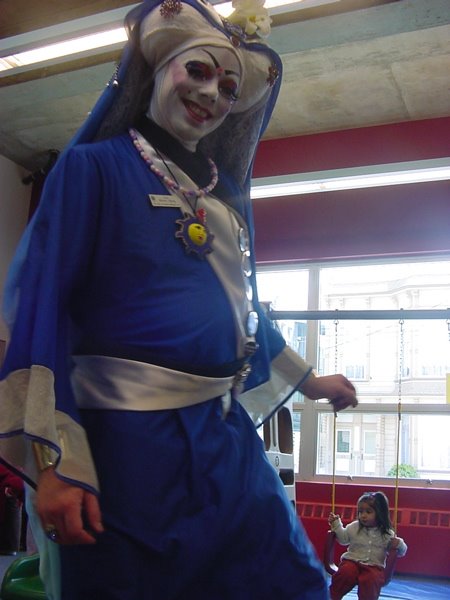
Easter in San Francisco: Children and drag queens everywhere; egg hunt, white rabbits, Hunky Jesus contest. At the annual Sisters of Perpetual Indulgence Easter Celebration, we saw our friends Lesley and Graham and their daughter Rivers; we also saw Shelley and Chris Pepper and their little boy Cole.

We were all happy living in a city where families and trannies (not mutually exclusive categories) can mix without fear of hellfire and damnation.

Shelley Pepper and I sat watching Liko and Cole tug-of-war over a truck:

Me: Boys sure do like trucks.

Shelley: Yeah, it’s true.

Me: They’re so little. I’m starting to think that there really are essential biological differences between boys and girls.

Shelley: Sure. I feel like I can admit that in San Francisco. Back in Missouri, I don’t think I would.

Me: Why is that?

Shelley: Because here you can admit it and people just think it’s funny. Back home people take it as evidence that women shouldn’t vote, or something.

Me: Here you can admit all kinds of things but not worry that somebody will put you in a box. Straight white guys like me don’t have all the social power.

Shelley: And everybody has better sex.

Me: You have sex?

(Liko loses the truck, starts weeping. Conversation over.)

Turns out that a recent study confirms Shelley’s observation. From the San Francisco Chronicle:
Sex is more satisfying in countries where women and men are considered equal, according to an international study of people between the ages of 40 and 80 by researchers at the University of Chicago…

"Male-centered cultures where sexual behavior is more oriented toward procreation tend to discount the importance of sexual pleasure for women," [said sociologist Edward Laumann, considered a top authority on the sociology of sex].


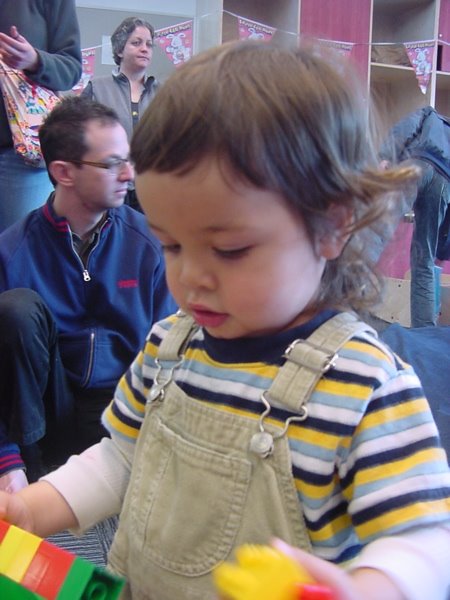
[For steel-eyed analysis of the study in question, see Echidne of the Snakes on April 20. Shelley, by the way, took the photos that go with today’s entry: Liko; a Sister of Perpetual Indulgence; Shelley's boy Cole dances with a rabbit.]

Wednesday, March 08, 2006

Jeremy vs. Patriarchy


I’ve been thinking about the question of how fathers can go about, concretely (as opposed to rhetorically), constructing identities, role models, whatever, that will help liberate their sons from rigid gender roles. That sounds very antiseptic, too much like a ideological formula. To put it a different way: how can I refrain from being a jerk to women, and how can I help my son to not be a jerk when he grows up?

This is going to be a perennial topic on Daddy Dialectic; I don't have a good answer and it's not easy finding one. Let me start by describing a small incident that occurred when my son Liko was three or four weeks old, that maybe will frame the problem. The three of us were in bed. I was reading a novel. Shelly was nursing the baby, who was starting to go to sleep. Very peaceful, and I was really into the novel, The Amazing Adventures of Kavalier and Clay.

Suddenly, Liko vomited all over the bed. Then he started to wail his little lungs out.

What was my reaction to this pedestrian mini-crisis? (The like of which I’ve since gone through, oh, maybe four hundred times during the past 20 months.) I was annoyed. Really annoyed – with both Shelly and the baby, as if it were somehow Shelly’s fault that the baby had thrown up all over everything. I was reading, for God's sake!

Thinking this way – I was a twit, you see – I didn’t see myself as involved, as responsible. There’s a moment in an Alice Munro story, “Post and Beam,” that describes this stance: “Later she asked Brendan to stop so that she could lay the baby down on the front seat and change his diaper. Brendan walked at a distance while she did this, smoking a cigarette. Diaper ceremonies always affronted him a little.” I wish I could say that I don’t understand Munro’s character Brendan. Unfortunately I do, and any North American dad who says he doesn’t is absolutely full of shit. This is the mechanism fathers use to foist daily childcare onto moms: they lump the baby and mom together and position themselves as above it – like a kind of shop-floor supervisor, sitting in a glass-walled office, watching the rows of women sewing T-shirts. The supervisor says, or thinks: You’re doing this wrong; you’re not doing it fast enough; snap out of it; can’t you see the baby’s hungry?

The standard, gendered dad-goes-to-work/mom-stays-home division of labor reinforces that glass wall. Making money is part of childrearing; that entails its own sacrifices, and has to be understood and honored – but how do you smash that glass wall that a job creates, that divides men from women and symbolizes separation from children and family? In the absence of a social revolution in parenting, how do you raise boys and girls who can avoid or escape all the traps set by gender roles? I’m going to stop here for today, to be continued.

(To anticipate one comment: I'm well aware that one's wife, sleep deprived and wrung out, can turn on a single innocent comment into a snake-haired Medusa whose single look can turn you to stone – and, uh, maybe there’s some personal/political issues there? But I’m not the one to find them. I am, as they say in AA, taking my own inventory.)