In today's SF Chronicle, columnist Jon Carroll pleads with liberals and progressives and decent people everywhere to conserve our outrage and not waste it on the likes of Nancy Grace.
"In these troubled times, outrage is a limited commodity," Carroll writes. "There are only so many hours in the day... So we need triage. We need risk assessment. We need to remember that just because the herd is running some place doesn't mean that we have to run that way too."
But Jon, I think I can spare a moment of spittle-spewing indignation in memory of Melinda Duckett, who was suspected of murdering her 2-year-old Trenton and foolishly agreed to go on national TV to talk about it. Duckett killed herself the day her interview with rabid talk-show host Nancy Grace aired on CNN, which ran an announcement of the suicide at the bottom of the screen. Classy. I've read the transcript and it's pretty clear that Grace grilled Duckett into incoherence, intent on solving the case right then and there in front of the whole audience.
Here's the context: Duckett had been laid off from her job and was going through a divorce with Trenton's father, who'd been hit with a temporary restraining order. Parents, try to walk a mile in her shoes and imagine the stress of a situation like that. Here's a 21-year-old woman, barely an adult, who was probably living every moment of every day with fear and anxiety. She's isolated and taking care of a toddler. She probably doesn't have much help or support. The money was running out. There's evidence that the dad was abusive, though I'm not going to say if he was or wasn't because I wasn't there.
Being a parent provokes a curiously bipolar response to a case like this. On one hand, it seems impossibly monstrous that any parent could commit an act of violence against a helpless baby; some of us want vengeance on behalf of our own children. On the other, I think that if we are willing to dig deep, most parents will find moments when we've all been pushed right to the edge of violence. (Think four in the morning and the baby's been crying for an hour and you've got a big meeting at work in five hours and your spouse is irritable and not much help and your arms are getting tired from carrying the baby and if you have to shush one more time you're going to scream...)
I've had sleep-deprived, stressed out moms tell me that they feel like they are going to die; one said that she didn't feel like she could control any aspect of her life and that she was angry at everything, including her little boy. I've read that moms who kill their kids often convince themselves that their children are better off dead, given the reality the family is facing. Certainly, there's no shortage of parents, moms and dads, who beat their kids to within an inch of their lives. This isn't to excuse the parents - they should be tried in court and either treated or punished, as the case warrants - but if we can try to understand the conditions that would drive a woman (or man) to that extremity, we might be able to help prevent a disaster or heal a family that's been through one.
That said, I don't know if Duckett was innocent or guilty. I have no idea if Nancy Grace drove Duckett to suicide. Neither do you. I'm less concerned about the facts of the case than about what the Nancy Grace interview reveals about our culture and parenting. In the transcript, Grace is conducting multiple interviews simultaneously, including with Melinda Duckett, her estranged husband Josh, and a circus tent of guests who critique Duckett's "performance" as the interview proceeds.
At one point, Duckett, who was probably exhausted and is visibly confused, says she doesn't want to answer a question "because I'm not dealing with media very well." (Turned out later her divorce lawyer had advised her not to answer certain questions.) Grace turns to Marc Klaas, president of an organization called Beyondmissing and crusading celebrity father of the murdered Polly, for an opinion. "Nancy, in these kinds of cases the media is never the problem," says Klaas, whose job is to appear in the media. "The media is always a friend, it's about sharing information. It's about transparency, it's about working with the authorities. It's about working with the media and it's about getting over that hump that people are looking at you. And quite frankly, Melinda is not doing that very well at all."
"The media is always a friend"? "Melinda is not doing that very well at all"? Who the hell is this guy? He acts like the "Queer Eye for the Straight Guy" for parents of missing children. Perhaps he should have coached Melinda beforehand, maybe gone through her wardrobe and shared his favorite hair gel, developed some talking points and blocked some tragic poses. Then perhaps Duckett might have performed to his satisfaction for our friend, the media. Even assuming that Klaas sincerely wants to help parents find abducted kids, I'd respectfully suggest that his appearance on Nancy Grace's show didn't help anyone except Marc Klaas. It's fun to be on TV, isn't it, Marc? Remember back when it was just a means to an end? How naive you were, back then. How much more sophisticated you are now.
And how sophisticated we all pretend to be. I scanned editorials, blogs like the one you're reading, and talk-show discussions. Newspapers and many blogs dutifully roasted Grace for being crass, but a substantial number of TV talking heads fell over themselves with support for Grace and her tactics. Duckett was an adult, say the talking heads. She should have known the score, and if she didn't, it's her fault. She should have watched more CNN and maybe taken some notes, for future reference, back when she had the chance, presumably. She didn't even have the common decency to have attended j-school.
Melinda Duckett may or may not have committed a crime. That hasn't been proved one way or the other. But in my eyes, and of course in the eyes of lots of people, CNN and Nancy Grace stand convicted of turning a family tragedy into entertainment. Grace and homelander celebrities like her say they're trying to "reunite families" (direct quote from a press release!), but they do nothing of the kind. Instead they directly hurt the families who stumble, blinking and nervous, in front of cameras hoping for help or vindication or sometimes fifteen minutes of fame.
That alone is wrong, but it's much bigger than the families who land in the spotlight. In a mindless drive for eyeballs and profits, mainstream media cheapen the culture that's supposed to bind us together and they drag their audiences into moral and political fantasylands. Many editorials I read faulted Grace for her journalistic ethics and technique, but to me the media's systemwide failure is moral (in failing to distinguish right and wrong) and political (in abandoning their historic mandate to afflict the comfortable and comfort the afflicted - today in the media and in every major institution, it is the comfortable who have their backsides kissed and the afflicted who gets their asses kicked).
When we can't find justice in the real world, we look for it on TV. We seek the appearance of justice and indulge ourselves in fantasies of moral rectification. Maybe that's necessary in fictions like 24 or Over There, but it's terrible and destructive when enacted as ritual slaughter on TV that purports to be reality, starring real people who don't have the benefits of a script, teleprompter, or competent legal representation.
Sometimes when I look out at the world I've helped to make - through inaction or self-indulgence - for Liko, I want to cry. We can do better than this.
Tuesday, September 19, 2006


Monday, September 11, 2006
Worming Into Books
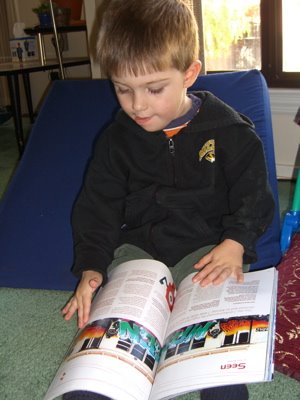
Cole has always been nuts about books. He's not quite 4, but already he's begging to keep the lights on at night so he can look at "just one more book." He can't really read yet, but he likes looking at the pictures, sometimes narrating the story to himself as he flips the pages.
The teachers at his preschool close the day with story time, and if they are in the middle of one story when I arrive to pick him up, Cole will barely acknowledge my presence until that last page is turned. Any attempt to interrupt will be met with emphatic protestation. The funny thing is, he doesn't like any of the songs or finger plays or clapping games that people tend to intermix into storytime. He just wants the stories, and couldn't care less about any of that other stuff.
One thing I would have never even thought to look for are audiobooks, but my friend Annalee passed along one of Mary Pope Osborne's Magic Treehouse CDs, and Cole was mesmerized by it. He picked out several more stories from the series at the library, and will sometimes sit for more than an hour listening to them. This interest in stories and storytelling is one childhood habit I hope he keeps.
When I took him back too his preschool last week, I saw some of the new parents struggling with sobbing, clingy kids who didn't want them to leave. I was reminded of Cole at this time last year, when most every school drop off was concluded in tears. Often the teachers would have to pull him off of me so I could get to work. It's such a contrast with how he is now, racing into school, taking off his own shoes and jacket, and having to be reminded to give me a hug and a kiss before he zooms off to his friends. The changes sure do come, don't they?
Friday, September 08, 2006
a mythology of contradiction
Lately, I have been obsessed with myths. Stories. The mythology of living. The tales we tell to define ourselves, explain our existence, create communities, clarify enemies. I read an essay by Frank Chin who chastised Maxine Hong Kingston and other Asian American writers for bastardizing the myths of China, creating hapa myths devoid of their “true” cultural relevance. And at first I aligned myself with him thinking of Disney’s Mulan, of Aladdin, thinking of history classes my children come home from and try to explain why they build model California Missions. My daughter acknowledge though that she is also building a cemetery for the dead Indians used to build those Missions. What bastardized and commercialized mythology is being told there? And why does it get retold over and over? What purposes does it serve?
So I see his point, but then I remembered how often I have written about the ways storytelling and talkstory can change you, change minds, change directions; how it can also replenish, can restore, bring peace, solidify, fortify. I believe storytelling is less about the events and more about the narration, the connections; you tell what needs to be told; you create what your people might need to hear. I remembered how when I think back on the most memorable moments of my life, I smile and recall the way they are told, narrated, shared with others over dinner or at bed time or accompanied by beers on Thursday night. It’s the retelling that is so powerful, is what makes us laugh and smile, or cry and feel empathy. It’s how we live on.
So my kids and I talk about the Missions and how there are so many stories; we talk about how I won’t go in them, how I waited outside the numerous catholic churches in Mexico as their mother went in to connect with the stories of her religious upbringing. We then talked about how her and I both learned from our individual choices and the exchanges or explanations we had around them. My children and I talk about how beautiful those Missions are and what it means to have something so beautiful, so spiritual, have such a dark origin. We talk about both sides; we create a mythology of contradiction.
And as my family marched with hundreds of thousand of other protesters during the May first general strike, we heard talk of what an American is (can you wave both an American and Mexican flag, someone scoffs at us). Well, what’s the mythology of immigration? What are the ways to explain boarder crossing, exile, diaspora? We, of course, know thanksgiving, but do we know the Florida Seminoles’ story, do we retell the stories of the southwest as it went from Indian, to Mexican, to American nations. And as Gloria Anzaldua fortells, “will become Indian once again.” Some day. My New Mexican family claims they have been here before anyone, and they survived by growing and welcoming others into their lives, into their stories and histories like the Mexicans, the gringos, your mother, they tell me. My father says I’m a new breed a chiconky. That’s how he tells it.
In Kingston’s book The Tripmaster Monkey Wittman says that language contains the key to the past and to our future; that in the Chinese character for I was imbedded in it the word warrior or fight or even weapon. To say I was to say I-fight. How powerful is that? But it has been lost to us now. But do I believe? This mythology isn’t mine. Do you believe me about my family? I’m sure I’m not they only half-bred boy from some idealistic white mother and some reckless father from the rez, or ghetto, or barrio. There’s probably a whole underground army of chiconkistas roaming the United States waiting for our story, our time. I think it’s time we start spreading the word, finding that language that says I and means Fight.
I don’t know how to read Cantonese or Mandarin; but I know what Wittman means when he says we have lost the fight and to regain it, we need to relearn our language. Or better yet create our own. Chin, if you wanna wage war against the storytellers, cut out your own tongue.
Because all language starts with stories. When my son asks me about why my mom ran like the prodigal daughter home to her parents after giving two years of her life to the New Mexican desert, what can I say? The myth that was told me from my abuela goes: it was a snowy night when your mom came, mijo, to say good-bye. She looked at all of us and hugged each one of us. But she did not say a word. And neither did we. We all stood in silence. What could we say, mijo, what could we say? Then, she just turned and left.
She never said a word about them again till I was 18. How strong must you be to hold your tongue for so long? The truth is something a little different: my mom, lonely, a single mother because my father left her and then went to jail, trying to survive, knowing she needed family, decide to return home. Who can blame her? What else needs to be said? But the problem was the silence. That is what caused the pain, what divided families years after the events happened. What people remember is the silence that followed my mother’s departure.
Wittman says Repetition makes a custom. Doing things over and over establishes reality. Hearing the words more than once, the people will get it. I want to get it. I want my kids to get it. I want everyone one to once and for all get it. But in order to do so, we must all start talking and start listening. Don’t worry if it is slightly different each time you tell it; don’t worry if someone else tells it differently. Just tell it like it might save your life. Tell it like you're fighting for your kids. For indeed, in these times, in this day and age, it just might and you certainly are.
So I see his point, but then I remembered how often I have written about the ways storytelling and talkstory can change you, change minds, change directions; how it can also replenish, can restore, bring peace, solidify, fortify. I believe storytelling is less about the events and more about the narration, the connections; you tell what needs to be told; you create what your people might need to hear. I remembered how when I think back on the most memorable moments of my life, I smile and recall the way they are told, narrated, shared with others over dinner or at bed time or accompanied by beers on Thursday night. It’s the retelling that is so powerful, is what makes us laugh and smile, or cry and feel empathy. It’s how we live on.
So my kids and I talk about the Missions and how there are so many stories; we talk about how I won’t go in them, how I waited outside the numerous catholic churches in Mexico as their mother went in to connect with the stories of her religious upbringing. We then talked about how her and I both learned from our individual choices and the exchanges or explanations we had around them. My children and I talk about how beautiful those Missions are and what it means to have something so beautiful, so spiritual, have such a dark origin. We talk about both sides; we create a mythology of contradiction.
And as my family marched with hundreds of thousand of other protesters during the May first general strike, we heard talk of what an American is (can you wave both an American and Mexican flag, someone scoffs at us). Well, what’s the mythology of immigration? What are the ways to explain boarder crossing, exile, diaspora? We, of course, know thanksgiving, but do we know the Florida Seminoles’ story, do we retell the stories of the southwest as it went from Indian, to Mexican, to American nations. And as Gloria Anzaldua fortells, “will become Indian once again.” Some day. My New Mexican family claims they have been here before anyone, and they survived by growing and welcoming others into their lives, into their stories and histories like the Mexicans, the gringos, your mother, they tell me. My father says I’m a new breed a chiconky. That’s how he tells it.
In Kingston’s book The Tripmaster Monkey Wittman says that language contains the key to the past and to our future; that in the Chinese character for I was imbedded in it the word warrior or fight or even weapon. To say I was to say I-fight. How powerful is that? But it has been lost to us now. But do I believe? This mythology isn’t mine. Do you believe me about my family? I’m sure I’m not they only half-bred boy from some idealistic white mother and some reckless father from the rez, or ghetto, or barrio. There’s probably a whole underground army of chiconkistas roaming the United States waiting for our story, our time. I think it’s time we start spreading the word, finding that language that says I and means Fight.
I don’t know how to read Cantonese or Mandarin; but I know what Wittman means when he says we have lost the fight and to regain it, we need to relearn our language. Or better yet create our own. Chin, if you wanna wage war against the storytellers, cut out your own tongue.
Because all language starts with stories. When my son asks me about why my mom ran like the prodigal daughter home to her parents after giving two years of her life to the New Mexican desert, what can I say? The myth that was told me from my abuela goes: it was a snowy night when your mom came, mijo, to say good-bye. She looked at all of us and hugged each one of us. But she did not say a word. And neither did we. We all stood in silence. What could we say, mijo, what could we say? Then, she just turned and left.
She never said a word about them again till I was 18. How strong must you be to hold your tongue for so long? The truth is something a little different: my mom, lonely, a single mother because my father left her and then went to jail, trying to survive, knowing she needed family, decide to return home. Who can blame her? What else needs to be said? But the problem was the silence. That is what caused the pain, what divided families years after the events happened. What people remember is the silence that followed my mother’s departure.
Wittman says Repetition makes a custom. Doing things over and over establishes reality. Hearing the words more than once, the people will get it. I want to get it. I want my kids to get it. I want everyone one to once and for all get it. But in order to do so, we must all start talking and start listening. Don’t worry if it is slightly different each time you tell it; don’t worry if someone else tells it differently. Just tell it like it might save your life. Tell it like you're fighting for your kids. For indeed, in these times, in this day and age, it just might and you certainly are.
When the Summer Comes Undone
Whew -- summer vacation is over! Back to school! I'm not always so excited to return to the books and bells, but the end of summer vacation has come (mostly) as a great relief this year, a welcome return to routine and regularity.
I teach high school, and ever since (almost 4-year-old) Cole was born I've cherished the summers where I get to spend long days with him. And I definitely enjoyed this summer, but things were different -- way different. Most notably, Cole's mom left me earlier this year, and, while we were theoretically co-parenting, Cole was with me most of the time. In fact, there was a particularly low point in the summer where I thought she might bow out of parenting altogether. Things have changed since then, and we're now splitting time about 60-40 (I'm the 60), but this summer Cole was with me a lot more than that.
As many of the posts here illustrate, being an attentive parent is challenging. I don't think I was quite prepared, however, for how much more challenging it would be to do it on my own. Cole is wonderful and full of joy most of time, but he's definitely been exhibiting some exaggerated up-and-downs while he tries to deal with his parents splitting up. And, like any little kid, he's constantly pressing the people closest to him, trying to see where the limits are and how people react to different behavior. All that's to be expected, but it's a lot to deal with when you're the only parent in the picture from dawn to dusk, especially while trying to keep a lid on the day-to-day stresses of laundry, dishes, bills, and a messy house.
Things got more challenging when my sister (my only local family member) moved to New York in July. By the time August rolled around, when I was really struggling to find free moments to get ready for the school year. I found myself wishing I could just call in a substitute parent for a day or two. Unfortunately, though, it seems someone forgot to write sick time into the parenting contract.
After feeling the stress of being a single parent, combined with weeks spent walking around the Mission, with its dilapidated (and often deserted) playgrounds and passed-out junkies, left me planning out ways to escape. As Cole gets older, I often find myself wishing I could give him a little more freedom without fearful adults watching him every second. I'd like him to be playing with his neighbors, learning how to ride a bike, and out looking for bugs, and it's sometimes hard for me to picture those things happening in San Francisco.
Living closer to my parents sounds really appealing sometimes, living in Berkeley seems really appealing sometimes. Being able to buy a house sounds really appealing almost all of the time. So maybe a move or a change is order, or maybe I'm just feeling a bit of divorcee depression that will pass now that my thoughts aren't just rattling around in my own head all day long. I'm just going to let things be for a while, and hopefully settle on a plan in the next two years, before Cole starts kindergarten. We'll see how things end up.
I teach high school, and ever since (almost 4-year-old) Cole was born I've cherished the summers where I get to spend long days with him. And I definitely enjoyed this summer, but things were different -- way different. Most notably, Cole's mom left me earlier this year, and, while we were theoretically co-parenting, Cole was with me most of the time. In fact, there was a particularly low point in the summer where I thought she might bow out of parenting altogether. Things have changed since then, and we're now splitting time about 60-40 (I'm the 60), but this summer Cole was with me a lot more than that.
As many of the posts here illustrate, being an attentive parent is challenging. I don't think I was quite prepared, however, for how much more challenging it would be to do it on my own. Cole is wonderful and full of joy most of time, but he's definitely been exhibiting some exaggerated up-and-downs while he tries to deal with his parents splitting up. And, like any little kid, he's constantly pressing the people closest to him, trying to see where the limits are and how people react to different behavior. All that's to be expected, but it's a lot to deal with when you're the only parent in the picture from dawn to dusk, especially while trying to keep a lid on the day-to-day stresses of laundry, dishes, bills, and a messy house.
Things got more challenging when my sister (my only local family member) moved to New York in July. By the time August rolled around, when I was really struggling to find free moments to get ready for the school year. I found myself wishing I could just call in a substitute parent for a day or two. Unfortunately, though, it seems someone forgot to write sick time into the parenting contract.
After feeling the stress of being a single parent, combined with weeks spent walking around the Mission, with its dilapidated (and often deserted) playgrounds and passed-out junkies, left me planning out ways to escape. As Cole gets older, I often find myself wishing I could give him a little more freedom without fearful adults watching him every second. I'd like him to be playing with his neighbors, learning how to ride a bike, and out looking for bugs, and it's sometimes hard for me to picture those things happening in San Francisco.
Living closer to my parents sounds really appealing sometimes, living in Berkeley seems really appealing sometimes. Being able to buy a house sounds really appealing almost all of the time. So maybe a move or a change is order, or maybe I'm just feeling a bit of divorcee depression that will pass now that my thoughts aren't just rattling around in my own head all day long. I'm just going to let things be for a while, and hopefully settle on a plan in the next two years, before Cole starts kindergarten. We'll see how things end up.
Wednesday, September 06, 2006
Hirshman vs. Parents

Linda Hirshman is gaining more publicity, this time in the progressive media: in The Progressive, Ruth Connif takes her ideas apart and doesn't bother to put them back together again; in AlterNet, readers do the job. All the hostility naturally makes me want to give Hirshman a second look: are her ideas really so terrible? I gave it some thought.
But I'm afraid that the answer is still a big, fat YES. What's good about Hirshman is what was good about second-wave feminism. She calls for smart, talented women to resist to the pre-ordained role of the housewife and use their intelligence and skills to make a difference in the world. "You can't have an equal, just and fair workplace and a gendered family," says Hirshman. I agree; I'm all for de-gendering the family.
Hirshman says she wants to start a social conversation about women and work - also fine and good - but unfortunately she doesn't do much to bring the conversation to the next level. She's still stuck in the second wave, and doesn't see how men have changed and are changing as a result of the feminist movement. "What about those who say raising children is the most important job a person can do?" asks the AlterNet interviewer. "I have no idea what they mean by that," replies Hirshman. "If, in fact, it were the most important thing a human being could do, then why are no men doing it? They'd rather make war, make foreign policy, invent nuclear weapons, decode DNA, paint The Last Supper, put the dome on St. Peter's Cathedral; they'd prefer to do all those things that are much less important than raising babies?"
First, as documented here and elsewhere, more men are "doing it" - the advances of second-wave feminism made it possible for more and more men to become caregivers. Wasn't that one of the goals? Second, for forty years many men have been explicitly rejecting the destructive empire-building roles Hirshman identifies as more desirable (making war, nuclear weapons, etc.) than raising children. (There's also considerable psychological, medical, and sociological evidence that focusing on work and neglecting family leads to profound unhappiness and health ills such as high blood pressure, but that's a point to be made at another time.)
Most perilously, I think the very existence of Hirshman's obtusely and arrogantly rendered argument drives a needless wedge between people who should be allies. Recently I've been reading and thinking about the political competition between Red States and Blue States (as part of a project for Political Research Associates), which is more accurately characterized as a rural vs. urban split. In his new book Welcome to the Homeland, public radio reporter Brian Mann cites example after example of "homelanders" (as he calls rural conservatives) who vote Republican because they feel scorned by the intellectuals and city folk whom they see as dominating the Democratic Party. "There's nobody there that I can relate to," says Mann's brother Allen, a homelander.
Mann's numbers, mostly from the 2004 election, are chilling: they show that Republicans have almost completely lost the cities and Democrats have mostly lost the country. The American political mix (e.g., the structure of the electoral college and the Senate, etc.) has given Republicans an edge in recent decades, but it's a precarious edge. Their small towns are in demographic and economic decline, while the cities keep growing stronger. Politically and culturally, we really and truly are becoming two nations, divisible and alien to each other. Though city folk are losing most of the national battles at the moment, in the long run we stand to win the war. Homelanders can sense that their way of life is dying; their fantasies of persecution do have some basis in reality.
Sure, to a degree homelanders have brought it on themselves. In a global society, fear of immigrants and foreign ways is an economic and cultural liability. In a knowledge-based economy, distrust of education and the scientific method is economic death. Homelanders are fighting Darwin in the classroom, but for their own sake they should be reading him. "It's not the strongest of species that survive," Darwin writes, "nor the most intelligent, but the one most responsive to change."
Sometimes when I think about this I feel galvanized; I want my side to "win" and I want the rubes to "lose" (yes, I'm angry, too). In more reflective moments, I just get depressed and I wonder what kind of country Liko is going to live in when he's my age: it can't be good for a culture and an economy to be split so severely and thrown so far out of balance.
That's why Hirshman's relentless scorn for childrearing, which is so inescapable and important to so many people, troubles me. I'm in favor of fighting when fighting is the only option: we can't afford to compromise with homelanders on issues of human and civil rights (I'm thinking of gay marriage, abortion, and the use of torture, in particular). But does it follow that we have to sneer at everything they stand for? We shouldn't be wasting time telling potential allies in the homeland that it's "stupid" to focus on raising children instead of making money.
From where I stand, our children and the experience of parenthood might be all that we have in common. It is, at least, what I have to talk about when I'm talking with someone from the homeland, and if our styles and roles differ, well, that's something we can talk about. For those of us who have freely chosen to have children, raising them is the most important job we can do; working is a part of that, but I've learned the hard way that there's more to life than work. Denigrating caregiving - as Hirshman certainly does, despite her denials - confirms the worst stereotypes of homelanders hold about selfish urban yuppies; it burns the only bridge we might have.
Perhaps it doesn't matter what Hirshman says or what I say; maybe all the good will in the world doesn't amount to a hill of beans. There are forces at work that none of us can control. But we can never know that for sure, and though there might be things happening that are bigger than any one of us, we as individuals still have ethical choices to make. I don't disagree with Hirshman because I believe (quoting from her interview) "that women's lives aren't important enough to merit a real analysis." I disagree with her because her message is completely at odds with my experience.
OK, that's the last thing I have to say about Hirshman.
Thursday, August 31, 2006
Dialectic vs. Dialectic

I was amused to run across this post at Daddytypes, about dialectics in the film Half Nelson. Includes a list of dialectics for kids resources (?!) that perhaps I should stick in ye olde blogroll...maybe I also need to see Half Nelson...
I'm also including with this post a picture of my beautiful wife and son...cause I feel like it and I want the world (that's you) to know how beautiful they are.
The City vs. Kids

This afternoon for lunch (I'm working today) I stopped by a playground near San Francisco's City Hall. I walked right past a sign that said, "NO ADULTS WITHOUT A CHILD," figuring that since I'm a dad the prohibition didn't apply to me. I sat down and opened a book.
A group of street people sat nearby, inside the playground gates. They were mostly minding their own business, although they also dominated that half of the playground. A grandmotherly woman walked up to me. "You should leave," she said, obviously nervous at confronting me. "This is a place for children, and your presence here violates the sanctity of the place - and the same goes for those people over there."
She was right, and I told her so. I closed my book and left. She didn't ask the street people to leave, for obvious reasons. Perhaps I should have; maybe I should have found a cop.
Dealing with homeless people, drunks, crazies, and junkies is a part of playground life in the city. This past Sunday I brought Liko to Mission Dolores park. There a drunk took it upon himself to regulate the children's play. He told one boy to get down from the monkey bars; he told a girl to give a toy back to the boy she took it from. The parents avoided eye contact and they kept their kids away, which is just about all parents can do in such situations. You learn that it doesn't pay to be confrontational, especially with your kid present. Better to just ignore them until they go away, and hope no one crosses a line.
That very afternoon, after a nap, we went to a completely different playground in Noe Valley - a mommy friend called to see if we could meet her and her boy there. Noe Valley's a pretty safe neighborhood, but when we got there we discovered a homeless-looking guy sleeping on the grass. "He was making me nervous," said the mommy, which is why she called us. Not nervous enough to leave the park; if you left every park where a drunk is sleeping on the grass, your kid wouldn't have anywhere to play.
Later the guy woke up and wandered directly into the playground, which is about the size of a postage stamp. He turned out to be a raving lunatic. He babbled to the kids and wandered in a circle around us. We followed procedure, avoiding eye contact, etc. It was a difficult situation, but eventually he wandered out into the street, where he was almost run down by a car. (By the way: all the drunks and crazies mentioned in this post were white guys, in case anybody is harboring an image in their heads of dark-skinned urban predators.)
This is the sort of thing that horrifies suburbanites and turns progressive moms and dads into the kind of people who vote for Rudy Giuliani: on the playground you find yourself wishing for a cop, though of course there never are any. In the absence of law and order, you contemplate abandoning the urban commons and moving to the privatized suburbs, where kids play in backyards or in malls that charge admission to indoor playgrounds. Where you can buy a house. Where the schools have doors on the bathroom stalls.
I'm not sure that I have an intelligent conclusion to share, but it troubles me and so I want to write about it. I'm a committed urban blue-state dad: I want my son to grow up in a place where cosmopolitanism and cross-pollination are facts of life. But sometimes, I wonder if it's worth it. And sometimes, I even wonder if people like Giuliani are right about what it takes to run a city that is fit for kids to live in.
Monday, August 28, 2006
What Dads Want to Do vs. What Dads Need to Do
From a press release:
"These conclusions are significant and interesting," writes author Dave Hill in the U.K. Guardian. "But do they mean that New Dad is, and always will be, a myth and a fantasy? Predictably, those obsessed with reinforcing and policing what they regard as 'natural' and 'traditional' boundaries between the sexes have been excitedly spinning that this is so, and using them as a stick with which to beat 'family-friendly' measures such as state-funded paternity leave."
It doesn't surprise me at all, that the U.K.'s homegrown convervatives would use the results to attack paternity leave; the Bristol study, which relies on data from the British Household Panel Survey and interviews with 25 "professional and managerial" fathers, appears to be filled with wrong-headed assumptions and conclusions.
For example: "There is no evidence that 'new,' involved fathers are adopting a 'female model' of parenthood." But do most new fathers have any choice? If new dads will be penalized at work (and in society) for adopting female models of parenthood, then obviously they will avoid the penalties. In fact, I'm sure many dads are terrified by the prospect of a reduction of hours that might push their families even closer to the financial edge. I asked Dermott (in an email) if her study addressed the question of what dads might want to do vs. what dads need to do - she didn't respond, but I have a feeling that the answer is no.
Another major flaw: the study looks at one narrow area (and only 25 professional dads, at that!), draws a sweeping conclusion, but does not take account of other factors and studies that might complicate the conclusion. "The time British dads spend with their kids has risen eightfold over the last 30 years," reports Newsweek International. "Today, 79 percent say they'd be happy to stay at home" with their kids. This isn't just talk: there are at least 155,000 stay-at-home dads in the U.K., a number that increases every year (while in the U.S., the number of SAHDs has doubled over the past decade). How might those numbers change Dermott's conclusions?
It seems to me that in fact more and more men are adopting what Dermott calls the "female model" of parenting - actually, it might be more accurate to speak of a "third way" that assumes men and women have an equal capacity to contribute to the financial and domestic integrity of the family.
But perhaps my biggest criticism of the study (as described in the press release) is that it acts like business is going on as usual, when in fact it announces something quite revolutionary. More and more men are joining women in challenging the "ideal worker" model, which Elizabeth at Halfchanged World describes as "the idea that employers are entitled to employees who are largely unencumbered by family responsibilities, who don't have to run out the door in the middle of the day when the daycare calls because a child is sick, who can stay late without hesitation." While men in the U.K. might not be adopting the "female model" of parenting, they are certainly rejecting the "ideal worker" model that says they must live for work. Flextime and paternity leave are only the minimum; families need much more.
On that note: I recently received a white paper from the Center for Law and Social Policy on flexible work. The author Jodi Levin-Epstein notes that "workers’ access to paid leave and flexible scheduling has declined in the United States, according to the U.S. Bureau of Labor Statistics, even as these issues have gained attention. The United States lags behind many other nations that have enacted paid leave laws and promoted flexible scheduling." She ends with a Christmas list of policy recommendations that would give a majority of workers, male and female, flexibility at work - all of which I'd like to see made law tomorrow. Of course, with the current "family-friendly" Bush administration, I doubt any of these proposals will get a serious hearing.
Being a father has little effect on men's working patterns, in spite of the fact that they cut back their working hours for a short time after a new child is born, according to Economic and Social Research Council funded research at the University of Bristol. "There is no evidence that 'new,' involved fathers are adopting a 'female model' of parenthood, with part-time work and high levels of child care," says sociologist Dr Esther Dermott, who conducted the research...
"It seems that fathers don't want to work fewer hours," says Esther Dermott. "What professional men value most about their jobs is their ability to control their working hours so that they can leave early to go to school functions or parents' meetings - and this flexibility was also what other men most wanted..."
Data analysis showed that around a quarter of men wanted to work fewer hours: less than one per cent wanted to increase their hours and the remainder wished to maintain the status quo. These preferences did not change when the men became fathers. They did not want to work shorter - or longer - hours.
"These conclusions are significant and interesting," writes author Dave Hill in the U.K. Guardian. "But do they mean that New Dad is, and always will be, a myth and a fantasy? Predictably, those obsessed with reinforcing and policing what they regard as 'natural' and 'traditional' boundaries between the sexes have been excitedly spinning that this is so, and using them as a stick with which to beat 'family-friendly' measures such as state-funded paternity leave."
It doesn't surprise me at all, that the U.K.'s homegrown convervatives would use the results to attack paternity leave; the Bristol study, which relies on data from the British Household Panel Survey and interviews with 25 "professional and managerial" fathers, appears to be filled with wrong-headed assumptions and conclusions.
For example: "There is no evidence that 'new,' involved fathers are adopting a 'female model' of parenthood." But do most new fathers have any choice? If new dads will be penalized at work (and in society) for adopting female models of parenthood, then obviously they will avoid the penalties. In fact, I'm sure many dads are terrified by the prospect of a reduction of hours that might push their families even closer to the financial edge. I asked Dermott (in an email) if her study addressed the question of what dads might want to do vs. what dads need to do - she didn't respond, but I have a feeling that the answer is no.
Another major flaw: the study looks at one narrow area (and only 25 professional dads, at that!), draws a sweeping conclusion, but does not take account of other factors and studies that might complicate the conclusion. "The time British dads spend with their kids has risen eightfold over the last 30 years," reports Newsweek International. "Today, 79 percent say they'd be happy to stay at home" with their kids. This isn't just talk: there are at least 155,000 stay-at-home dads in the U.K., a number that increases every year (while in the U.S., the number of SAHDs has doubled over the past decade). How might those numbers change Dermott's conclusions?
It seems to me that in fact more and more men are adopting what Dermott calls the "female model" of parenting - actually, it might be more accurate to speak of a "third way" that assumes men and women have an equal capacity to contribute to the financial and domestic integrity of the family.
But perhaps my biggest criticism of the study (as described in the press release) is that it acts like business is going on as usual, when in fact it announces something quite revolutionary. More and more men are joining women in challenging the "ideal worker" model, which Elizabeth at Halfchanged World describes as "the idea that employers are entitled to employees who are largely unencumbered by family responsibilities, who don't have to run out the door in the middle of the day when the daycare calls because a child is sick, who can stay late without hesitation." While men in the U.K. might not be adopting the "female model" of parenting, they are certainly rejecting the "ideal worker" model that says they must live for work. Flextime and paternity leave are only the minimum; families need much more.
On that note: I recently received a white paper from the Center for Law and Social Policy on flexible work. The author Jodi Levin-Epstein notes that "workers’ access to paid leave and flexible scheduling has declined in the United States, according to the U.S. Bureau of Labor Statistics, even as these issues have gained attention. The United States lags behind many other nations that have enacted paid leave laws and promoted flexible scheduling." She ends with a Christmas list of policy recommendations that would give a majority of workers, male and female, flexibility at work - all of which I'd like to see made law tomorrow. Of course, with the current "family-friendly" Bush administration, I doubt any of these proposals will get a serious hearing.
Friday, August 25, 2006
Some thoughts on time and kids
 Time's a funny thing. It seems like before we had kids, we were in this timeless bubble. We'd go out to plays and dances and clubs and bars whenever we wanted. We'd travel, we'd just hang out, we were a cool young couple going out on the town. There was a cafe/restaurant down the street from our apartment owned by an Iraqi guy who loved the fact that we were this young couple in love, and would give us cardamom-laced coffee on the house. Life was good, and it seemed like it would go on forever.
Having kids ends that timeless phase, and the clock starts ticking as soon as the little one comes along. Don't get me wrong, I love being a dad, and wouldn't trade it for anything. But here I am, 15 years older than I was when I was last childless, now a late 40-something instead of an early 30-something. I still can't believe my daughter is starting 10th grade, or that all the kids I met when she was in kindergarten are also now 10th graders. Kids I remember just yesterday being toddlers are suddenly fifth graders.
The time has flown in some ways, in other ways it seems like my daughter's birth took place in another era. I realize that seven years ago my daughter was 8 and my son was 5; seven years from now, she'll be 22 and he'll be 19. It'll be a different world. And by the time my son finishes college, I'll be in my mid-50s. Yikes!
The dads I see now with little babies and toddlers are so young. I identify with them, but on the other hand I realize they're from another generation, probably born when I was in high school. I remember that when my kids were that age, older kids and teenagers were in another universe, they weren't on my radar screen, and I don't think I even knew any parents of older kids.
In a way, I think maybe being a parent is the time in the bubble, but not a timeless bubble. We popped into that bubble in our early 30s, and will pop out in our early 50s. We'll be the same, yet fundamentally changed. We'll once again have our time all to ourselves, and be able to do whatever we want whenever we want, but we won't be that young cool couple anymore, we'll be that old couple, and I don't know if old couples can be cool...
Cross posted at daddychip2
Trust the Man vs. Mr. Mom
It just hit me. We've been doing this all wrong. Dads advocating for other dads to stay at home with their kids (or at least take more of a role in childrearing) have been yammering on about the emotional and spiritual benefits, being close to your kids, blah blah blah.
Boring!
Instead we should be talking about all the great sex stay-at-home dads can have! The "Mr. Mom" image of the bumbling, fish-out-of-water stay-at-home dad is out. Today's Mr. Mom is living la vida loca!
In the new movie Trust the Man and the forthcoming movie Little Children, stay-at-home dads get to watch porn all day and have torrid affairs with really hot (but curvy - that's how you can tell she's real!) mommies like Kate Winslet. Finally, Hollywood is telling the truth about stay-at-home daddyhood!
I feel like these movies could be documentaries about, you know, my life, and stuff.
I'm telling ya, these movies are going to recruit more dads to our cause than any ten pious blog entries about the joys of diaper-changing. Dads, let's drop the posturing and really speak to what most guys care about: sex.
Sex, sex, sex!
Whoo hoo!
Monday, August 21, 2006
Jeremy vs. the X-Men

“Cyclops, Storm, Nightcrawler, Wolverine, Colossus. Children of the atom, students of Charles Xavier, MUTANTS – feared and hated by the world they have sworn to protect. These are the STRANGEST heroes of all!”
Image: Middle of the night. Jean Grey – the Dark Phoenix – returns home to Annandale-on-Hudson. She embraces her father.
Father: “This is fantastic! My goodness, girl, we haven’t heard from you in weeks! Why didn’t you write or call? Elaine! Sarah! Come Downstairs! Look who’s here!”
Dark Phoenix (thinking): “Oh, no! Please, no! My telepathic power is so sensitive, I can’t block out Dad’s thoughts. He’s an open book to me! Nothing’s secret, nothing’s sacred, anymore!
Mother: It's wonderful to see you, dear...You look thin, Jean. Are you eating enough?
Dark Phoenix (thinking): I can read Mom’s love for me, her concern. But beneath that – buried so deeply she probably isn’t even aware the feeling exists – she’s scared of me.”
--from Uncanny X-Men No. 136: “Child of Light and Darkness”
Lately, I've been thinking and writing a lot about comic books. I read comics from the ages of 11 to 14, when I was a bookish social outcast in Saginaw, Michigan. When my family moved to Florida, I suddenly stopped reading them. (I also stopped running track, drawing, and playing the flute. In Florida I discovered punk rock, black clothes, and the joys of hanging out with other outcasts, and I didn't have time for much else.)
Years went by. I sold my comic book collection. I ended up in San Francisco. Along the walk between my house and my old office there was a comic book store, which I ignored until Liko was born. A month later, I found myself going in and browsing. The proprietor, a rotund black man with a beard like Karl Marx’s, watched me warily, like an unwanted houseguest. The new titles were displayed in the front of the store along a junkyard of racks; the rear was filled with paperbacks piled to the ceiling. During my first visit I tried to extricate one.
"Do you know how to put that back?" asked the proprietor, hands quivering, eyes almost fearful.
"Sure," I said. I started to put the title back in its stack but the proprietor snatched it from my hand.
"You’re not doing it right!" he shrieked.
For the rest of the day, I thought back on this encounter with a combination of bemusement and annoyance. Later, after I visited other stores in the Bay Area, I realized that this dude was a fairly typical example of a comic dealer - they all have the personalities of shut-ins and treat their disheveled shops like inviolable Fortresses of Solitude.
But I kept coming back. His distrust never wavered and I never saw another customer in the store. I found the titles of my pre-pubescence – Frank Miller's run on Daredevil, the classic Dark Phoenix saga, and the first 40 or so issues of the New Teen Titans, as well as random old favorites like Rom: The Space Knight and Jack Kirby's Kamandi: The Last Boy on Earth. I started to buy the omnibus paperbacks, one a week, in which many of these stories are collected.
Faintly embarrassed, I’d hide my acquisitions from Shelly, and in the dead of night I'd read them, sometimes with the newborn Liko cradled in the other arm. At 11 years old, the art had seemed fluid and beautiful to me, but as I re-read the stories, it took only the smallest effort to see through the action to how stiff and shallow the figures and backgrounds were. At times I giggled aloud at the ponderous solemnity of the dialogue, particularly in Chris Claremont's X-Men.
But I was transfixed by the stories. I've never been good at remembering my childhood; at times it seems to me that I slept, like an astronaut in suspended animation, through my first decade-and-a-half of life, only to wake at 14 or 15 on a strange alien planet called Florida. Reading the X-Men, however, I found that I remembered the stores in Saginaw where I’d gone to buy comic books.
The first was a convenience store that I could reach on my Huffy, where the comics had been displayed in a revolving rack near the entrance. I'd loiter there munching on Twinkies and flipping through the pages; I don't ever remember the clerk telling me to get lost. I also bought comics at a specialty store called The Painted Pony, somewhere in downtown Saginaw. I remember the owner as a middle-aged, hunchbacked homunculus. He wore glasses that always sat at a tilt on his nose, whose lenses were so thick that they warped his eyes into ever-changing funhouse shapes. Was he really so grotesque, or are my memories distorted by childish perception?
One day after a trip to the Painted Pony, my dad asked me what I wanted to be when I grew up.
"I’d like to own a comic-book shop," I said.
My dad was silent as he drove through downtown.
"Are you sure?" he finally said. "Look at that guy in that funny-book store I take you to. [My dad always called them "funny books."] Do you really want to end up like him?"
"What's wrong with him?" I wanted to know.
In general, my parents did not approve of my "funny book" habit. I think they saw comics as violent and emotionally unhealthy, and they were rightfully nervous about the social (anti-social?) milieu that surrounds the buying and selling of comics. But in reading the same comic books as a new father during the past two years, I've remembered many things about my comic-reading years that were previously lost to me. It's helped build a connection to my childhood that I think I need as a dad.
What really strikes me about these old stories, however, is how much, and what, they have to say about being a child and being a parent. Ninety percent of comic books are crap (Sturgeon's Law: 90 percent of everything is crap), "but the remaining 10 percent is worth dying for." True enough. A series like the Dark Phoenix saga reads - I'm being completely serious - like a paradigmatic new myth about the inevitability of loss and the responsibilities that come with power. The parent-child relationship is at the center of the myth.
When Jean Grey discovers that her mother is secretly afraid of her - and parents, admit it: we're all a little bit afraid of our children - it's a terrifying moment for the child. "Behold your creation, Charles Xavier!" says Jean to her surrogate father, the leader of the X-Men, before she tries to kill him. Children represent the future, but they also evoke our mortality. In the end, the entire X-Men series - which tells the story of the next stage in human evolution - is about accepting change, loss, and renewal. (Which, come to think of it, is probably why the Phoenix image has become so central to the series.)
Such were the lessons imprinted on my tender, confused little brain. During the past two years, I've broadened my reading and brought myself up to date in the state of comic book art. I've found that comics have matured and dramatically improved in terms of writing, art, and sophistication - in fact, most comics these days seem much more directed to adults instead of kids.
James Robinson's Starman series, which is thematically focused on the relationship between fathers and sons, was one of the first new titles I encountered. The last five issues of the 80-issue series are stunning, especially when viewed through the lens of Daddy Dialectic's themes. Jack Knight, who inherited his father's mantle as the superhero Starman, himself becomes a father. Jack's dad, the original Starman, dies, and so does the baby's mother.
Instead of retreating into superhero fantasy, Jack becomes a stay-at-home dad. "My son is more my life than...crime-fighting," says Jack. In the panels of the comic book, we see an exhausted Jack changing, feeding, and burping the baby, often in the dead of night, surrounded by laundry and dirty dishes. "My boy needs feeding. He needs changing. My boy needs love so he can begin to understand I'm his dad and not just some weird guy he got stuck with. He cries for his mom. He misses her. I cry too sometimes for my losses."
Later Jacks seeks the counsel of Superman. "I have a son," he tells the Man of Steel. "He needs me now. I don't want him to become an orphan. And... I don't know... something's gone. Some part of me. I'm not motivated like I was. Suddenly there's an unknown vista ahead and none of them involve crimefighting. Is that wrong?" He asks Superman's permission to quit. "You met evil with valor," Superman replies. "Now let others."
You have to understand: at the moment I read this, I was thinking of quitting full-time work and staying home with Liko. I can't say that I ever "met evil with valor," but I know exactly what Jack is talking about when he says, "I'm not motivated like I was." And it was incredibly moving to me to see such an accurate picture of parenting in a comic book: not a romanticized, fantastic picture, but gritty and real. In the end Jack does quit. He packs a station wagon and drives with his son to San Francisco, queer capital of the world.
Think about it, folks: this is a fucking comic book that shows a man giving up his profession so that he can stay at home with his baby. Back in the Golden Age, Superman never would have done that. The superheroes of his time were muscle-bound warriors, not stay-at-home caregivers. In the end, giving it all up for his child is the most heroic thing Jack can do. It seems fitting that a father-figure like Superman guides Jack in that direction; it feels like a watershed.
What if I had read that when I was 14? What if such images became commonplace in our culture?
Monday, August 07, 2006
peein like a boy
hey everyone -- sorry i've been a bit silent -- summer is always more hectic then i plan for...but it's been one that i learned an incredible amount of humility, patience, and the utmost respect for friendship in difficult times; i've dealt with my son's arrest, my daughter's desire for a bra-lette, my youngest daughter’s on going attempts to pee like a boy...
but i did manage to get rad dad 4 out and boxcutter 13 so read'um and weep
i also want to add that i will be at the sf zine fest aug 9 and 10th and would love to meet and talk with others out there in the real world
until then write something for rad dad 5 – i dare you and i’m, off to the jungles of chiapas for two weeks with my son – wish me luck
tomas moniz
here’s the intro to rad dad 4:
a just gettin by dad
One thing I do not enjoy is the limelight. I hate when someone I know introduces me and says, he’s the guy that does rad dad; you two need to talk and then walks away. I feel like I need to be The Rad Dad, have some eloquent spiel prepared about perfect parenting and how few mistakes I’ve made. And we ALL know that shit ain’t true. What I really feel like is a phony, especially when I’m introduced to someone while I have a beer in one hand, or it’s 1:30 in the morning at a bar, or my kids are off somewhere in the world while the person I’m introduced to has a six month old in his hands. I smile.
And talk about mistakes. Yes, my son still smokes pot and I am aware of it, but really what can I do? Yes, I believe my boy is amazing and I am so proud of him and encourage him to keep on skating and doing graffiti. And then he gets arrested for it. What do I say now? I told you so, just don’t cut it. The other day my partner confided in me that a close friend of hers was giving her hell about us not doing more with our son. Or to him. Or for him. Are we not? What can we do, I wondered: send him away, or let him continue unchecked, unabated. Balance. There needs to be balance. We can be honest with him about our fear, our displeasure, and we can trust him to deal with the consequences. He said he is willing to face them, but when those consequences include juvenal hall? Balance...
I often repeat a phrase that China Doll shares in her zine The Future Generation (one of the only other parenting zines I’ve come across that deals with parenting a teen) get tough skin, keep asking them to do things, and then trust. That’s balance. But it is hard to share that with people who think I am making a mistake though.
My middle daughter is reading a book about the coming of age story of a queer woman of color. She asks me sitting at the gelato store within earshot of countless others what queer means and what a strap-on is. At that moment the whole place seems to fall silent. I don’t feel like a rad dad then. Well..., I start off hoping I am doing more good than bad.
So let’s say instead of a rad dad, I am a making-do dad, a just getting by dad, a motherfucking grumpy dad. But I also know that I am a dad with friends, I am a dad with adults who trust me, believe in me, who got my back. I am ultimately a dad like so many others out there who believe in my kids, believe in all kids, believe that there is a better world possible and it can start now: during the car rides I share to the beach, on the living room floor making puzzles with my love\r and her kids, on bike rides down the coast of Oregon with my babies’ mama even though there are no kids around, as we look out and say our kids would love this and we plan for the future.
The time is now; let me know you are out there and that you give a damn. Welcome to rad dad #4
but i did manage to get rad dad 4 out and boxcutter 13 so read'um and weep
i also want to add that i will be at the sf zine fest aug 9 and 10th and would love to meet and talk with others out there in the real world
until then write something for rad dad 5 – i dare you and i’m, off to the jungles of chiapas for two weeks with my son – wish me luck
tomas moniz
here’s the intro to rad dad 4:
a just gettin by dad
One thing I do not enjoy is the limelight. I hate when someone I know introduces me and says, he’s the guy that does rad dad; you two need to talk and then walks away. I feel like I need to be The Rad Dad, have some eloquent spiel prepared about perfect parenting and how few mistakes I’ve made. And we ALL know that shit ain’t true. What I really feel like is a phony, especially when I’m introduced to someone while I have a beer in one hand, or it’s 1:30 in the morning at a bar, or my kids are off somewhere in the world while the person I’m introduced to has a six month old in his hands. I smile.
And talk about mistakes. Yes, my son still smokes pot and I am aware of it, but really what can I do? Yes, I believe my boy is amazing and I am so proud of him and encourage him to keep on skating and doing graffiti. And then he gets arrested for it. What do I say now? I told you so, just don’t cut it. The other day my partner confided in me that a close friend of hers was giving her hell about us not doing more with our son. Or to him. Or for him. Are we not? What can we do, I wondered: send him away, or let him continue unchecked, unabated. Balance. There needs to be balance. We can be honest with him about our fear, our displeasure, and we can trust him to deal with the consequences. He said he is willing to face them, but when those consequences include juvenal hall? Balance...
I often repeat a phrase that China Doll shares in her zine The Future Generation (one of the only other parenting zines I’ve come across that deals with parenting a teen) get tough skin, keep asking them to do things, and then trust. That’s balance. But it is hard to share that with people who think I am making a mistake though.
My middle daughter is reading a book about the coming of age story of a queer woman of color. She asks me sitting at the gelato store within earshot of countless others what queer means and what a strap-on is. At that moment the whole place seems to fall silent. I don’t feel like a rad dad then. Well..., I start off hoping I am doing more good than bad.
So let’s say instead of a rad dad, I am a making-do dad, a just getting by dad, a motherfucking grumpy dad. But I also know that I am a dad with friends, I am a dad with adults who trust me, believe in me, who got my back. I am ultimately a dad like so many others out there who believe in my kids, believe in all kids, believe that there is a better world possible and it can start now: during the car rides I share to the beach, on the living room floor making puzzles with my love\r and her kids, on bike rides down the coast of Oregon with my babies’ mama even though there are no kids around, as we look out and say our kids would love this and we plan for the future.
The time is now; let me know you are out there and that you give a damn. Welcome to rad dad #4
Tuesday, August 01, 2006
Mommy wars vs. daddy wars
Elisa over at Mother Talkers recently posted on a Salon article that asked whether we're going to see "daddy wars." My hunch is that the answer is no.
When I think of all the stay-at-home dads — or even really involved dads — that I know, none of them are parenting like the overachiever moms described by Judith Warner. These dads aren't overscheduling their kids or parenting in what Warner described as an “excessive, control-freakish way." They're not fixated on the choices of other dads (or moms for that matter), and don't feel the need to "prove" they are better parents.
Why is that?
Why would men, who are raised in and subjected to the same societal expectations and definitions of success, but who decide to stay home with the kids, have such a different parenting style?
My best guess is that it is all about different gender expectations and the different pressures men and women face in our competitive, individualistic society, and especially in the context of middle and upper-middle class America.
A dad who decides to stay home full-time with his kids has to make a major identity shift. He has to reject society's expectations of him as a male, and change his identity from one focused on "achieving" in a material sense to one focused on "caring." He's giving up a career, money, status and prestige, in short, everything by which our society defines success, in order to care for his kids.
(Of course he still has his male privilege, that is, he still knows that, push comes to shove, he's still a guy, that society values him as a guy, and he can choose to get back into the professional workforce somehow.)
The SAHD has already decided to reject society's definition of "achievement" and "ambition," he's already surrendered himself to a different mode of being. So his time with his kids reflects that different mode.
No need to be the perfect overachieving dad. No need to overschedule the kids, no need to compete with other dads (or moms), no need to prove in the realm of parenting that he's successful in those traditional terms. Dad can accept that parenting is not about ambition and achievement because he's had to move to a different place in order to be a SAHD.
If a mom decides to stay home full-time, it's also a serious, hard decision. Like the dad, she too is giving up career, money, status and prestige. For these moms too a key part of their identity is society's definitions of achievement and ambition. As Warner explains,
She's clearly talking about a class-specific group here, but let's set that fact aside for the moment (since many SAHDs are from that same class).
For women from this class background, maybe it is much harder to make the shift that the SAHDs have made. Success for women of this class is defined in the traditional masculine, materialistic way: power career, climbing the professional ladder, high-status jobs, more money, high-status lifestyle.
This is a big change from the past, when expectations for women were quite different, when women were oppressed by a traditionally subordinate and dependent role. So we have progressed as a society because women can now be as ambitious and successful as men.
But do they have a choice? Can a woman feel successful if she does not meet the traditional masculine measures of achievement and success in our competitive, materialistic society?
I think maybe that it's hard for these women to do what the SAHD's do (that is, shift out of this achievement mode), because for women, more is at stake. Foresaking a career and the dominant definitions of achievement seems to mean reverting to that oppressed, traditional role described so well by Betty Friedan. And once you revert, there's no going back.
So maybe what's happening among some women is that they are hanging onto society's definition of ambition and success, and just transferring it to their roles as moms. That definition of ambition and success is so central to their identities, in part because if they give it up they fear reverting to the old, oppressed roles and identities described by Friedan.
So momming becomes competitive, it becomes focused on achievement, especially achievement of their kids as the measure of their own success.
I think since the stay-at-home dads have had to make a decision to downshift, and because they have that male identity to fall back on, they are in some ways more able to shift into that non-achievement oriented mode of caring, outside of and different than the competitive definition of "success" that dominates our society.
The question then becomes, how can women downshift without reverting to the past. How can they do what SAHDs have done, how can they come to terms with an identity that is not in line with society's definition of "success" and "achievement," how can they shift to an identity that values caring and defines success in noncompetitive and nonmaterialistic ways? I do know some SAHMs who seem to have done that, who are not parenting in the ways described by Warner. While they are highly educated, they also tend to be much more counter-cultural than Warner’s moms. I’m not sure, this seems like it would be a great area for some research.
On a final note, Warner is right about the need for societal support for families and children. But based on the above hunches, I don't think that alone would do anything at all to relieve the anxieties and overachieving parenting style of the moms she focuses on.
What it would do is provide needed support and relief to moms and dads who just want to spend more time with their kids. And that's an important first step.
Reposted in slightly revised form from daddychip2
When I think of all the stay-at-home dads — or even really involved dads — that I know, none of them are parenting like the overachiever moms described by Judith Warner. These dads aren't overscheduling their kids or parenting in what Warner described as an “excessive, control-freakish way." They're not fixated on the choices of other dads (or moms for that matter), and don't feel the need to "prove" they are better parents.
Why is that?
Why would men, who are raised in and subjected to the same societal expectations and definitions of success, but who decide to stay home with the kids, have such a different parenting style?
My best guess is that it is all about different gender expectations and the different pressures men and women face in our competitive, individualistic society, and especially in the context of middle and upper-middle class America.
A dad who decides to stay home full-time with his kids has to make a major identity shift. He has to reject society's expectations of him as a male, and change his identity from one focused on "achieving" in a material sense to one focused on "caring." He's giving up a career, money, status and prestige, in short, everything by which our society defines success, in order to care for his kids.
(Of course he still has his male privilege, that is, he still knows that, push comes to shove, he's still a guy, that society values him as a guy, and he can choose to get back into the professional workforce somehow.)
The SAHD has already decided to reject society's definition of "achievement" and "ambition," he's already surrendered himself to a different mode of being. So his time with his kids reflects that different mode.
No need to be the perfect overachieving dad. No need to overschedule the kids, no need to compete with other dads (or moms), no need to prove in the realm of parenting that he's successful in those traditional terms. Dad can accept that parenting is not about ambition and achievement because he's had to move to a different place in order to be a SAHD.
If a mom decides to stay home full-time, it's also a serious, hard decision. Like the dad, she too is giving up career, money, status and prestige. For these moms too a key part of their identity is society's definitions of achievement and ambition. As Warner explains,
We saw ourselves as winners. We'd been bred, from the earliest age, for competition. Our schools had given us co-ed gym and wood-working shop, and had told us never to let the boys drown out our voices in class. Often enough, we'd done better than they had in school. Even in science and math. And our passage into adulthood was marked by growing numbers of women in the professions. We believed that we could climb as high as we wanted to go, and would grow into the adults we dreamed we could be.
She's clearly talking about a class-specific group here, but let's set that fact aside for the moment (since many SAHDs are from that same class).
For women from this class background, maybe it is much harder to make the shift that the SAHDs have made. Success for women of this class is defined in the traditional masculine, materialistic way: power career, climbing the professional ladder, high-status jobs, more money, high-status lifestyle.
This is a big change from the past, when expectations for women were quite different, when women were oppressed by a traditionally subordinate and dependent role. So we have progressed as a society because women can now be as ambitious and successful as men.
But do they have a choice? Can a woman feel successful if she does not meet the traditional masculine measures of achievement and success in our competitive, materialistic society?
I think maybe that it's hard for these women to do what the SAHD's do (that is, shift out of this achievement mode), because for women, more is at stake. Foresaking a career and the dominant definitions of achievement seems to mean reverting to that oppressed, traditional role described so well by Betty Friedan. And once you revert, there's no going back.
So maybe what's happening among some women is that they are hanging onto society's definition of ambition and success, and just transferring it to their roles as moms. That definition of ambition and success is so central to their identities, in part because if they give it up they fear reverting to the old, oppressed roles and identities described by Friedan.
So momming becomes competitive, it becomes focused on achievement, especially achievement of their kids as the measure of their own success.
I think since the stay-at-home dads have had to make a decision to downshift, and because they have that male identity to fall back on, they are in some ways more able to shift into that non-achievement oriented mode of caring, outside of and different than the competitive definition of "success" that dominates our society.
The question then becomes, how can women downshift without reverting to the past. How can they do what SAHDs have done, how can they come to terms with an identity that is not in line with society's definition of "success" and "achievement," how can they shift to an identity that values caring and defines success in noncompetitive and nonmaterialistic ways? I do know some SAHMs who seem to have done that, who are not parenting in the ways described by Warner. While they are highly educated, they also tend to be much more counter-cultural than Warner’s moms. I’m not sure, this seems like it would be a great area for some research.
On a final note, Warner is right about the need for societal support for families and children. But based on the above hunches, I don't think that alone would do anything at all to relieve the anxieties and overachieving parenting style of the moms she focuses on.
What it would do is provide needed support and relief to moms and dads who just want to spend more time with their kids. And that's an important first step.
Reposted in slightly revised form from daddychip2
Friday, July 28, 2006
20th vs. 21st Century Feminism

The Broadsheet blog at Salon.com comments on a feature in Sunday's SF Chronicle about stay-at-home dads:
"I came away feeling like any article that praised moms who stayed at home in the same terms would get absolutely pilloried for trying to send women back to the kitchen," wrote one Broadsheet reader. "Also, the dads interviewed seemed to feel like they could get away with saying things that I felt would be very controversial coming from a woman's mouth."
Our reader is referring to quotes like this one from Wayne Wilson: "I don't want my babies to be raised by anybody else." The Broadsheet reader continued: "I mean, if a stay-at-home mom suggested that a working mother was not raising her own kids, but having someone else do it, it would be yet another bomb thrown in the 'Mommy Wars.'"
Why, the reader asks, is it "cool when men stay at home since it's opposite their traditional role, but it's lame and antifeminist if a woman does it?" For many people, this is a confusing question. Is Linda Hirshman right? Should we renounce childrearing as unworthy and all get to work?
For a very, very long time, and still in many places around the world, it was/is compulsory for women to stay home with babies, an arrangement enforced by custom and sometimes law. Women, went the theory, ruled the domestic sphere, men the public sphere.
Feminism busted that down, and feminists urged women out of the kitchen and into the public sphere, both in work and political life. The result was a social revolution; by almost every measure, feminism was spectacularly successful.
Good, as far as it goes. Women got more freedom and more power. That was stage one of the revolution. It meant putting a lot of kids in daycare; a whole generation. Many kids were raised that way and they turned out just fine. But the dual-income family also created a lot of contradictions, more for the parents than the kids. Many parents grew dissatisfied. Why should any of us, male or female, be slaves to work? Why should someone else have the satisfaction of raising kids? What's so bad about raising kids anyway? Screw the politics, it comes down to this: I love my kids and I miss them and I want to see them raised by people who love them.
So now we're in stage two of the revolution. Women's economic and political power has grown; many women have more career potential than the men they partner with. When such (relatively privileged) couples have kids, they can make decisions based on what they want instead of what society says they should want. Couples come up with many different arrangements, depending on the circumstances of their lives. It's a hard time, in some ways, without well-defined roles and paths, and sometimes with a lot of economic instability. This describes a condition of freedom.
So for now, a man proclaiming that he doesn't want his babies raised by anybody else, and he's going to be the one to take care of them, is risky and revolutionary in the same way that a woman doing the opposite was once revolutionary.
That a few feminists like Linda Hirschman don't get this is just sad; history is passing them by. They're fighting the battles of the Sixties, but it's the 21st Century. "The biggest problem with American feminism today is its obsession with women," writes my buddy Lisa Jervis, founder of the magazine Bitch: Feminist Response to Pop Culture and editor of the forthcoming book Bitchfest. She continues:
Yes, you heard me: It’s time for those of us who care deeply about eliminating sexism within the context of social justice struggles to stop caring so damn much about what women, as a group, are doing. Because a useful, idealistic, transformative progressive feminism is not about women. It’s about gender, and all the legal and cultural rules that govern it, and power—who has it and what they do with it.
A transformative progressive feminism envisions a world that is different from the one we currently inhabit in two major and related ways. Most obviously, this world would be one in which gender doesn’t determine social roles or expected behavior. More broadly, it would also be one in which people are not sacrificed on the altar of profit—which would mean universal health care, living wages, drastically reduced consumption, and an end to the voracious marketing machine that fuels it.
Lisa is sketching out the next stage of the revolution. For those of us who have chosen to have children, we need transformative, progressive, feminist values that are consistent with our desires and the realities of our lives - and I don't know about you, but my desire is to be close to my family and take care of my baby.
Horribly, the Right, especially the Religious Right, has gained ground by capitalizing on desires like mine - but they argue that the answer is to go back to the good old days of patriarchy and get women back in the kitchen. According to their ideology, a person with a penis is simply not supposed to have my desire. For many guys of my generation, right-wing "family values" make no sense. For all the noise and their rise to political power, I think it's too late for the Right. History is passing them by, too.
The only way to go is forward, into stage three - when, hopefully, men and women can raise children in a context of equality. We need a 21st Century vision of the family. Many of us are already living it.
Wednesday, July 26, 2006
Markets vs. parents
Firefighters who want to live in high-priced cities can work two jobs, said W. Michael Cox, chief economist for the Federal Reserve Bank of Dallas. “I think it’s great,” he said. “It gives you portfolio diversification in your income.” *
When I read this quote in a NY Times article about how rising real estate prices in major cities are squeezing out the middle class, I couldn't believe it. I had to read it again to make sure he actually said what what I thought he said.
He did.
Let's put aside for a second the nature of the job of firefighter, in terms of physical and psychological demands. Let's put aside for a moment the degree to which firefighting is a vital service for any community, including big cities.
Let's put aside my own belief that to be truly great, a city has to have the entire economic spectrum, especially including working and middle classes.
What really struck me is how this economist -- and not just any economist, but the chief economist of one of the Federal Reserve banks -- thinks working two jobs is "great." That you should have a second job as a kind of "portfolio diversification."
If you are single and without kids, working two jobs might be okay, and depending on the jobs and your own choices, even "great" -- though when I was single and kid-less I actually enjoyed having free time to pursue non-job related activities like going out, hanging with friends, exercising, reading, etc.
But think about what this attitude means for parents, either single parents or parents living with partners.
Imagine what it means to have to work two jobs, at least one of which is full time and as demanding as firefighting. I've never had to do that, but even trying to imagine it makes me exhausted.
And then imagine that you have a kid or two.
If you are working two jobs, it's really hard to even think about having time to spend with kids.
Maybe Mr. Cox sees kids are a luxury that should only be indulged by people who can make enough money to afford them. I don't know for sure, but that's my hunch about him, based on this statement and other things he's written or said. So he'd just say that this hypothetical firefighter just shouldn't have kids.
Mr. Cox's view represents one strand of conservative thinking in this country -- an influential one among elite conservative economists and policy makers -- that reduces everything to economics, and to a particular kind of sink-or-swim, kill or be killed, "let the market decide everything" view of how economies should work.
What they miss is that some things can't be reduced to economics. Some things are just too important to be left to the market.
It's important that parents be able to spend time with their kids, and not have to work two jobs just to make ends meet. It's important that parents be able to support their family financially while still having time and energy to devote to parenting.
It's so ironic that the political party that claims to be in favor of "family values" is at the same time pushing an extreme vision of our economy that makes it impossible to actually parent, that's actually weakening families.
What do we need? We need to understand that we're all in this together. We need to understand that we live not as isolated individuals, but in communities. We need to understand that the most important things we have are relationships with other human beings. It is these relationships that tie communities together.
Rather than telling the firefighter he or she should just work two jobs, our leaders should be asking how they could help to ensure affordable housing in every community.
They should be asking what steps could be taken to make sure that working and middle class people can afford to rent or buy homes in the communities where they work.
It's a tall order, for sure, and there are no easy answers. But one thing I do know is that the answer is not to tell people they should be happy to work two jobs.
-------------------
*Source: "Cities Shed Middle Class, and Are Richer and Poorer for It," Janny Scott, New York Times, July 23, 2006
Cross posted at daddychip2
Tuesday, July 25, 2006
An odd vs. An end

"Dreamworks has picked up the latest successful pitch from The Office staff writers," writes Martha Fischer at Blogging Sundance. "This one was dreamed up by Lee Eisenberg and Gene Stupnitsky, and is called The Intern... The movie will tell the undoubtedly hilarious story of 'a middle-age, stay-at-home dad who decides to return to the work force and is forced to start as an intern.' This is the point at which I almost write something like 'Gee, a story about the humiliation of a sad-sack middled [sic] aged man?'"
Note that in the writer's eyes a "stay-at-home dad" reentering the workforce equals a "sad-sack" dad.
Dads: leave a comment and let the writer know what's what.
We'll see what the film is like. I've seen only one episode of the American version of The Office. The original British version is subtle and compassionate; the boss from hell is a figure to be pitied as well as laughed at, and in the British Office his personal maturation (the culmination of which is portrayed in the post-series Special) is moving and hilarious to see. Will The Intern make fun of stay-at-home dads, or focus its satire on our society's absurd hypocrisies about work and parenting?
I recently also read this article from the Canadian magazine MacLeans on a "boot camp" for dads in the U.S., where older dads mentor new ones. "Women have instant networks for stuff," says the founder. "Men don't." That's right. Seems like a good idea to me!
Thursday, July 20, 2006
Boys, toys and militarism

It's hardly controversial to argue that war and instruments of killing are glorified in our society, and that young boys are a particular target of this promotion.
Just walk down the "boys" aisle of any toy store and you see that a huge proportion of toys are military-themed or military-related. My local dollar store, in fact, in its toy section, carries nothing but military toys for boys. Some video games also promote the sense that warfare is fun. And I do believe there is a connection between this promotion of military toys and the tendency of many Americans, especially men, to cheer and support US military action abroad without thinking about the costs to those on the receiving end of US military action, without thinking of the costs to the US soldiers who take part, without thinking about what war really is.
When my son BK was born we began facing the question of how we wanted to raise him, what kind of man did we want him to become. Part of the concern was the hyper-militaristic boy culture in our society, which was reinforced by the typical macho stereotypes foisted on boys from a very very early age.
But then we started to see that our son liked to shoot at things, even though he had no toy guns, even though he did not watch television or violent movies. He found a stick and would use it as a gun. We were quite concerned about this kind of thing.
One day I ran into the son of friends of ours who was about 20. His parents had been active in the peace and feminist movements from the time he as born. He himself is a very cool kid, not at all militaristic or macho; in fact, I'd be thrilled if my own son turned out like this kid.
I talked to him about my concerns -- BK was probably about 5 years old at the time. And he told me his own story. He'd grown up in a feminist, peace-activist household.
Yet he loved to play army and war, he loved to play violent video games. It seemed like such a contradiction.
But he explained that he knew the difference between fantasy and reality. Because his parents had actually talked to him about war, warfare, killing, and militarism, he understood that the fantasies of playing army or playing violent video games were very different than actual warfare.
And as I thought about it, I realized that as a kid I also played army. We'd divide up into opposing armies, and roam the neighborhood "killing" each other with pretend guns. Although there were no video games back then, we watched plenty of tv shows and movies that glorified military action.
And yet, I did not become a militaristic, violent guy.
The point here is that the attitudes of our kids come from many different places. Yeah, there's a lot of pressure and opportunity for our boys to adopt a militaristic mindset, to think of war as "cool" and of violence as normal. But as I wrote earlier in my post about politics and kids, we parents are our kids' first teachers.
Given this societal environment, it's so important that we actually talk to our sons about militarism and war. Of course we need to talk to our daughters about it. But our sons are the main targets, and when they turn 18, the sons of those of us in the US are required to sign up for "selective service" (military service registry).
Given US foreign policy over the past several years -- actually, over the past half-century -- and given the extent to which US military action is glorified in the news, in history books, in newspapers, it's especially important for us as Americans to talk openly and frankly with our kids, and especially our sons, about militarism.
My wife and I have done that. From the time he was little we made sure BK knew what war actually was, putting it in very human terms.
We explained the difference between doing something to defend yourself, and doing something that is closer to bullying. We explained what fighting a war means for people on the receiving end of our missiles and bullets -- not just soldiers but moms and dads and kids. We explained exactly what happens in a war -- people actually get killed and maimed, homes are destroyed -- conveying the immense sadness and tragedy that comes with violence. We explained that unfortunately sometimes leaders, including our own, do not obey the most basic rules of nursery school -- use words, not your hands.
All of this helps make it clear that playing war and "shooting" with sticks, pushing buttons on a gamecube or watching a dvd are not war. They are fantasy. And war is fundamentally different.
Our kids have to know that war is not a game, and that violence should only be used as a very last resort. They have to know that our society tries to create the false impression that war is exciting and fun and bloodless. They have to know that our leaders try to deceive us into believing that we are always justified to use bombs and guns.
Of course BK has a lot of non-violent toys, and he and his friends do a lot of other kinds of play that does not involve war or guns. But when BK plays army, when he plays with his plastic army guys, when he and his friends -- including a good friend whose parents are feminist and pacifist and pretty much on the same page as we are on those issues -- have gunfights, with sticks, with supersoakers, with toy guns (yes, BK somehow has a toy revolver, the kind I had as a kid, and his friends do too), he understands that this is not war.
BK plays with the toys, but he understands that the reality of war is not a game.
Cross-posted at daddychip2
Tuesday, July 18, 2006
Pissing into the wind vs. Going with the flow: The Play
Based on a more or less true story!
Characters:
Dad#1 is a writer.
Dad#2 runs a nonprofit law firm that sues prescription drug companies.
Act II, Scene 2:
Scene: Irish bar in Boston.
Dad#1: How’s work going?
Dad#2: Win some, lose some. Lately I’ve been trying to stay enthusiastic. Sometimes I feel like we’re just part of the cost of doing business for these big pharmaceutical companies.
Dad# 1: The cost of doing business matters. It can change behavior.
Dad#2: Don’t you ever feel like you’re just pissing into the wind?
Dad#1: Sure, all the time. When I left my job a year ago, I absolutely felt that way.
Dad#2: Still feel that way?
Dad#1: All the time. But I realized something kind of important, which is that I didn’t have any choice but to do the kind of work I do. I may be pissing in the wind but I have to do what I think is right and hope it works out. I mean, look, we don’t know what effect our actions will have. What seems ineffectual today can turn out to have a huge impact later on – Rosa Parks and King were inspired by people we’ve never heard of, blah, blah, blah.
Dad#2: Like the butterfly that flaps his little wings in China and causes a hurricane off the coast of Louisiana.
Dad#1: Sure, exactly. Except the butterfly doesn’t have any choice but to flap his little wings. That’s just what he does. We on the other hand have to make annoying choices. See, the problem with my old job is that the organization had, you know, strayed from its founding values. I joined a social justice organization but it turned into this business while I was there. At the end I wasn’t doing work that made sense to me, and so I was unhappy. Right after I left I just felt disillusioned, like no good intention goes unpunished. But then I realized I couldn’t live that way, thinking that whatever I started would turn to shit.
Dad#2: You can’t think that way if you’re dad.
Dad#1: That was a big part of it, yeah. Exactly. We don’t know how our kids are going to turn out, but we just have to raise them in a way that seems right to us. It’s like how E.L. Doctorow described the experience of writing a novel: you’re driving a car through the desert at night and you can only see as far as the headlights shine. You have to just keep driving in the right direction and have faith that you’ll get to your destination.
Dad#2: That’s the problem. What if you start to think that you’re not actually going anywhere?
Dad#1: What else are you going to do?
Dad#2: Stop the car. Get a job with one of the pharmaceutical companies you’ve been suing, buy a big house, send your kid to private school, retire in luxury.
Dad#1: I got a glimpse of that life at my old job. After I became a dad, I thought lots, more than I’d like to admit, about whether or not I should focus on making money. It seemed like the right thing to do, provide for my family and so on. That whole manly dad thing. But I was so unhappy. I’d be holding the baby and thinking about arguments at work. I wasn’t focused on the baby; I was always somewhere else.
Dad#2: That can be true at any job.
Dad#1: Sure, lots of nonprofit jobs suck. But some are great. This is about values and what you want out of life. After I quit I realized that I couldn’t organize my life around private accumulation. Why should that be the point of being a man? That’s somebody else’s idea of daddyhood. It’s a trap. For lots of guys, maybe it’s OK. I’m not judging them anymore. I just know that I have to live a certain way or I won’t be happy. And what kind of father will I be if I’m not a happy person?
Dad#2: So it’s destiny.
Dad#1: Maybe that’s one way of putting it, like you have a purpose and the secret to happiness is discovering that purpose, though I have no idea how that purpose would get assigned. It’s probably just accident, like everything else in our lives. Anyway, I just felt like, I had to live my life come what may. Maybe I wouldn’t make as much money, but maybe there are other things I could give my son by living my life the way I do. I’m not sure what. I’m still figuring that out.
Dad#2: But what if you’re no good at fulfilling your destiny? Like, you sue drug companies but you suck at it? Or maybe you just think it’s boring?
Dad#1: First of all, you probably don’t suck at it as much as you think you do. You can’t win every battle and if you lose a couple in a row, you can start to have negative bullshit ideas about yourself. Second, you don’t have to do this particular job forever. You can move on. Third, you know, a lot of work is boring. Especially legal work. If you worked for a big company, would it be any less boring? It’d probably be even more boring.
Dad#2: At least you’d make a lot of cash. (Finishes beer and slams it down on the bar.)
Dad#1: If that’s what you want to do, that’s fine with me. The only problem is, would you be making the world better or worse in that job?
Dad#2: Yeah. I think I know the answer to that one.
Dad#1: I dunno. Drugs help people live longer, right? You could tell yourself lots of stories that would make it easier to go to work.
Dad#2: Ugh.
Dad#1: See? (Laughs.) You can’t do it, can you?
Dad#2: I think I’m drunk. And I have to piss. Do you want another beer?
Dad#1: Sure. Does beer help people live longer?
Dad#2: I dunno but it sure makes me piss.
Dad#1: Just don’t do it into the wind.
Characters:
Dad#1 is a writer.
Dad#2 runs a nonprofit law firm that sues prescription drug companies.
Act II, Scene 2:
Scene: Irish bar in Boston.
Dad#1: How’s work going?
Dad#2: Win some, lose some. Lately I’ve been trying to stay enthusiastic. Sometimes I feel like we’re just part of the cost of doing business for these big pharmaceutical companies.
Dad# 1: The cost of doing business matters. It can change behavior.
Dad#2: Don’t you ever feel like you’re just pissing into the wind?
Dad#1: Sure, all the time. When I left my job a year ago, I absolutely felt that way.
Dad#2: Still feel that way?
Dad#1: All the time. But I realized something kind of important, which is that I didn’t have any choice but to do the kind of work I do. I may be pissing in the wind but I have to do what I think is right and hope it works out. I mean, look, we don’t know what effect our actions will have. What seems ineffectual today can turn out to have a huge impact later on – Rosa Parks and King were inspired by people we’ve never heard of, blah, blah, blah.
Dad#2: Like the butterfly that flaps his little wings in China and causes a hurricane off the coast of Louisiana.
Dad#1: Sure, exactly. Except the butterfly doesn’t have any choice but to flap his little wings. That’s just what he does. We on the other hand have to make annoying choices. See, the problem with my old job is that the organization had, you know, strayed from its founding values. I joined a social justice organization but it turned into this business while I was there. At the end I wasn’t doing work that made sense to me, and so I was unhappy. Right after I left I just felt disillusioned, like no good intention goes unpunished. But then I realized I couldn’t live that way, thinking that whatever I started would turn to shit.
Dad#2: You can’t think that way if you’re dad.
Dad#1: That was a big part of it, yeah. Exactly. We don’t know how our kids are going to turn out, but we just have to raise them in a way that seems right to us. It’s like how E.L. Doctorow described the experience of writing a novel: you’re driving a car through the desert at night and you can only see as far as the headlights shine. You have to just keep driving in the right direction and have faith that you’ll get to your destination.
Dad#2: That’s the problem. What if you start to think that you’re not actually going anywhere?
Dad#1: What else are you going to do?
Dad#2: Stop the car. Get a job with one of the pharmaceutical companies you’ve been suing, buy a big house, send your kid to private school, retire in luxury.
Dad#1: I got a glimpse of that life at my old job. After I became a dad, I thought lots, more than I’d like to admit, about whether or not I should focus on making money. It seemed like the right thing to do, provide for my family and so on. That whole manly dad thing. But I was so unhappy. I’d be holding the baby and thinking about arguments at work. I wasn’t focused on the baby; I was always somewhere else.
Dad#2: That can be true at any job.
Dad#1: Sure, lots of nonprofit jobs suck. But some are great. This is about values and what you want out of life. After I quit I realized that I couldn’t organize my life around private accumulation. Why should that be the point of being a man? That’s somebody else’s idea of daddyhood. It’s a trap. For lots of guys, maybe it’s OK. I’m not judging them anymore. I just know that I have to live a certain way or I won’t be happy. And what kind of father will I be if I’m not a happy person?
Dad#2: So it’s destiny.
Dad#1: Maybe that’s one way of putting it, like you have a purpose and the secret to happiness is discovering that purpose, though I have no idea how that purpose would get assigned. It’s probably just accident, like everything else in our lives. Anyway, I just felt like, I had to live my life come what may. Maybe I wouldn’t make as much money, but maybe there are other things I could give my son by living my life the way I do. I’m not sure what. I’m still figuring that out.
Dad#2: But what if you’re no good at fulfilling your destiny? Like, you sue drug companies but you suck at it? Or maybe you just think it’s boring?
Dad#1: First of all, you probably don’t suck at it as much as you think you do. You can’t win every battle and if you lose a couple in a row, you can start to have negative bullshit ideas about yourself. Second, you don’t have to do this particular job forever. You can move on. Third, you know, a lot of work is boring. Especially legal work. If you worked for a big company, would it be any less boring? It’d probably be even more boring.
Dad#2: At least you’d make a lot of cash. (Finishes beer and slams it down on the bar.)
Dad#1: If that’s what you want to do, that’s fine with me. The only problem is, would you be making the world better or worse in that job?
Dad#2: Yeah. I think I know the answer to that one.
Dad#1: I dunno. Drugs help people live longer, right? You could tell yourself lots of stories that would make it easier to go to work.
Dad#2: Ugh.
Dad#1: See? (Laughs.) You can’t do it, can you?
Dad#2: I think I’m drunk. And I have to piss. Do you want another beer?
Dad#1: Sure. Does beer help people live longer?
Dad#2: I dunno but it sure makes me piss.
Dad#1: Just don’t do it into the wind.
Tuesday, July 11, 2006
Kindergarten racism
When my daughter CB was in kindergarten I spent about 2-3 hours every week volunteering in her classroom. I wanted to get to know her classmates and be part of her first year of school. The teacher was a good sport, he gave me interesting things to do with the kids, and I got to know all of them pretty well.
The class had 18 kids, 12 boys and 6 girls, mostly white, but five of the boys were black. The teacher, who was pretty young, and the teacher's aides, who tended to be older, were all white, as am I. I never thought much about it.
But then I started noticing that the teacher treated the black boys much differently than the white boys, reacting much more harshly to the same behaviors if committed by the black boys rather than the white ones.
The teachers' aide, a very nice woman, became almost a different person when working with the black kids. She would assume they couldn't do the project or assignment, and would often just give up. I'd step in and could see that these kids could do the projects just as well as any of the other kids in the class.
But the most memorable event had to do with a substitute teacher. She was white, probably in her 30s, from a suburban area. She was very uncomfortable with the black kids.
When one of them did something or needed some direction, she acted like she was afraid of them. In fact, I could see that she was afraid of them, the expression on her face was one of fear, almost terror. These are five year olds we're talking about.
She asked me to deal with them, which I did. I knew the kids pretty well by then, and they knew me.
What has stuck with me from that day is the fear on the face of this woman. A fear of five year olds. Because they were black. That really opened my eyes. I realized how naive I'd been.
From that moment I began noticing a lot of things that we white folks are used to not seeing, not recognizing, or ignoring. How black kids are treated differently, in a negative sense, by the white adults in authority. And of course other kids notice that.
One day my daughter came home from kindergarten and said, "the dark-skinned boys are bad." At the time we were shocked that she'd say that, but I realized that she was just saying what she was seeing. The adults in the room treated the black boys as bad, and so they were bad. White boys who did the same things were merely mischievous.
Most white Americans reportedly think that racism is a thing of the past, and that we live in a colorblind society. Any continuing disadvantages experienced by blacks must, by this logic, be their own fault. And we shouldn't even really talk about race, because, the thinking goes, that is what perpetuates racism.
We live in the US Northeast, in a town that is very liberal. No one is openly racist. Yet the attitudes of white adults towards these black children reflect an ingrained racism. What I saw in CB's kindergarten class was real. And it showed me that if most white Americans believe racism is dead, then most white Americans don't understand how insidious racism continues to be.
And of course part of the problem was me. I did not stand up to any of these people and call them on their racism. Thinking about it now, some of them were probably not even aware of what they were doing. I know that they would have been extremely offended had I pointed it out. Since I was a new kindergarten parent, I was overly cautious on this and on other issues. If it were now I think I would have reacted differently.
But would it have mattered?
All of these school district employees had been through "multicultural and diversity training," meant to make them sensitive to issues of race and class. But it didn't seem to help. I know groups that advocate for children of color in our town, and they are frustrated with the school district administration and much of the school board. The administration and board are all good white liberals, and they just don't get it.
I don't have an answer. But these personal experiences have led me to see that the bottom line is, the race problem in this country is a white problem.
Reposted (slightly revised) from daddychip2.
The class had 18 kids, 12 boys and 6 girls, mostly white, but five of the boys were black. The teacher, who was pretty young, and the teacher's aides, who tended to be older, were all white, as am I. I never thought much about it.
But then I started noticing that the teacher treated the black boys much differently than the white boys, reacting much more harshly to the same behaviors if committed by the black boys rather than the white ones.
The teachers' aide, a very nice woman, became almost a different person when working with the black kids. She would assume they couldn't do the project or assignment, and would often just give up. I'd step in and could see that these kids could do the projects just as well as any of the other kids in the class.
But the most memorable event had to do with a substitute teacher. She was white, probably in her 30s, from a suburban area. She was very uncomfortable with the black kids.
When one of them did something or needed some direction, she acted like she was afraid of them. In fact, I could see that she was afraid of them, the expression on her face was one of fear, almost terror. These are five year olds we're talking about.
She asked me to deal with them, which I did. I knew the kids pretty well by then, and they knew me.
What has stuck with me from that day is the fear on the face of this woman. A fear of five year olds. Because they were black. That really opened my eyes. I realized how naive I'd been.
From that moment I began noticing a lot of things that we white folks are used to not seeing, not recognizing, or ignoring. How black kids are treated differently, in a negative sense, by the white adults in authority. And of course other kids notice that.
One day my daughter came home from kindergarten and said, "the dark-skinned boys are bad." At the time we were shocked that she'd say that, but I realized that she was just saying what she was seeing. The adults in the room treated the black boys as bad, and so they were bad. White boys who did the same things were merely mischievous.
Most white Americans reportedly think that racism is a thing of the past, and that we live in a colorblind society. Any continuing disadvantages experienced by blacks must, by this logic, be their own fault. And we shouldn't even really talk about race, because, the thinking goes, that is what perpetuates racism.
We live in the US Northeast, in a town that is very liberal. No one is openly racist. Yet the attitudes of white adults towards these black children reflect an ingrained racism. What I saw in CB's kindergarten class was real. And it showed me that if most white Americans believe racism is dead, then most white Americans don't understand how insidious racism continues to be.
And of course part of the problem was me. I did not stand up to any of these people and call them on their racism. Thinking about it now, some of them were probably not even aware of what they were doing. I know that they would have been extremely offended had I pointed it out. Since I was a new kindergarten parent, I was overly cautious on this and on other issues. If it were now I think I would have reacted differently.
But would it have mattered?
All of these school district employees had been through "multicultural and diversity training," meant to make them sensitive to issues of race and class. But it didn't seem to help. I know groups that advocate for children of color in our town, and they are frustrated with the school district administration and much of the school board. The administration and board are all good white liberals, and they just don't get it.
I don't have an answer. But these personal experiences have led me to see that the bottom line is, the race problem in this country is a white problem.
Reposted (slightly revised) from daddychip2.
Tuesday, July 04, 2006
Cars Stink, Ride a Bike!
I don't have a car, and ever since Cole was old enough to wear a helmet, he and I have made a lot of trips by bike together. Riding provides a great opportunity to see and learn about the city, a practical way for busy parents to stay in shape, and an active and visible way to cut pollution and oil demand. Plus it's usually faster (and definitely more fun!) than taking the bus.
Unfortunately, I know a lot of parents, especially urban parents, are scared to take their little ones out on the road. If you fall into that category, I encourage you to take a look at the new Family Biking site The San Francisco Bike Coalition just put up, which has some really clear, practical information about equipment, safety, and good places to ride. It also includes a discussion forum where you can ask questions, like the ever-pressing "Will the Xtracycle fit in a MUNI bus rack?"
Hope to see you on the road!
Unfortunately, I know a lot of parents, especially urban parents, are scared to take their little ones out on the road. If you fall into that category, I encourage you to take a look at the new Family Biking site The San Francisco Bike Coalition just put up, which has some really clear, practical information about equipment, safety, and good places to ride. It also includes a discussion forum where you can ask questions, like the ever-pressing "Will the Xtracycle fit in a MUNI bus rack?"
Hope to see you on the road!
Monday, July 03, 2006
Politics and kids
My 15-year-old daughter CB likes to talk about politics. She discusses and argues politics with friends and relatives, in her classes at school, as well as online.
From her first forays into cyberspace (in "Sims Online") politics has been part of her online interactions with others. She's had online run-ins with Republicans from all over the country in Sims and then later via her blog and instant-messaging. And since she and her friends have friends in other places who then check out each others' blogs and IM each other, she's talked politics with all kinds of people.
Sometimes at the political blogs and discussion boards I frequent someone asks, what is the appropriate age to start talking to children about politics? I am always blown away when some people give ages from ten and older, or even moreso when they say you shouldn't talk to kids about politics because they should be able to make up their own minds!
When this question comes up, I jump right in and tell them that you need to be talking politics with your kids from the youngest age, and certainly by the time they are in kindergarten.
As progressive parents my wife and I felt strongly that we needed to start early on to explain our values and worldview to our children, and to teach them to defend and be proud of their views. We felt that, especially in our society, where media and public discourse tends to denigrate progressive, humanist values, it was important to start as early as possible.
Another way of looking at it is that we need to start explaining the world and how it works to our kids at an early age.
Of course people have no problem doing that when it comes to plants and animals, stars and planets. But for some reason, when it comes to politics, some people don't see it as important. But it is vital.
It's important to teach our kids our values, what's right and what's wrong. We explain to our kids that it's right to help people who are in need. We explain that people are less well off not because they are bad people, but because of the structure of our economy, racism and classism, and the realities of personal circumstances.
We teach our kids that it's wrong to treat people badly just because they are different. Those of us who are white have to teach our kids that the system is stacked to their advantage whether they realize it or not.
Just as important as passing on our values is how we do it. The most important thing we can teach our kids is to think creatively and critically, and to question authority.
So one of the first lessons we taught our kids is that you don't obey someone just because they have authority. You need to understand what their goal is, why they are asking you to do something, and how they are asking you.
It's helped that our kids' teachers tended to use participatory kinds of classroom management, where the kids themselves set the rules of the classroom (with teacher guidance) and discussed why it's important for everyone to obey the rules. And kids have to understand that in some situations they will have to just obey.
But this relationship to authority at the personal level lays the groundwork for kids to think critically about political leaders, for them to question the things that political leaders and other authority figures tell us, to not just accept at face value the words of our presidents and other leaders. It also means we have to explain our choices to them.
What also matters is how to talk about politics. My kids knew that George Bush would be a bad president from the very beginning. Not because George Bush is a bad person (he may or may not be), but because the policies that have come to dominate the Republican Party and conservative movement, of which he is the head, are diametrically opposed to our values. This is not a simplistic, "Republicans are bad." Rather, it's about values and priorities.
We explain to our kids that we value fairness and justice, and that unfortunately conservatives pursue policies that are the opposite of that by defending the interests of the wealthy rather than the poor. We give them specific examples -- the recent refusal to raise the minimum wage at the same time as the Republican dominated Congress tries to give itself a $3,000 raise and cuts taxes for the very wealthiest of the wealthy are cases in point. We explain why some people support Bush on these policies -- for wealthy people who are concerned mostly about their own short term material well-being, it might be a logical choice. For others, it's more complicated.
Of course beyond economic justice issues are also social issues, and here too we have explained to our kids from early ages that many people in our society are very intolerant of particular kinds of people, including people who are not white, people who are not Christian, people who are not straight. This intolerance comes in part because they don't know people who are different. For my kids, this is maybe the hardest thing to understand.
We explain why it is so important for there to be a strong separation between church and state, how such separation was meant originally to protect religious people, and how it now protects everyone regardless of belief or nonbelief.
It's hard to understand why people would support some of these conservative policies, and the politicians who are pushing them. It's hard to understand why some grandparents and uncles and aunties support them. So we explain that people disagree about politics in part because they have different values and priorities and beliefs. We explain, for example, that some people believe that the market should decide everything and that government is bad. We explain that such people think that the price you pay in such a system -- poverty, for example -- is worth the overall benefit. We explain that people have different beliefs and values. And we explain that sometimes it's better not to argue about politics (with grandfather, for example).
I should add the obvious: explaining politics to a kindergartner is different than discussing it with a ninth grader. But kindergartners fully understand concepts such as fairness and unfairness, they know about sharing, about treating others as you would like to be treated. They know about being trusting, and being tricked. They understand bullying and greediness, and that those things are wrong. They fully understand enough of the world that they can understand the basics of politics and political values.
Of course talking about politics is just one part of the story. Kids also are sensitive to whether you walk the walk. But I think that explaining why we do what we do, and why others disagree, is an important foundation.
In general, CB's run-ins with conservatives drive her a bit crazy. But she is very good at keeping her cool and having rational arguments. Just last week she had a discussion with a teen blogger who is very much against legalized abortion. CB has also had heated political discussions in her classes, and with one of her uncles. I have to say I was very proud that she really held her own against him -- I think he was really shocked that a mere 14-year old was able to explain so clearly and articulately her position and to critique his.
More recently she's having IM and email run-ins over racism with a self-described "liberal" cousin her age who lives in a Conservative Southern State. I should add that while my 12-year old son BK is not quite as into political discussions as his big sister, he has stood up to friends who gay-bash, explaining why that is wrong. And both of them have come with me to demonstrations: BK was with me at the local anti-war march in the fall of 2002, and CB came with me to the more recent local march in support of immigrants.
When my kids take political stands, when they stand up for what they know is right, they make me so proud to be their dad.
Cross posted at daddychip2
From her first forays into cyberspace (in "Sims Online") politics has been part of her online interactions with others. She's had online run-ins with Republicans from all over the country in Sims and then later via her blog and instant-messaging. And since she and her friends have friends in other places who then check out each others' blogs and IM each other, she's talked politics with all kinds of people.
Sometimes at the political blogs and discussion boards I frequent someone asks, what is the appropriate age to start talking to children about politics? I am always blown away when some people give ages from ten and older, or even moreso when they say you shouldn't talk to kids about politics because they should be able to make up their own minds!
When this question comes up, I jump right in and tell them that you need to be talking politics with your kids from the youngest age, and certainly by the time they are in kindergarten.
As progressive parents my wife and I felt strongly that we needed to start early on to explain our values and worldview to our children, and to teach them to defend and be proud of their views. We felt that, especially in our society, where media and public discourse tends to denigrate progressive, humanist values, it was important to start as early as possible.
Another way of looking at it is that we need to start explaining the world and how it works to our kids at an early age.
Of course people have no problem doing that when it comes to plants and animals, stars and planets. But for some reason, when it comes to politics, some people don't see it as important. But it is vital.
It's important to teach our kids our values, what's right and what's wrong. We explain to our kids that it's right to help people who are in need. We explain that people are less well off not because they are bad people, but because of the structure of our economy, racism and classism, and the realities of personal circumstances.
We teach our kids that it's wrong to treat people badly just because they are different. Those of us who are white have to teach our kids that the system is stacked to their advantage whether they realize it or not.
Just as important as passing on our values is how we do it. The most important thing we can teach our kids is to think creatively and critically, and to question authority.
So one of the first lessons we taught our kids is that you don't obey someone just because they have authority. You need to understand what their goal is, why they are asking you to do something, and how they are asking you.
It's helped that our kids' teachers tended to use participatory kinds of classroom management, where the kids themselves set the rules of the classroom (with teacher guidance) and discussed why it's important for everyone to obey the rules. And kids have to understand that in some situations they will have to just obey.
But this relationship to authority at the personal level lays the groundwork for kids to think critically about political leaders, for them to question the things that political leaders and other authority figures tell us, to not just accept at face value the words of our presidents and other leaders. It also means we have to explain our choices to them.
What also matters is how to talk about politics. My kids knew that George Bush would be a bad president from the very beginning. Not because George Bush is a bad person (he may or may not be), but because the policies that have come to dominate the Republican Party and conservative movement, of which he is the head, are diametrically opposed to our values. This is not a simplistic, "Republicans are bad." Rather, it's about values and priorities.
We explain to our kids that we value fairness and justice, and that unfortunately conservatives pursue policies that are the opposite of that by defending the interests of the wealthy rather than the poor. We give them specific examples -- the recent refusal to raise the minimum wage at the same time as the Republican dominated Congress tries to give itself a $3,000 raise and cuts taxes for the very wealthiest of the wealthy are cases in point. We explain why some people support Bush on these policies -- for wealthy people who are concerned mostly about their own short term material well-being, it might be a logical choice. For others, it's more complicated.
Of course beyond economic justice issues are also social issues, and here too we have explained to our kids from early ages that many people in our society are very intolerant of particular kinds of people, including people who are not white, people who are not Christian, people who are not straight. This intolerance comes in part because they don't know people who are different. For my kids, this is maybe the hardest thing to understand.
We explain why it is so important for there to be a strong separation between church and state, how such separation was meant originally to protect religious people, and how it now protects everyone regardless of belief or nonbelief.
It's hard to understand why people would support some of these conservative policies, and the politicians who are pushing them. It's hard to understand why some grandparents and uncles and aunties support them. So we explain that people disagree about politics in part because they have different values and priorities and beliefs. We explain, for example, that some people believe that the market should decide everything and that government is bad. We explain that such people think that the price you pay in such a system -- poverty, for example -- is worth the overall benefit. We explain that people have different beliefs and values. And we explain that sometimes it's better not to argue about politics (with grandfather, for example).
I should add the obvious: explaining politics to a kindergartner is different than discussing it with a ninth grader. But kindergartners fully understand concepts such as fairness and unfairness, they know about sharing, about treating others as you would like to be treated. They know about being trusting, and being tricked. They understand bullying and greediness, and that those things are wrong. They fully understand enough of the world that they can understand the basics of politics and political values.
Of course talking about politics is just one part of the story. Kids also are sensitive to whether you walk the walk. But I think that explaining why we do what we do, and why others disagree, is an important foundation.
In general, CB's run-ins with conservatives drive her a bit crazy. But she is very good at keeping her cool and having rational arguments. Just last week she had a discussion with a teen blogger who is very much against legalized abortion. CB has also had heated political discussions in her classes, and with one of her uncles. I have to say I was very proud that she really held her own against him -- I think he was really shocked that a mere 14-year old was able to explain so clearly and articulately her position and to critique his.
More recently she's having IM and email run-ins over racism with a self-described "liberal" cousin her age who lives in a Conservative Southern State. I should add that while my 12-year old son BK is not quite as into political discussions as his big sister, he has stood up to friends who gay-bash, explaining why that is wrong. And both of them have come with me to demonstrations: BK was with me at the local anti-war march in the fall of 2002, and CB came with me to the more recent local march in support of immigrants.
When my kids take political stands, when they stand up for what they know is right, they make me so proud to be their dad.
Cross posted at daddychip2
Subscribe to:
Posts (Atom)